

Preschool to grade 12
English Games, Worksheets and Learning Resources by Grade
Find the Right English Activities for Your Classroom
Discover spelling games, vocabulary worksheets, lesson activities and interactive classroom challenges designed for different learning levels. Choose your grade to find resources and learn how to host live word games with Spelling Better.
Across 14 grades: 56 weekly word lists (717 words with meanings and sentences), 84 classroom games, 80 printable worksheets and 28 lesson plans, all on the pages themselves.
Early learning
Preschool and kindergarten
Preschool
Ages 3–5 (approximate)
Letter names and sounds, big and small letters, and picture words through short circle-time games.
Includes: s, a, t, m, p, i · c, o, a, d, g, q · cat, dog, pig, hen · hand, foot, nose
Activities: Lily Pad Letter Hop, Sound Sack Surprise, Big Letter, Little Letter Partners
Explore Preschool resourcesKindergarten
Ages 5–6 (approximate)
Letter sounds, blending short a, i and o words, and first sight words with team games and simple printables.
Includes: s, a, t, p, i, n · cat, map, bag, fan · pig, dog, mop, hop · the, and, see, like
Activities: Sound Train Blending, Robot Talk Partners, Sight Word Swat
Explore Kindergarten resources
Lower elementary
Grades 1–2 · early primary
Grade 1
Ages 6–7 (approximate)
Short vowel CVC words, everyday tricky words and the digraphs sh, ch, th and ck.
Includes: cat · said · ship · duck
Activities: Sound Box Push, Vowel Corners, Heart Word Hunt
Explore Grade 1 resourcesGrade 2
Ages 7–8 (approximate)
Consonant blends, silent e words, vowel teams (ai, ay, ee, ea, oa, ow) and compound words.
Includes: frog · smile · rain · rainbow
Activities: Blend Riddles, Magic E Switch, Which Vowel Team?
Explore Grade 2 resourcesGrade 3
Ages 8–9 (approximate)
Two-syllable words, prefixes un-, re- and pre-, homophones and describing words with suffixes
Includes: picnic · rewrite · knight · happiness
Activities: Syllable Memory Match, Prefix Switch Station, Homophone Hold-Up
Explore Grade 3 resources
Upper elementary
Grades 3–5 · upper primary
Grade 4
Ages 9–10 (approximate)
Synonyms for said, antonym pairs, tricky homophones and word families with -ment, -able and -ation
Includes: whisper · ancient · through · imagination
Activities: Said Is Tired, Antonym Tug of War, Homophone Court
Explore Grade 4 resourcesGrade 5
Ages 10–11 (approximate)
Word roots, -tion and -sion nouns, academic vocabulary and tricky multi-syllable spellings
Includes: permission · interrupt · hypothesis · definitely
Activities: Root Roundup, Verb to Noun Shift, Claim, Evidence, Conclusion
Explore Grade 5 resources
Middle school
Grades 6–8 · lower secondary
Grade 6
Ages 11–12 (approximate)
Greek and Latin roots, prefixes and the academic words students need to explain and argue
Includes: misjudge · biography · perspective · trajectory
Activities: Prefix Flip, Root Museum Gallery Walk, Context Clue Signals
Explore Grade 6 resourcesGrade 7
Ages 12–13 (approximate)
Word formation with suffixes, figurative language and choosing the word with the right shade of meaning
Includes: courageous · personification · notorious · irresistible
Activities: Suffix Chain Challenge, Shade Snap, Figurative or Literal? Fact Check
Explore Grade 7 resourcesGrade 8
Ages 13–14 (approximate)
Tricky spellings, subject vocabulary, word origins and the precise words students need to argue well
Includes: accommodate · photosynthesis · silhouette · ambiguous
Activities: Spelling Clinic, Etymology Passport, Headline Rewrite
Explore Grade 8 resources
High school
Grades 9–12 · upper secondary
Grade 9
Ages 14–15 (approximate)
Academic verbs, literary terms, precise adjectives and essay spellings that still catch strong writers.
Includes: convey · foreshadowing · meticulous · millennium
Activities: Word Choice Court, Misspelling Auction, Connotation Corners
Explore Grade 9 resourcesGrade 10
Ages 15–16 (approximate)
Formal register, Greek and Latin roots, advanced suffix spelling and the vocabulary of argument.
Includes: commence · anachronism · irresistible · substantiate
Activities: Register Remix, Neologism Lab, Ending Verdicts
Explore Grade 10 resourcesGrade 11
Ages 16–17 (approximate)
Literary and analytical language: verbs for essays, literary devices, tone and precise character words.
Includes: foreground · synecdoche · sardonic · conscientious
Activities: Tone Dial Rewrite, Device Smuggling, Thesis Stress Test
Explore Grade 11 resourcesGrade 12
Ages 17–18 (approximate)
College and workplace vocabulary, logic and evidence terms, hedging adverbs and advanced Latin and Greek roots.
Includes: prerequisite · corollary · albeit · incontrovertible
Activities: Planning Meeting Simulation, Mock Peer Review, Hedge or Commit?
Explore Grade 12 resources
Browse by teaching objective
Every grade page has the same sections, so you can jump straight to what you need once you have chosen a grade.
Spelling practice
Weekly lists with patterns, read-aloud tests and spelling worksheets.
Vocabulary development
Meanings, example sentences and matching or quiz worksheets.
Phonics and word recognition
Letters, sounds and first words for preschool to grade 2.
Classroom games
Six teacher-led games per grade with full rules and example rounds.
Worksheet creation
Ready-made worksheets per grade, each one editable in its tool.
Homework activities
Take-home tasks and family games for each grade.
Spelling bee preparation
Host a class bee in your browser, then use the school bee guide.
After-school learning
Club and weekend ideas inside each grade's homework section.
Daily English practice
A five-day plan with a printable checklist for every grade.
Vocabulary assessment
Quizzes, dictations and lesson plans with an assessment stage.
Live classroom games
Whole class, one screen: the free Spelling Bee Host says each word, gives the meaning and a sentence, and tracks who is still in. No accounts, no student devices.
Small groups, in the app: rooms of 2–4 players join with a 6-digit code. Each player needs the Spelling Better app, an account and in-app coins. There is no grade setting: Audio Quiz rooms use levels A1–C2, Group Battles use quiz categories.
Every grade page has a suggested game session for that age and a step-by-step guide with screenshots.
Learn How to Host a Live Classroom Game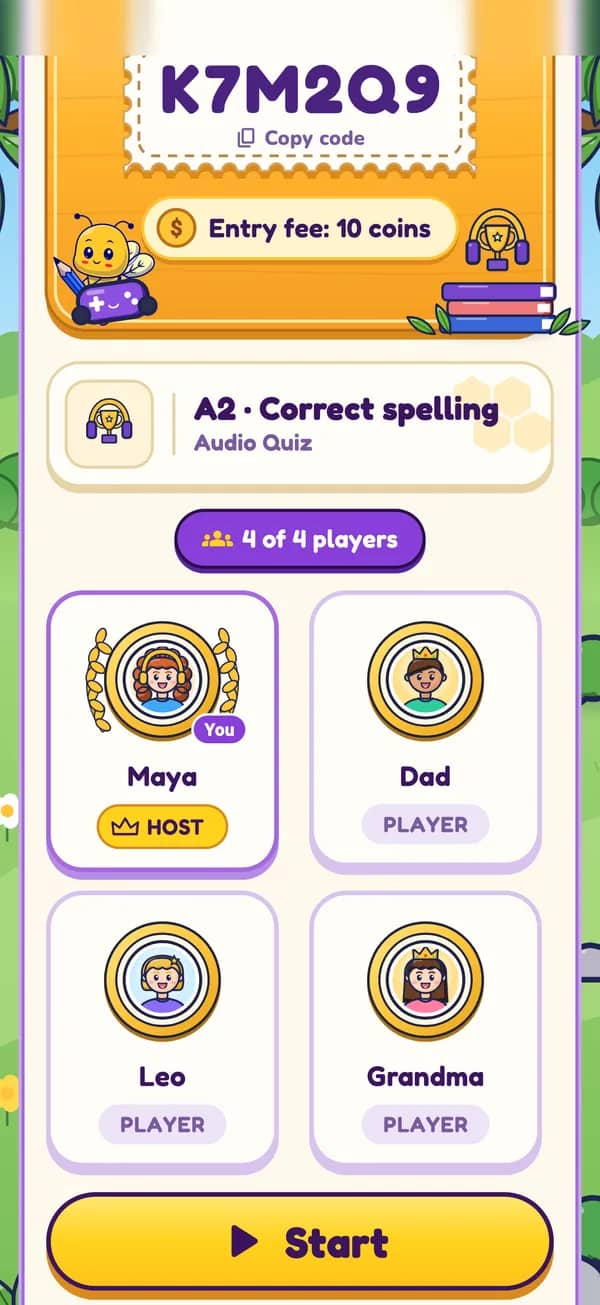
Teacher tools for any grade
Questions
How do I choose the right grade?
Start with your students' school grade, then look at the weekly lists. If the words look too easy or too hard, use the grade above or below: the pages are organised by typical age, but language ability varies a lot, especially for English learners.
Are the resources free?
Yes. Every word list, worksheet, lesson plan, game and printable on these pages is free to use and print, with no sign-up. You may print and photocopy them for your own classes, students, club or home school.
Do the grades follow a curriculum?
No. They follow a common progression from letters and sounds to academic vocabulary, written for this site. They are not mapped to Common Core, a national curriculum or CEFR, so check them against your own scheme of work.
Can I host a live game with my class?
Yes, two ways. The free Spelling Bee Host runs a spoken spelling bee for the whole class on one screen. In the Spelling Better app, small groups of 2–4 can play live rooms on their own devices; every player needs an account and rooms use in-app coins. The app has no grade setting.
How do I print a worksheet?
Open a worksheet on a grade page and press Print or save as PDF. Each one has an answer key on its own page, and you can open it in its tool to change the words.
Do the international year groups match exactly?
Not exactly. Each grade page gives the usual ages and the year or class names often used in other countries, but school systems differ, so treat them as a guide.
Your Next English Lesson Just Got More Interactive
Bring your students together with spelling challenges, vocabulary activities and word games.
Spelling Better is free to download for iPhone, iPad and Android. Group rooms use in-app coins. Premium is free for everyone until 31 December 2026.
Direct store links: App Store · Google Play
