Vocabulary Games for 9th Graders, Literary Word Activities and Worksheets
Vocabulary games you can run with ninth graders tomorrow: argue word choices in Word Choice Court, bid on spellings in a Misspelling Auction, and run a whole-class bee on one screen. Weekly lists, worksheets and lesson plans back them up with the verbs of analysis, literary terms and essay spellings.
Students in 9th grade are usually 14–15 years old; in England and Wales this is often Year 10, and in many other countries it is called Grade 9 or Year 9. Every class is different: use an easier or harder grade’s lists whenever they fit your students better.
What 9th grade students can practise
Academic vocabulary
Use verbs of analysis such as interpret, convey, emphasize and infer accurately when writing about a text, instead of falling back on shows or says.
Literary language
Name and explain common literary terms (protagonist, imagery, irony, foreshadowing, symbolism) and point to an example of each in a text the class is reading.
Precise word choice
Choose between near-synonyms by meaning and connotation, for example knowing when a character is hesitant rather than reluctant, or candid rather than rude.
Spelling accuracy
Spell frequently misspelled essay words (receive, possession, apparent, millennium) correctly and explain the tricky part of each one.
Word knowledge
Use word parts, context and a dictionary together to work out and check the meaning of an unfamiliar academic word.
Speaking and listening
Justify a word choice aloud with a reason, and listen to and respond to a classmate's reasoning with respect.
Spelling patterns and word study: -yze verbs (analyze; British analyse) · -ize / -ise endings (emphasize, synthesize) · Double consonants (possession, millennium) · -ance / -ent endings (maintenance, independent) · Silent letters (acknowledge) · Greek-origin terms (protagonist, metaphor, irony) · Connotation and shades of meaning.
These are suggested focus areas for this age, not an official curriculum. Adapt them to your own scheme of work.
Classroom games and activities for 9th grade
Teacher-led activities with full rules and an example round. None of them needs the app.
Word Choice Court
15–25 min · team, whole-class · On-level and advanced readers; works well with mixed teams
Objective: Teams argue which of two close synonyms fits a sentence best, using meaning and connotation as evidence.
You need
Sentence cards with a gap and two possible words
A board to record verdicts
Timer
Before you start
Write six to eight sentences, each with a gap and two candidate words from the week 3 list (for example hesitant or reluctant).
Split the class into two teams and choose a rotating judge panel of three students.
How to play
The teacher reads a sentence card. Team A argues for one word, Team B for the other.
Each team gets 45 seconds to make its case, using the meaning of the word and the feeling it gives.
The judges decide which word fits better and must give a one-sentence reason.
A team scores 1 point when the judges choose its word, and 1 bonus point for spelling the winning word correctly on the board.
If both words could work, the judges may call it a draw and explain how the sentence changes with each one.
Rotate the judges every two cards so everyone argues and everyone judges.
Example round: Card: “When the coach asked for a volunteer, Sam was ___ to raise his hand, but he did it anyway.” Team A argues for hesitant: he paused because he was nervous. Team B argues for reluctant: he did not want to do it. The judges choose hesitant because “but he did it anyway” suggests nerves rather than unwillingness, and Team A spells hesitant correctly for the bonus.
Easier: Give each team a printed meaning for both words and a sentence starter for their argument (“This word fits because…”). Harder: Use three candidate words per card (hesitant, reluctant, adamant) and ask teams to explain why the losing words do not fit.
20–30 min · team · All levels; the stakes are pretend points only
Objective: Teams decide whether sentences are spelled correctly and bid points on their confidence, practising the week 4 words.
You need
Ten sentences on slides, some with one misspelled word
A pretend budget of 100 points per team
A scoring grid on the board
Before you start
Write ten sentences using the week 4 words. Misspell one word in about half of them; keep the rest correct.
Put students in teams of three or four and give each team its 100 points.
How to play
Show one sentence. Each team privately decides: correct or misspelled?
Teams then bid between 5 and 30 points on their decision, written on a mini whiteboard.
Reveal the answer. Right answers win the amount bid; wrong answers lose it.
If the sentence was misspelled, a team only wins its bid if it also writes the correct spelling.
The team with the most points after ten sentences wins.
Example round: Slide: “The museum now has possesion of the letter.” Team 1 bids 20 that it is misspelled and writes possession with both double s pairs, winning 20. Team 2 bids 25 that it is correct and loses 25. Next slide: “Learning to code takes perseverance.” This one is correct, and teams that bid on correct win their points.
Easier: Underline the word that might be wrong, so teams only judge one word per sentence. Harder: Hide two possible errors in some sentences and let teams bid separately on each.
10–20 min · whole-class · All levels; good for building discussion confidence
Objective: The whole class decides whether a word in context sounds positive, negative, neutral or depends, and defends the choice.
You need
Four signs for the corners: Positive, Negative, Neutral, Depends
Sentences using the week 3 words
Before you start
Put a sign in each corner of the room (or number the corners on a slide if moving is not possible).
Prepare eight short sentences that each use one word from the week 3 list.
How to play
Read a sentence aloud and show it on the board.
Students walk to the corner that matches the feeling of the underlined word in that sentence.
Ask one student from each corner to explain their choice in one sentence.
Anyone persuaded by another corner may move before you reveal what you think.
Finish each round by asking someone to spell the word aloud while the class checks.
Example round: Sentence: “The reviewer was candid about the film's weak ending.” Most students go to Positive (honest), some to Depends (it could feel harsh). Then: “The town is notorious for its traffic.” Almost everyone goes to Negative, and a student explains that famous would be the neutral or positive choice.
Easier: Use only two corners, Positive and Negative, for the first few rounds. Harder: After each round, students suggest a word with the opposite connotation and a similar meaning (candid and blunt, notorious and famous).
Shades-of-Meaning Line-Up
15–20 min · small-group · On-level and advanced; extra word cards support newcomers
Objective: Small groups put related words in order of strength and explain the small differences between them.
You need
Sets of word cards (four to six related words each)
A long strip of paper per group labeled weaker and stronger
Before you start
Make card sets that mix week 3 words with everyday words, for example hesitant, unsure, reluctant, adamant.
Prepare a second set for fast groups (for example interested, curious, fascinated, indifferent).
How to play
Each group lays its cards along the strip from weaker to stronger.
Every member must be able to explain at least one placement.
Groups visit another group's line-up and leave one sticky-note question.
Groups may change their order after reading the questions, but must say why.
Close by writing one sentence that uses the strongest word in each set correctly.
Example round: Set: unsure, hesitant, reluctant, adamant (all about agreeing to a plan). A group places unsure first, then hesitant (unsure and pausing), then reluctant (does not want to), and adamant last (firmly refuses). Another group asks whether adamant belongs on the same scale, since you can be adamant for something as well, which leads to a useful discussion.
Easier: Use sets of three cards with one everyday word in each set. Harder: Groups build their own set of five from a thesaurus and must remove any word whose meaning does not truly fit the scale.
20–30 min · pair · All levels; use a short story or film for support and a novel for stretch
Objective: Pairs place literary term cards on a story arc for a text the whole class knows, and back each placement with a moment or quotation.
You need
A large story arc per pair (beginning, rising action, climax, falling action, ending) with a 'whole story' box above it
A set of cards with the 14 week 2 terms
A short story, film or novel the whole class has finished
Before you start
Choose a text everyone has finished, so nobody meets a spoiler.
Print one arc and one set of term cards for each pair.
How to play
Pairs place each card where the term shows up in the story: foreshadowing early on, the climax at the peak, and so on.
Terms that belong to the whole story (theme, tone, narrator, protagonist) go in the box above the arc.
Beside every card, the pair writes one moment or short quotation that proves the placement.
Pairs score 1 point for each card with fitting evidence and 1 more when they explain what that moment adds to the story.
In the final five minutes, two pairs compare arcs and settle any disagreements with evidence.
Example round: For a short story about two brothers, a pair puts foreshadowing near the start beside “the cracked mirror in the hallway”, conflict in the rising action beside “the argument about selling the boat”, and climax at the peak beside “they finally meet on the bridge”. Theme and protagonist go in the box above. Another pair placed irony at the ending, and the two pairs agree after rereading the last page.
Easier: Give pairs six cards only: protagonist, narrator, conflict, foreshadowing, climax and theme. Harder: Pairs build a second arc for another text and explain how one term, such as foreshadowing, works differently in each.
15–20 min · individual, pair · Developing writers and on-level writers
Objective: Students revise weak sentences about a text by replacing vague verbs with precise verbs of analysis.
You need
A slide or sheet of eight weak sentences about a text the class knows
The week 1 word list
Before you start
Write eight sentences about the class text that use shows, says, tells or talks about.
Decide which week 1 verbs you would accept for each sentence; often more than one works.
How to play
Students work alone first: rewrite each sentence with a stronger verb from the list, changing other words if needed.
No verb may be used twice on one sheet.
Partners swap sheets and circle the upgrade they think is most precise, writing why in the margin.
Share three of the best upgrades with the class and discuss what changed in the meaning.
Example round: Weak: “The author shows that the town is poor.” Upgrades: “The author conveys the town's poverty through images of broken windows.” “The broken windows emphasize how poor the town has become.” Students notice that conveys focuses on the author's method and emphasize on the effect, and they check the spelling of emphasize.
Easier: Give a word bank of four verbs per sentence instead of the full list. Harder: Students must also add a short quotation and use a second verb from the list to comment on it (for example, “which reveals…”).
Read-aloud tests by grade; the device says each word.
Grade 9 spelling and vocabulary words, week by week
Four original weekly lists with meanings and example sentences. Copy or print a list, or turn it into a worksheet, flashcards or a read-aloud spelling test in one click.
Week 1 · Academic verbs of analysis
Week 1: Verbs for Writing About Texts
Objective: Students replace vague verbs such as shows and says with precise verbs of analysis when they write about a text.
Week 1: Verbs for Writing About Texts: words, meanings and example sentences
Word
Meaning
Example
Listen
analyzeUK: analyseverb · -yze (British -yse)
To study something closely, part by part, to understand how it works or what it means.
In this essay, you will analyze how the poet builds tension in the final stanza.
evaluateverb
To judge how good, useful or successful something is, and give reasons for your judgment.
We will evaluate both arguments before deciding which one is stronger.
interpretverb
To explain what you think something means, especially when it could mean more than one thing.
Readers can interpret the open ending of the story in more than one way.
illustrateverb
To make a point clearer by giving an example or a picture of it.
Use a short quotation to illustrate how the narrator feels about the city.
emphasizeUK: emphasiseverb · -ize (British -ise)
To give special importance or attention to something so that it stands out.
The repeated question helps emphasize the speaker's doubt.
contrastverb
To show how two things are different from each other.
The opening chapter contrasts the noisy market with the silent library.
inferverb
To work out something that is not stated directly, using clues and what you already know.
From her careful answers, we can infer that she is hiding something.
justifyverb
To give good reasons that show an idea, claim or decision is right.
Justify your answer with two pieces of evidence from the text.
conveyverb
To communicate a feeling, an idea or a message to someone.
The short, broken sentences convey the character's panic.
revealverb
To make known something that was hidden or secret.
The letter in chapter ten reveals the truth about the missing ring.
establishverb
To set something up firmly, or to show it clearly so that it is accepted.
The first paragraph should establish the main claim of your essay.
examineverb
To look at something carefully and in detail.
Let's examine the word choices in the second verse.
demonstrateverb
To show something clearly, often by giving evidence or an example.
Her research will demonstrate that the plan saves water.
To combine ideas from several sources into one new, connected whole.
Strong research essays synthesize ideas from several articles.
Practice ideas
Give students a paragraph that uses shows five times. In pairs, they replace each one with a different verb from the list and explain why it fits.
Sort the verbs into two piles: verbs that describe what a writer does (convey, emphasize) and verbs that describe what a reader does (infer, interpret).
Exit line: students write one sentence about the class text that uses two of the week's verbs correctly.
Spelling focus: analyze, emphasize and synthesize. Point out that British English often uses -yse and -ise, and agree which spelling the class will use.
Week 2 · Literary terms and devices
Week 2: The Language of Literature
Objective: Students name and explain common literary terms and find an example of each in a story, poem or play they are reading.
Week 2: The Language of Literature: words, meanings and example sentences
Word
Meaning
Example
Listen
protagonistnoun
The main character in a story, play or film.
The protagonist of the novel is a young sailor who wants to see the world.
antagonistnoun
A character or force that works against the main character.
In many adventure stories, the antagonist is a storm rather than a person.
narratornoun
The voice or character who tells a story.
The narrator admits in the last chapter that he forgot some details.
metaphornoun
A comparison that says one thing is another thing, without using like or as.
Calling the classroom a zoo is a metaphor for how noisy it was.
similenoun
A comparison between two different things that uses like or as.
The writer uses a simile when she says the fog moved like a slow gray cat.
imagerynoun
Descriptive language that helps the reader see, hear, smell, taste or feel a scene.
The poem's imagery of cold rain and empty streets creates a lonely mood.
ironynoun
A gap between what is expected and what happens, or between what is said and what is really meant.
There is a touch of irony when the safety inspector trips over his own clipboard.
foreshadowingnoun
Hints placed early in a story about what will happen later.
The cracked mirror in chapter one is foreshadowing of the bad luck to come.
symbolismnoun
The use of an object, color or action to stand for a bigger idea.
The symbolism of the locked gate suggests the family's secrets.
themenoun
A big idea or message about life that a story explores.
One theme of the story is that courage can be quiet.
tonenoun
The writer's attitude toward a subject, shown through the words they choose.
The tone of the letter changes from polite to angry.
conflictnoun
A struggle between opposing people, forces, wishes or ideas in a story.
The main conflict is between the girl's dream and her family's needs.
allusionnoun
A brief mention of a well-known person, place, story or event, without explaining it.
The title is an allusion to a famous fairy tale.
climaxnoun
The turning point of a story, where the tension is at its highest.
The climax comes when the two brothers finally meet on the bridge.
Practice ideas
Read a short story together and stop at each page to ask: which term from the list could we use here, and what is the evidence?
Make a two-column chart: term in one column, an example from a book, film or song the students know in the other.
Contrast the pairs that are easy to mix up: metaphor and simile, protagonist and antagonist, tone and theme.
Spelling focus: the Greek endings -ist and -phor. Students underline them and say each word in syllables (pro-tag-o-nist, met-a-phor).
Week 3 · Precise adjectives and connotation
Week 3: Shades of Meaning
Objective: Students choose precise adjectives for characters, arguments and writing, and explain the difference between close synonyms.
Week 3: Shades of Meaning: words, meanings and example sentences
Word
Meaning
Example
Listen
reluctantadjective
Not wanting to do something, so you do it slowly or unwillingly.
Marcus was reluctant to read his poem aloud, but the class loved it.
hesitantadjective
Pausing or holding back because you feel unsure or nervous.
She gave a hesitant smile before stepping onto the stage.
adamantadjective
Refusing to change your mind, whatever other people say.
The coach was adamant that everyone would warm up before the match.
candidadjective
Honest and direct, even when the truth is uncomfortable to hear.
Thank you for your candid feedback on my first draft.
meticulousadjective
Showing great care with every small detail.
His meticulous notes made revising for the test much easier.
indifferentadjective
Not caring or not interested either way.
The cat seemed indifferent to the new toy we bought it.
resilientadjective
Able to recover quickly after a difficulty or a setback.
After losing the first game, the resilient team came back to win the series.
ominousadjective · -ous
Giving the feeling that something bad is about to happen.
The ominous music told us the storm was getting closer.
profoundadjective
Very deep, serious or strongly felt.
The trip had a profound effect on how she saw her own town.
eloquentadjective · -quent
Able to express ideas clearly and in a way that moves or persuades people.
Her eloquent speech persuaded the council to keep the library open.
vividadjective
Very clear, bright and full of detail.
The author's vivid description made me feel the desert heat.
tediousadjective
Long, slow and boring to do.
Copying the table by hand was tedious, so we used the printer.
plausibleadjective
Reasonable and likely enough to be true.
Your theory is plausible, but you need more evidence to support it.
notoriousadjective
Well known for something bad.
The bend in the road is notorious for accidents in winter.
Practice ideas
Line up words on a scale: hesitant, reluctant, adamant. Ask students where each sits and why, then add a fourth word of their own.
Rewrite a flat character description (She was careful and honest) twice, once with meticulous and candid, once with two other words from the list, and compare the effect.
Connotation check: is notorious positive or negative? Is candid always polite? Students sort the words into positive, negative and depends on context.
Spelling focus: the -ous ending in ominous, meticulous, tedious and notorious, and the -ent ending in eloquent, resilient and indifferent.
Week 4 · Commonly misspelled words
Week 4: Essay Words People Misspell
Objective: Students spell sixteen frequently misspelled words correctly and use a memory trick for the tricky part of each one.
Week 4: Essay Words People Misspell: words, meanings and example sentences
Word
Meaning
Example
Listen
receiveverb · ei after c
To get or be given something.
You will receive feedback on your draft by Friday.
beginningnoun · double n before -ing
The first part of something.
The beginning of an essay should make the reader want to keep going.
apparentadjective · double p, -ent
Easy to see or understand; obvious.
It soon became apparent that the narrator could not be trusted.
immediatelyadverb · immediate + ly (keep the e)
At once; without waiting.
Save your work immediately after you finish each paragraph.
possessionnoun · double s, twice
Something that you own, or the state of owning it.
The old letter is now in the possession of the town museum.
paralleladjective · double l in the middle, one l at the end
Side by side and always the same distance apart; also very alike.
The novel tells two parallel stories, one set in the past and one today.
consciousadjective · sc + -ious
Aware of something, or awake and able to notice what is happening.
Poets make conscious choices about every word in a line.
pronunciationnoun · pronounce loses the o
The way a word is said aloud.
Check the pronunciation of the author's name before you present.
acknowledgeverb · silent k; -dge
To accept or admit that something is true or exists.
A fair essay should acknowledge the other side of the argument.
maintenancenoun · main-ten-ance
The work of keeping something in good condition.
The pool is closed for maintenance this week.
perseverancenoun · per-sever-ance
Continuing to try even when something is difficult or slow.
Learning an instrument takes perseverance and patience.
weirdadjective · ei, an exception to i before e
Very strange or unusual.
The story has a weird twist that nobody in the class saw coming.
acquireverb · cq
To get or gain something, often through effort over time.
You acquire new words fastest when you read widely.
exaggerateverb · double g
To describe something as bigger, better or worse than it really is.
Don't exaggerate the problem; it is only one missing page.
independentadjective · -ent, not -ant
Not controlled by others and not relying on them.
The library has an independent study area for older students.
millenniumnoun · double l, double n
A period of one thousand years.
The town celebrated the start of the new millennium with fireworks.
Practice ideas
Each student picks the four words they find hardest and invents a memory trick for each (for example, the double l in parallel looks like two parallel lines).
Proofreading race: hand out a short essay paragraph with six of the words misspelled. Pairs find and fix them against the clock.
Look, say, cover, write, check for any word missed in Monday's pretest, then a partner dictation on Thursday.
Discuss why these words are hard: unstressed vowels (apparent), double letters (possession) and letters you do not hear (acknowledge).
Your browser has no speech voice, so the listen buttons are hidden.
Need a longer list? See the full hard spelling bee words, with a read-aloud test for every level.
Turn these words into a classroom game: paste a week’s list into the free Spelling Bee Host and run a spoken bee on the board, or see how to host a live game below.
How to host live word games for Grade 9 students
Suggested game session for 9th grade
The free Spelling Bee Host runs a whole-class bee on one screen, reads each word aloud in the device's voice and needs no student devices or accounts, so every ninth grader can take part in the same round.
Game
Spelling Bee Host (in your browser)
Settings to try
Paste this week's list and enter 4–5 teams as spellers (16 week 4 words cover three points rounds for five teams), or choose the Hard words or Misspelled words list to give every student a turn.
Vocabulary focus
Essay words people often misspell, plus the week's academic and literary terms when you want a meaning round.
Warm-up
Two minutes of look, say, cover, write with the four hardest words of the week before the first speller steps up.
Session length
15–25 minutes
Format
Whole class on one screen, in teams. Use points over two or three rounds rather than elimination, so no one sits out for long.
Supervision
The teacher runs the screen and confirms each answer; keep a student scorer at the board.
Afterwards
Every word missed in the bee goes onto a shared list for Thursday's dictation and Friday's quiz.
Independent practice
Students who finish other work early can test themselves on the list with the online spelling test or a missing-letters sheet.
For small groups of 2–4 who already have the Spelling Better app, an Audio Quiz room (Arena → Play with Friends → Create Room) is an optional extra. Each player needs their own device, account and entry coins, and the host plays too.
Session length and grouping are teaching suggestions, not app settings. The app has no grade setting.
Step by step: Spelling Bee Host (in your browser)
Best for: A whole class on one screen, from kindergarten up. Free, no accounts, no student devices.
Players: 2–60 spellers on one screen
Devices: Any computer, laptop or interactive whiteboard with a modern browser and speakers
Cost: Free. No sign-up.
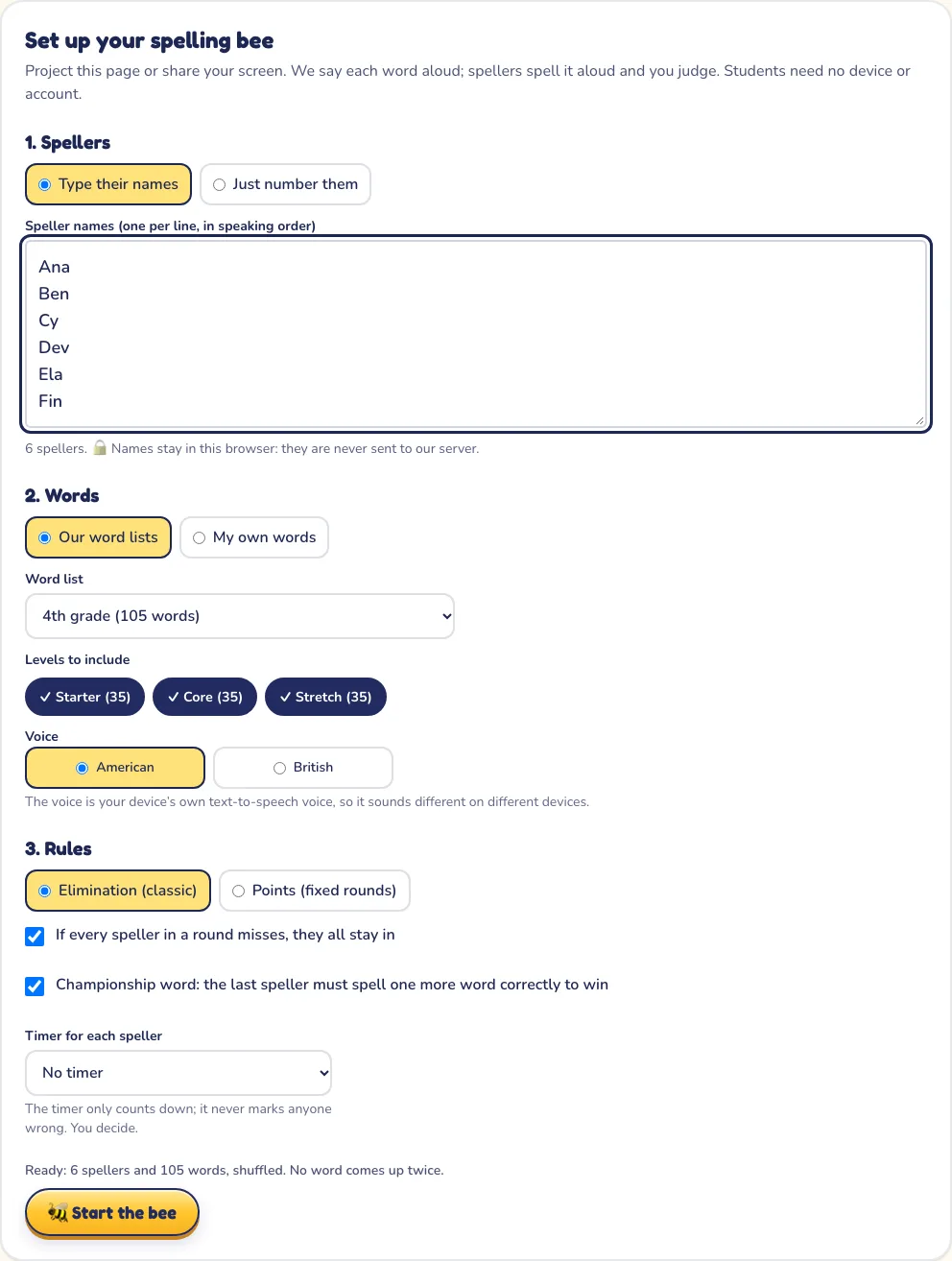
Settings you can choose: Speller names, or just a number of spellers; A word list by grade (1st–8th grade, plus harder and adult lists) or your own words; American or British device voice; Format: Elimination (classic) or Points (fixed rounds); optional answer timer.
1
Open the Spelling Bee Host
On the classroom computer, open the Spelling Bee Host page. Connect speakers or the board's sound.
What you should see: The setup form appears.
2
Add spellers and words
Type speller names (one per line) or choose Just number them. Under Words, pick a grade list or paste this week's words.
What you should see: The form says how many spellers and words are ready.
Setting up a bee: names, a word list and the format.
3
Start the bee
Press Start the bee. Explain the rules: listen, ask for the definition or a sentence if needed, then spell aloud.
What you should see: The first speller's name appears with the round number.
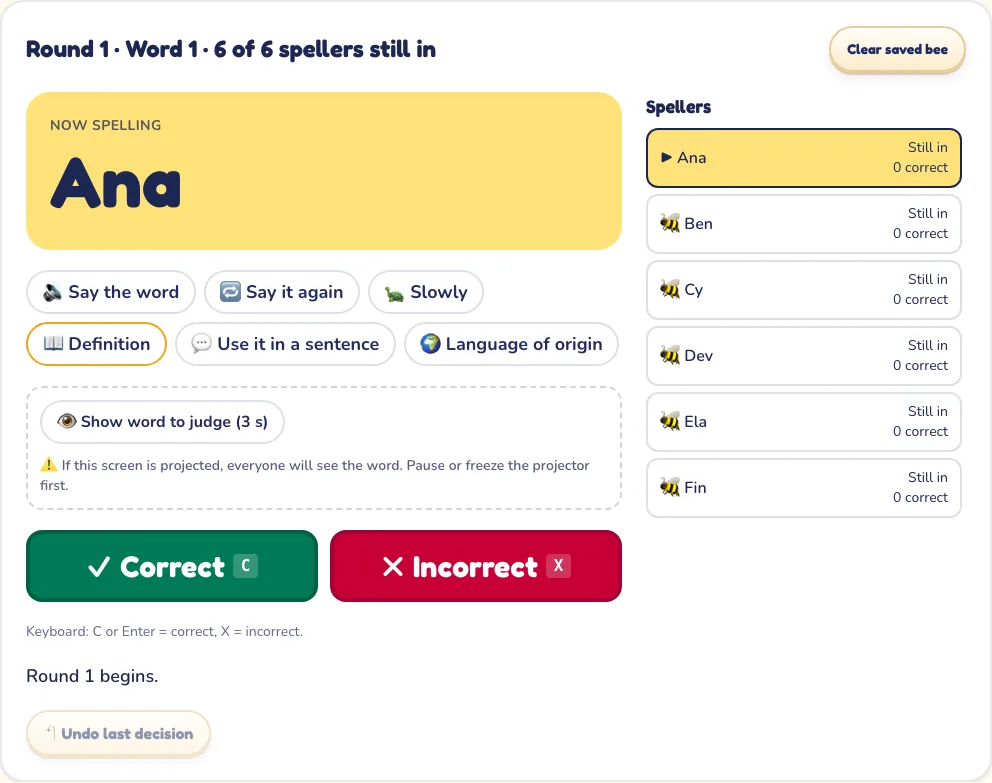
4
Run each turn
Press Say the word (and Definition, Use it in a sentence or Slowly when asked). Listen to the speller, then press Correct or Incorrect (keys C and X).
What you should see: The Host moves to the next speller and keeps track of who is still in.
A round in progress: the device says the word; you mark Correct or Incorrect.
5
Finish and review
When one speller is left (or after the points rounds), the Host shows the winner. Press Print results for the words used and missed.
What you should see: A printable results sheet to review difficult words with the class.
Good to know
Runs on one screen; students do not play on their own devices.
The voice is the device's text-to-speech: check unusual words first.
Names stay in your browser; nothing is saved by us.
If something goes wrong
No sound
Check the device volume and the board's audio; try another browser (voices differ by device).
A word sounds wrong
Use Say it again or Slowly, or read the word yourself; remove it from your list next time.
The projector shows the word
Freeze the projector before pressing Show word to judge.
Checked against Spelling Better 2.3.6 (73) and the live website on 28 November 2026. Screens marked “sample data” show example players and questions.
Free printable Grade 9 worksheets
Real worksheets made from this page's weekly lists, each with an answer key. Preview, print or save as PDF, or open one in its tool to change the words.
Verbs for Writing About Texts: Match and Complete
Matching first, then sentences: students meet the meaning before they choose the verb in context.
Students who have the Spelling Better app can keep practising spelling and vocabulary with its quizzes and word games at home. This is optional extra practice: the app uses its own word lists, not the words from this lesson.
Made with the free lesson plan generator at spellingbetter.com. A template-based starting point: change anything that does not suit your class.
Literary Terms in Action, with a Class Spelling Bee
55 minutes · Students learn fourteen literary terms, find them in a short passage, then spell them in a whole-class bee on one screen.
Literary Terms in Action, with a Class Spelling Bee
Students learn fourteen literary terms, find them in a short passage, then spell them in a whole-class bee on one screen.
Objectives
By the end of the lesson, students should be able to:
Define and give an example of the literary terms on the week 2 list.
Identify a simile, metaphor, imagery and foreshadowing in an unseen passage.
Spell the terms correctly from hearing them read aloud.
Materials
Week 2 word list
A short passage for each pair
Highlighters
A screen with the free Spelling Bee Host
Scorecards
Target words
protagonist
antagonist
narrator
metaphor
simile
imagery
irony
foreshadowing
symbolism
theme
tone
conflict
allusion
climax
Timing
Time
Stage
Minutes
0–5 min
Film and story quick-fire
5
5–17 min
Fourteen terms, three groups
12
17–27 min
Label it together
10
27–42 min
Whole-class spelling bee
15
42–50 min
Device hunt
8
50–55 min
One term, one example
5
Whole lesson
55
Lesson stages
1. Film and story quick-fire5 min (0–5 min)
Activate what students already know about stories.
Ask: who is the main character in a film you saw recently, and who or what works against them?
Write the answers under two headings, then reveal the words protagonist and antagonist.
2. Fourteen terms, three groups12 min (5–17 min)
Teach the terms in meaningful groups rather than as one long list.
Group the terms: people (protagonist, antagonist, narrator), comparisons and images (metaphor, simile, imagery, symbolism, allusion), and story shape and meaning (conflict, climax, foreshadowing, irony, theme, tone).
Give a quick, original example for each term.
Contrast the easily confused pairs: metaphor and simile, tone and theme.
3. Label it together10 min (17–27 min)
Model finding a device and explaining its effect.
Read the first three lines of the passage aloud and label one simile together.
Model the explanation: name the device, quote it, then say what effect it has.
Pairs label the next device and share their sentence.
4. Whole-class spelling bee15 min (27–42 min)
Practise spelling the terms aloud in a game everyone can join.
Open the Spelling Bee Host on the class screen, paste the fourteen week 2 words and enter each table as a speller (up to seven tables for two points rounds).
Run two rounds with points: the device reads the word, a student from that table spells it aloud, the teacher confirms.
For a bonus point, the speller's table gives a one-line example of the term.
Tip: Points rounds keep everyone involved; elimination can leave some students waiting for a long time.
Students who have the Spelling Better app can keep practising spelling and vocabulary with its quizzes and word games at home. This is optional extra practice: the app uses its own word lists, not the words from this lesson.
Made with the free lesson plan generator at spellingbetter.com. A template-based starting point: change anything that does not suit your class.
Choose a paragraph you wrote earlier this year about a text. Rewrite it, replacing every shows, says and tells with a precise verb from the week 1 list. Highlight the new verbs.
Literary terms crossword
printable · about 15 min
Complete the literary terms crossword. Then pick three of the terms and write an example of each from a book, film or song you know.
Describe someone in a film or series to a person at home using three words from the week 3 list (for example meticulous, candid, resilient). Ask them whether they agree, and note one word they would have chosen instead.
Misspelled words self-test
online · about 10 min
Take the read-aloud online spelling test, then write any word you missed three times with its tricky part underlined. Compare your mistakes with the week 4 list.
Proofread one piece of your own writing (an essay, a long message or a story). Find any word from the commonly misspelled words page and check it. Bring one word you were unsure about to class.
Students who have the Spelling Better app can do extra practice with its spelling quizzes, vocabulary quizzes, flashcards and word games. The app uses its own word lists and does not report back to teachers.
A week of English practice for 9th grade
A five-day ninth-grade plan for the week 4 list of commonly misspelled essay words, mixing a pretest, memory tricks, games and a sentence dictation. Swap in any of the other three lists.
Monday20 min
Pretest and memory tricks
Read the sixteen words aloud as a pretest. Students mark their own work, circle the tricky part of each missed word and invent a memory trick for two of them.
Tuesday20 min
Missing vowels
Students complete the missing-vowels sheet, then use look, cover, write, check on the words they got wrong.
Teams play the Misspelling Auction with ten sentences built from the list. Finish by writing the three words that cost teams the most points.
Thursday20 min
Class spelling bee
Run a points-based bee with the free Spelling Bee Host, pasting the week's words and entering teams as spellers (16 words cover two rounds for up to eight teams). Missed words go onto the board for Friday.
☐ I checked my dictation and corrected every mistake.
☐ I used three of the words correctly in my own writing.
spellingbetter.com/for-teachers/grades/
Grade 9 teacher questions
Is there a 9th grade spelling word list on Spelling Better?
There is no separate grade 9 word-list page. This page has four ninth-grade weekly lists with meanings and example sentences. For more practice, the hard spelling bee words (/hard-spelling-bee-words/), commonly misspelled words (/commonly-misspelled-words/) and spelling bee words for adults (/spelling-bee-words-for-adults/) pages suit many high school students.
What if these lists are too easy or too hard for my ninth graders?
Classes vary a lot at this age, so treat the lists as a starting point. For students who need support, the 8th grade word list page and the week 1 verbs are a good bridge. For confident spellers, use the hard spelling bee words or add Greek and Latin roots from the word roots page (/word-roots/).
How do I get ninth graders to actually use new vocabulary in their essays?
Make the words part of the writing task, not a separate exercise. Ask for two or three named verbs or terms in each analytical paragraph, have students underline them, and give feedback on whether each word was precise, not just whether it appeared. Short games such as Word Choice Court help them hear why one word fits better than another.
Can I run a whole-class spelling bee with a high school class?
Yes. The free Spelling Bee Host runs on one classroom screen, reads each word aloud with the device's voice and lets you paste your own list, so you can use this week's words. With a short list, enter teams as spellers: the Host needs one word per speller per round. Students spell aloud and need no devices or accounts. Points rounds usually work better than elimination with teenagers.
Can my students play against each other in the Spelling Better app?
In small groups, yes. Group Battle and Audio Quiz rooms hold 2–4 players, including the host, and players join by typing a 6-digit code. Each student needs the app on their own phone or tablet, their own account and enough in-app coins for the entry. The app cannot load your word list, so use it as extra practice alongside your own lists.
Should my class use American or British spelling for words like analyze?
The lists here use American spelling and note the British form where it differs (analyse, emphasise, synthesise). Either is correct; what matters is that a student is consistent within one piece of writing. You can edit any word in the worksheet tools before you print.
Continue practising with Spelling Better
Students can practise spelling and vocabulary at their own level in the app, on their own phone or tablet.
Spelling Better is free to download for iPhone, iPad and Android. Group rooms use in-app coins. Premium is free for everyone until 31 December 2026.