Grade 10 Vocabulary Activities, Word Root Games and English Worksheets
Tenth graders need to switch between casual and formal English, unlock long words through their roots and argue a point precisely. These activities, word lists and printables cover register, complex roots, the -able/-ible and -cede/-ceed puzzles, and the vocabulary of debate.
Students in 10th grade are usually 15–16 years old; in England and Wales this is often Year 11, and in many other countries it is called Grade 10 or Year 10. Every class is different: use an easier or harder grade’s lists whenever they fit your students better.
What 10th grade students can practise
Register
Recognize formal and informal register and switch between them, for example replacing get, put off and look into with obtain, postpone and investigate in a formal email or essay.
Word roots
Use Greek and Latin roots such as chron, spect, dict, cred, bene and mal to work out the likely meaning of an unfamiliar word, then confirm it in a dictionary.
Advanced spelling
Spell words with the -able/-ible, -ance/-ence and -cede/-ceed/-sede endings correctly, and know which tendencies help and where the exceptions are.
Argument vocabulary
Use words such as rebuttal, counterargument, substantiate and fallacy accurately when planning, writing and discussing arguments.
Connotation and tone
Explain how connotation and euphemism shape the tone of a text, and choose words that suit the audience and purpose.
Speaking
Use formal vocabulary naturally in a short speech or debate, and adjust it for a less formal audience.
Spelling patterns and word study: Formal vs informal register (obtain / get) · Latin and Greek roots (chron, spect, dict, cred) · bene- and mal- (good and bad) · -able vs -ible endings · -ance vs -ence endings · -cede, -ceed and -sede · Silent letters (paradigm) · Prefix + root + suffix (in-cred-ulous).
These are suggested focus areas for this age, not an official curriculum. Adapt them to your own scheme of work.
Classroom games and activities for 10th grade
Teacher-led activities with full rules and an example round. None of them needs the app.
Register Remix
15–25 min · pair · All levels; sentence frames support less confident writers
Objective: Pairs rewrite the same message for two audiences, switching between informal and formal vocabulary.
You need
Message cards (casual texts and formal notices)
The week 1 list with informal partners
Two colors of pen
Before you start
Write six short message cards: three casual texts and three stiff formal notices on everyday school topics.
Pair students and give each pair one casual and one formal card.
How to play
Partner A rewrites the casual message as a formal email to the principal, using at least four words from the list.
Partner B rewrites the formal notice as a friendly message to a younger student.
Partners swap and underline every word that changed register, using one pen color for formal and one for informal.
Each pair reads one version aloud; the class guesses who the audience is.
A version only counts if it keeps all the original information.
Example round: Casual card: “hey, can we put off the meeting? we need more time to look into the costs and get the forms.” Formal rewrite: “Would it be possible to postpone the meeting? We require more time to investigate the costs and obtain the forms.” The pair underlines postpone, require, investigate and obtain.
Easier: Give the informal and formal partners side by side on the card (put off / postpone) so students only need to choose and spell. Harder: Add a third audience, such as a short notice for the school website, and ask what changes beyond vocabulary (sentence length, contractions, tone).
Print or project the root chart with a meaning for each root, prefix and suffix.
Prepare one example invented word to show the class.
How to play
Each group invents one new word for a modern situation, built only from real roots and affixes on the chart.
On the back of a card, they write the word's meaning and how each part contributes to it.
Groups swap cards and must decode the new word from the front only, writing their best definition.
Score 2 points for a decoding that matches the meaning, and 1 point for each real English word the decoding group can list that shares a root with the invented one.
Finish by checking two of the real words in a dictionary.
Example round: A group invents “chronovore” (chron = time, vor = eat) for an app that eats up your time. The decoding group guesses “something that eats time” and earns 2 points, then lists chronological, synchronize and anachronism for chron, and carnivore for vor.
Easier: Limit the chart to four roots and give each group a situation to name. Harder: Groups must build their word with a prefix, a root and a suffix, and write a sentence using it that a reader could understand from context.
10–15 min · whole-class · All levels; fast to run as a warm-up
Objective: The whole class votes on the correct ending for a word with cards, then a volunteer spells the full word.
You need
Each student needs cards marked -able, -ible, -ance, -ence, -cede, -ceed, -sede (or a mini whiteboard)
A list of word stems
Before you start
Prepare about fifteen stems from the week 3 list and similar words (irresist-, indispens-, relev-, pro-, super-).
Hand out the ending cards or mini whiteboards.
How to play
Say a stem and use the full word in a short sentence, without stressing the ending.
On “show”, every student holds up the ending they think is correct.
Reveal the answer; a volunteer spells the whole word aloud and writes it on the board.
Every student keeps their own tally of correct endings; aim to beat your score in the next round.
After each set of five, ask the class for a tip or memory trick for the word most people got wrong.
Example round: Stem: “neglig-” in the sentence “The cost was negligible.” Most students show -ible, a few -able. Reveal: negligible. Next stem: “super-” in “The new law will supersede the old one.” Many show -cede; the answer is -sede, and someone shares the trick that supersede is the only common -sede word.
Easier: Use only two endings per round (for example -able and -ible) and give five practice stems first. Harder: Add words not on the list (visible, dependable, intercede, succeed) and ask students to explain the tendency each one follows or breaks.
20–30 min · team · On-level and advanced; reading support available with shorter texts
Objective: Teams find the weak reasoning in short invented arguments and write a rebuttal using the week 4 vocabulary.
You need
Six short invented arguments on cards
A reference sheet of four common fallacies
Scoring grid
Before you start
Write six two- or three-sentence arguments, each with one clear flaw (for example: everyone believes it, so it must be true; one example proves the rule).
Prepare a reference sheet that names and explains each flaw in plain language.
How to play
Teams receive one argument card at a time and have three minutes to name the flaw.
They then write a one-sentence rebuttal that uses at least one word from the list (substantiate, counterargument, fallacy, nuance).
Score 2 points for naming the flaw correctly and 1 point for a rebuttal that uses a list word accurately and spells it correctly.
Teams read their rebuttals aloud; other teams may challenge if the reasoning is weak.
Example round: Card: “My cousin used this app and passed her driving test, so the app makes everyone a better driver.” A team names the flaw (one example used to prove a general rule) and writes: “One success story cannot substantiate a claim about everyone, so the argument rests on a fallacy.” They score 3 points.
Easier: Give teams a multiple-choice list of three possible flaws for each card. Harder: Teams write their own flawed argument for another team to solve, with a hidden answer on the back.
20–40 min · individual, whole-class · On-level and advanced; preparation time can be extended
Objective: Each speaker hides three secret argument words in a short speech; listeners must catch them, spell them and judge whether each was used accurately.
You need
Topic slips with an everyday motion
Secret word slips with three week 4 words each
Listener sheets listing all sixteen week 4 words
Classroom timer
Before you start
Write motions on familiar topics (for example: the school library should open on Saturdays; every school should grow its own vegetables).
Make secret word slips with three words each from the week 4 list; speakers keep their slip hidden.
How to play
Each student draws a motion and a secret word slip and has five minutes to prepare.
Speeches last 60–90 seconds. The speaker must use the three secret words naturally and no other week 4 words.
Listeners tick the words they hear on their sheet, then write each one, spelled correctly, and mark it 'accurate' or 'off'.
The speaker reveals the slip. Listeners score one point for each secret word they caught and spelled correctly.
The speaker scores one point for each secret word that most listeners judged accurate.
Example round: Motion: “The school library should open on Saturdays.” Secret words: pragmatic, extrapolate, mitigate. The speaker calls Saturday opening a pragmatic answer to crowded weekday evenings, extrapolates from last term's sign-in sheets that about forty students would come, and suggests that parent volunteers could mitigate the cost. Most listeners catch all three; one writes extropolate and loses that point. The class judges all three uses accurate, so the speaker scores three.
Easier: Give two secret words instead of three and let students prepare with a partner. Harder: Speakers must also include a short rebuttal of their own argument, and listeners name the counterargument they heard.
15–20 min · individual · All levels; private and self-paced
Objective: Students sort their own spelling mistakes by pattern and set a personal focus for the next week.
You need
A marked dictation or spelling quiz for each student
An error-pattern table (ending, double letter, silent letter, vowel, root)
Before you start
Give a dictation of the week 3 words and mark it, without writing the corrections.
Print the error-pattern table with an example in each column.
How to play
Students write each misspelled word in the column that explains the mistake (for example, irresistable goes under ending).
Next to it, they write the correct spelling and underline the part that changed.
They count which column has the most entries and write one sentence about their main pattern.
Each student chooses three words to practise and one strategy (memory trick, related word, saying it in syllables).
The table stays in the student's folder; it is for them, not for a grade.
Example round: A student's dictation has irresistable, persistance, preceed and accesible. They sort three into ending (-ible, -ence, -cede) and one into double letter (accessible), notice that endings are their main pattern, and choose the strategy of linking each word to a related one: persistent, so persistence.
Easier: Give students a pre-filled table with two example mistakes and their own marked list of five words. Harder: Students write their own rule of thumb for their main pattern, test it on five new words and report where it fails.
Read-aloud tests by grade; the device says each word.
Grade 10 spelling and vocabulary words, week by week
Four original weekly lists with meanings and example sentences. Copy or print a list, or turn it into a worksheet, flashcards or a read-aloud spelling test in one click.
Week 1 · Formal vocabulary and register
Week 1: Formal and Informal Register
Objective: Students replace informal words and phrasal verbs with formal equivalents and judge when each register is appropriate.
Week 1: Formal and Informal Register: words, meanings and example sentences
Word
Meaning
Example
Listen
obtainverb · informal: get
A formal word for get, especially after effort or by following a process.
Students must obtain a signed permission form before the trip.
requireverb · informal: need
A formal word for need, or to make something necessary.
All entries require a title and the writer's name.
assistverb · informal: help
A formal word for help someone with a task.
Two volunteers will assist the visitors at the front desk.
commenceverb · informal: start
A very formal word for begin or start.
The ceremony will commence at ten o'clock.
concludeverb · informal: end, decide
To bring something to an end, or to decide something after looking at the evidence.
The report concludes that the bridge needs repairs.
investigateverb · informal: look into
To look into something carefully to find out the facts.
The council will investigate the complaints about the noise.
purchaseverb · informal: buy
A formal word for buy.
Tickets may be purchased at the school office.
inquireUK: enquireverb · informal: ask
A formal word for ask, especially when you ask for information.
Please inquire at reception if you have lost an item.
postponeverb · informal: put off
To move an event to a later time.
The match was postponed because of heavy rain.
eliminateverb · informal: get rid of
To remove something completely or get rid of it.
Careful proofreading helps eliminate small errors.
tolerateverb · informal: put up with
To accept or put up with something you do not like.
This plant can tolerate long periods without water.
comprehendverb · informal: get, understand
A formal word for understand something fully.
It took me a while to comprehend the instructions for the experiment.
sufficientadjective · informal: enough
A formal word for enough for a particular purpose.
Is there sufficient evidence to support this claim?
numerousadjective · informal: lots of
A formal word for many; a large number of.
The author has received numerous letters from young readers.
Practice ideas
Show a casual text message (hey, can u help me sort out the trip, gotta get the form) and have pairs rewrite it as a formal email using at least five words from the list.
Reverse it: turn a stiff formal notice into a friendly message for a younger sibling, and discuss what changes besides the vocabulary.
Register sort: students place each word and its informal partner on a line from very casual to very formal.
Spelling focus: double letters in commence, assist and sufficient, and the qu in inquire (British English often writes enquire).
Week 2 · Greek and Latin roots
Week 2: Roots That Unlock Long Words
Objective: Students use Greek and Latin roots to work out, spell and remember long academic words.
Week 2: Roots That Unlock Long Words: words, meanings and example sentences
Word
Meaning
Example
Listen
benevolentadjective · bene (well)
Kind and wanting to do good for others (bene = well, vol = wish).
A benevolent neighbor paid for new books for the library.
malevolentadjective · mal (bad)
Wishing harm to others (mal = bad, vol = wish).
The villain's malevolent grin told us he had a plan.
benefactornoun · bene (well)
A person who gives money or help to a person or a cause (bene = well, fact = do).
An anonymous benefactor paid for the new science lab.
maliciousadjective · mal (bad)
Meant to hurt or upset someone on purpose (mal = bad).
Spreading malicious rumors online can cause real harm.
chronologicaladjective · chron (time)
Arranged in the order in which events happened (chron = time).
Put the main events of the novel in chronological order.
anachronismnoun · chron (time)
Something shown in the wrong time period, such as a wristwatch in an ancient story (chron = time).
A digital clock in a medieval castle scene would be an anachronism.
To make things happen at exactly the same time (syn = together, chron = time).
The dancers synchronize their steps with the drumbeat.
circumspectadjective · spect (look)
Careful to think about possible risks before acting (circum = around, spect = look).
Be circumspect about sharing personal details online.
retrospectnoun · spect (look)
Looking back on past events, often with a clearer view (retro = back, spect = look).
In retrospect, starting the project earlier would have helped.
contradictverb · dict (say)
To say the opposite of what someone else has said (contra = against, dict = say).
The second witness contradicts the first one's story.
verdictnoun · dict (say)
A decision reached after looking at the facts, especially by a jury (ver = true, dict = say).
The jury took two days to reach a verdict.
jurisdictionnoun · dict (say)
The official power to make legal decisions in a certain area (juris = law, dict = say).
The city police have no jurisdiction outside the city limits.
credibleadjective · cred (believe)
Believable and trustworthy (cred = believe).
Use credible sources, such as published research, in your report.
incredulousadjective · cred (believe)
Unable or unwilling to believe something (in = not, cred = believe).
She gave me an incredulous look when I said I had finished all my homework.
Practice ideas
Root webs: put chron, spect, dict, cred, bene and mal in six circles and have groups add every word they know that contains each root.
Decode before you define: show a new word (for example benediction or chronometer), ask students to guess its meaning from the roots, then check a dictionary.
Root partners: benevolent and malevolent are opposites; credible and incredulous share cred but describe different things (a believable claim, a doubting person). Students write one sentence that uses both words in a pair.
Spelling focus: each root keeps its spelling inside longer words, so spell the root first, then add the prefix and suffix (in + cred + ulous).
Week 3 · Advanced suffix spelling patterns
Week 3: Endings That Trip Up Good Spellers
Objective: Students spell words ending in -able/-ible, -ance/-ence and -cede/-ceed/-sede, using tendencies and memory tricks.
Week 3: Endings That Trip Up Good Spellers: words, meanings and example sentences
Word
Meaning
Example
Listen
irresistibleadjective · -ible
Too attractive or too strong to be refused.
The smell of fresh bread from the bakery was irresistible.
indispensableadjective · -able
Absolutely necessary; impossible to manage without.
A good dictionary is indispensable when you learn a language.
inevitableadjective · -able
Certain to happen and impossible to avoid.
With no rain for months, a water shortage was inevitable.
accessibleadjective · -ible
Easy to reach, enter, use or understand.
The new ramp makes the theater accessible to wheelchair users.
negligibleadjective · -ible
So small or unimportant that it hardly matters.
The difference in price between the two phones was negligible.
permissibleadjective · -ible
Allowed by the rules.
Calculators are permissible in the second half of the exam.
relevancenoun · -ance
How closely something is connected to the subject being discussed.
Explain the relevance of this quotation to your argument.
persistencenoun · -ence
Continuing firmly with something even when it is difficult.
Her persistence paid off when the publisher finally replied.
resemblancenoun · -ance
The way two people or things look or seem alike.
There is a strong resemblance between the two sisters.
existencenoun · -ence
The state of being real or of being alive.
Scientists argued about the existence of the distant planet for years.
precedeverb · -cede
To come before something in time or in order.
A short welcome will precede the main speech.
proceedverb · -ceed
To go on or continue, often after a pause.
After the fire drill, please proceed to your classrooms.
concedeverb · -cede
To admit, often unwillingly, that something is true or that you have lost.
I concede that your plan is cheaper, but mine is faster.
exceedverb · -ceed
To go beyond a limit or an amount.
Your speech must not exceed three minutes.
supersedeverb · -sede (the only common one)
To take the place of something older or less useful.
The new rules supersede the ones in last year's handbook.
Practice ideas
Teach the tendency, then test it: -able often follows a complete English word (depend, dependable), while -ible often follows a stem that is not a word on its own (vis-ible). Then find the exceptions on the list, such as inevitable.
Learn the -ceed words as a set: proceed, exceed and succeed. Supersede is the only common -sede word. Most of the others end in -cede.
Pairs quiz each other on the -ance and -ence words and record which ones they mix up; link them to related words (relevant, persistent, existent).
Students write a short paragraph about a school rule using at least five list words, then swap and check every ending.
Week 4 · Argument and rhetoric vocabulary
Week 4: The Vocabulary of Argument
Objective: Students use precise words to plan, write and discuss arguments, and recognize persuasive techniques in what they read.
Week 4: The Vocabulary of Argument: words, meanings and example sentences
Word
Meaning
Example
Listen
rhetoricnoun
The skill of using language to persuade or impress an audience; sometimes, speech that sounds good but says little.
The speech was full of rhetoric but short on facts.
rebuttalnoun
A reply that tries to show that an opposing argument is wrong.
Each team has two minutes for its rebuttal.
fallacynoun
A mistaken belief, or a flaw in reasoning that makes an argument weak.
Saying something must be true because many people believe it is a common fallacy.
substantiateverb
To support a claim with evidence.
Can you substantiate that statistic with a reliable source?
extrapolateverb
To use known facts to estimate or predict something beyond them.
From five years of data, we can extrapolate how the town might grow.
pragmaticadjective
Dealing with problems in a sensible, practical way.
Her pragmatic solution was to share one laptop between two groups.
ambivalentadjective
Having mixed feelings about something.
I feel ambivalent about the ending, because it is sad but fitting.
nuancenoun
A very small difference in meaning, tone or feeling.
Good translators notice every nuance in the original text.
juxtaposeverb
To place two things side by side to show how they contrast.
The film juxtaposes scenes of the busy city with the empty countryside.
paradigmnoun · silent g
A typical model or pattern, or a whole way of thinking about something.
The printing press changed the paradigm for sharing knowledge.
mitigateverb
To make something bad less severe or less harmful.
Planting trees can mitigate the heat in city streets.
articulateverb
To express ideas or feelings clearly in words.
She articulates her ideas clearly in class discussions.
euphemismnoun
A gentle or indirect expression used instead of one that might sound harsh or upsetting.
Calling a tiny apartment “cozy” is sometimes a euphemism.
connotationnoun
The feeling or idea a word suggests beyond its basic meaning.
The word “home” has a warmer connotation than the word “house”.
counterargumentnoun
An argument that disagrees with or answers another argument.
A strong essay responds to at least one counterargument.
unprecedentedadjective
Never having happened or existed before.
The river reached an unprecedented height last spring.
Practice ideas
Map an argument: claim, evidence, counterargument, rebuttal. Students label a short opinion article using the list words.
Euphemism and connotation hunt: find three euphemisms in adverts, notices or news headlines and rewrite each one plainly.
Debate prep: pairs choose a motion and must substantiate one claim, name one possible fallacy and plan one rebuttal.
Spelling focus: the silent g in paradigm, the double t in rebuttal and the double l in fallacy.
Your browser has no speech voice, so the listen buttons are hidden.
Need a longer list? See the full hard spelling bee words, with a read-aloud test for every level.
Turn these words into a classroom game: paste a week’s list into the free Spelling Bee Host and run a spoken bee on the board, or see how to host a live game below.
How to host live word games for Grade 10 students
Suggested game session for 10th grade
Many tenth graders have their own phones, so an Audio Quiz room works as a focused small-group station while the rest of the class works on register or roots. The app cannot load your list, so it adds variety rather than replacing it.
Game
Audio Quiz room (Play with Friends, in the app)
Settings to try
Arena → Play with Friends → Create Room. Try level B2 as a starting point with Mix it up, and move to C1 if it is too easy or B1 if it is too hard.
Vocabulary focus
Listening and spelling practice at an upper level, alongside this week's register, root or suffix list taught in class.
Warm-up
Five minutes of Ending Verdicts with the whole class before groups move to their stations.
Session length
10–15 minutes per room, inside a 30-minute station rotation
Format
Groups of 2–4 students, each on their own device. One student hosts and plays; others join by typing the 6-digit code. Other stations use worksheets.
Supervision
Check your school's device rules. Each player needs their own signed-in account and enough entry coins. Circulate, and make sure students without the app have an equal station.
Afterwards
Results are not saved, so each group writes down two words or questions they missed and adds them to the class list for Friday.
Independent practice
Students who have the Spelling Better app can do extra practice with its spelling quizzes, vocabulary quizzes, flashcards and word games.
For the whole class at once, use the free Spelling Bee Host on one screen: paste this week's list and enter teams as spellers, or choose the Hard words or Adults list so every student can be a speller. Students spell aloud and need no devices or accounts.
Session length and grouping are teaching suggestions, not app settings. The app has no grade setting.
Step by step: Audio Quiz room (Play with Friends, in the app)
Best for: Small groups of older students who each have a phone or tablet: listen to a word, choose the right spelling.
Players: 2–4 players including the host
Devices: iPhone, iPad and Android phones and tablets; every player on their own device
Cost: Uses in-app coins: the host sets the entry coins and every player pays them when the game starts.
Settings you can choose: Quiz topic: a level (A1 to C2) and a skill, or Mix it up; Entry coins.
1
Install Spelling Better and sign in
Every player installs Spelling Better (iPhone, iPad and Android phones and tablets) and signs in with their own account: email, Google, phone, or Apple on iPhone and iPad.
What you should see: Each player sees the app's Home screen with the tabs at the bottom.
2
Open Play with Friends
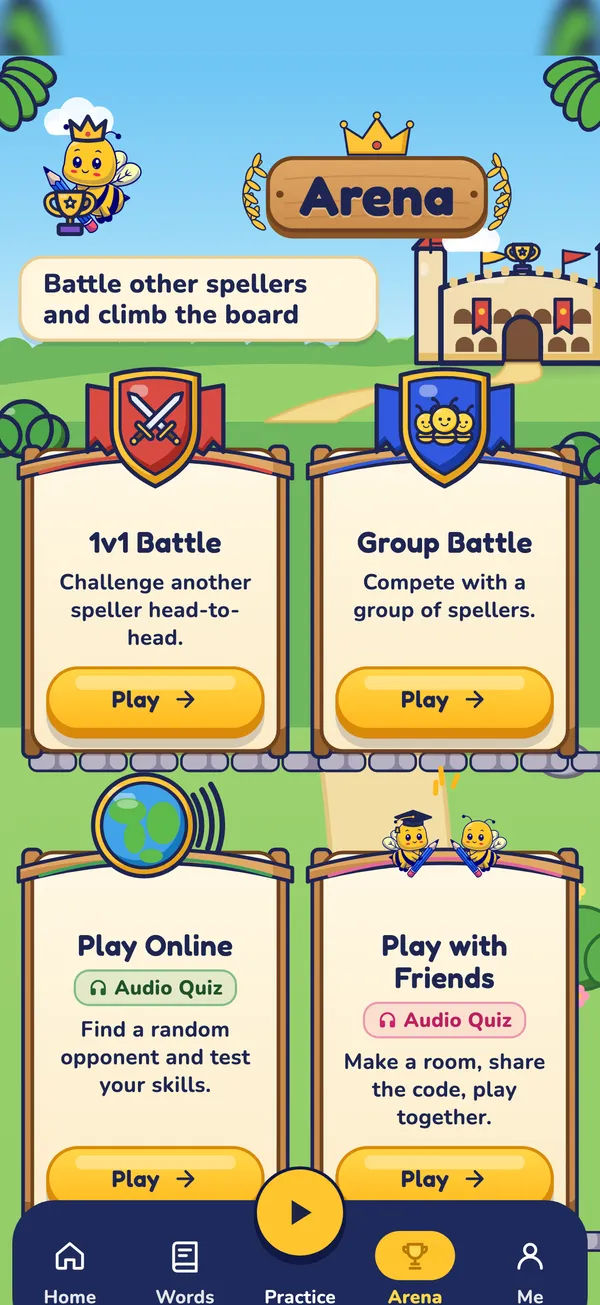
Tap Arena at the bottom, then Play with Friends.
What you should see: The room screen opens.
Arena: Group Battle and Play with Friends start group rooms. (sample data)
3
Create the room
Tap Create Room. Under Quiz topic, choose a level and a skill, or Mix it up; choose the Entry coins; tap Create Room.
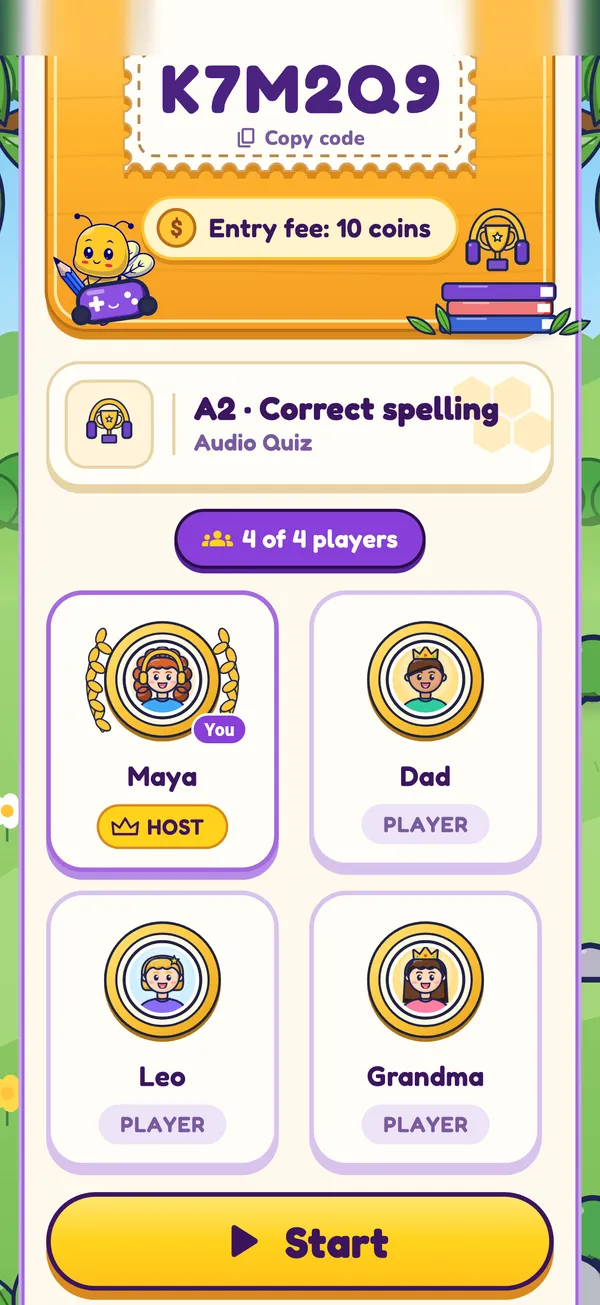
What you should see: The lobby shows a 6-digit room code.
4
Share the code
Copy the code, share it from the phone, or write it on the board.
What you should see: Players appear in the lobby as they join (up to 4).
A room lobby: share the code, wait for players, then Start. Real codes are digits. (sample data)
5
Start
When at least one other player has joined, the host taps Start.
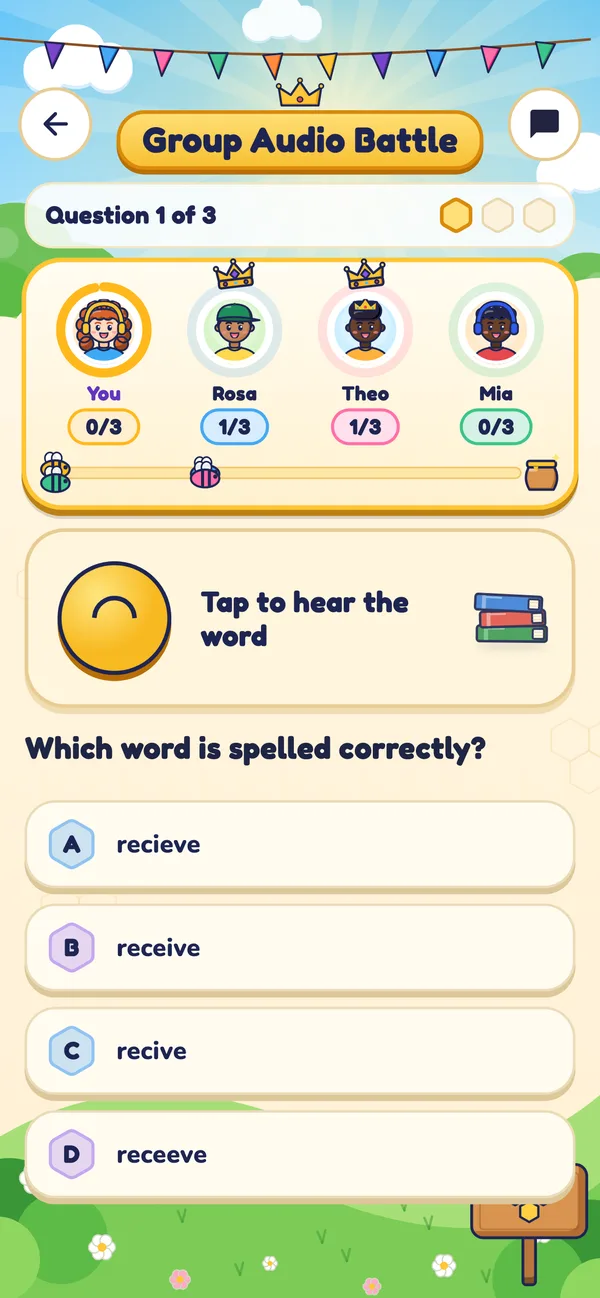
What you should see: Everyone hears the same words and chooses a spelling.
Audio rooms: players hear the word, then choose the spelling. (sample data)
6
Results and review
The result screen ranks players. Note scores yourself if you want a class record, then go over the words people missed.
What you should see: Rooms are not saved afterwards.
The result screen ranks players by correct answers. (sample data)
Student guide: how to join
1
Install Spelling Better and sign in
Every player installs Spelling Better (iPhone, iPad and Android phones and tablets) and signs in with their own account: email, Google, phone, or Apple on iPhone and iPad.
What you should see: Each player sees the app's Home screen with the tabs at the bottom.
2
Join the room
Tap Arena, then Play with Friends, then Join Room. In Join a Friend's Room, type the 6-digit code in Room code (or Paste code).
What you should see: The player appears in the host's lobby and waits for Start.
Checked against Spelling Better 2.3.6 (73) and the live website on 28 November 2026. Screens marked “sample data” show example players and questions.
Whole class on one screen instead: the free Spelling Bee Host
Best for: A whole class on one screen, from kindergarten up. Free, no accounts, no student devices.
Players: 2–60 spellers on one screen
Devices: Any computer, laptop or interactive whiteboard with a modern browser and speakers
Cost: Free. No sign-up.
Settings you can choose: Speller names, or just a number of spellers; A word list by grade (1st–8th grade, plus harder and adult lists) or your own words; American or British device voice; Format: Elimination (classic) or Points (fixed rounds); optional answer timer.
1
Open the Spelling Bee Host
On the classroom computer, open the Spelling Bee Host page. Connect speakers or the board's sound.
What you should see: The setup form appears.
2
Add spellers and words
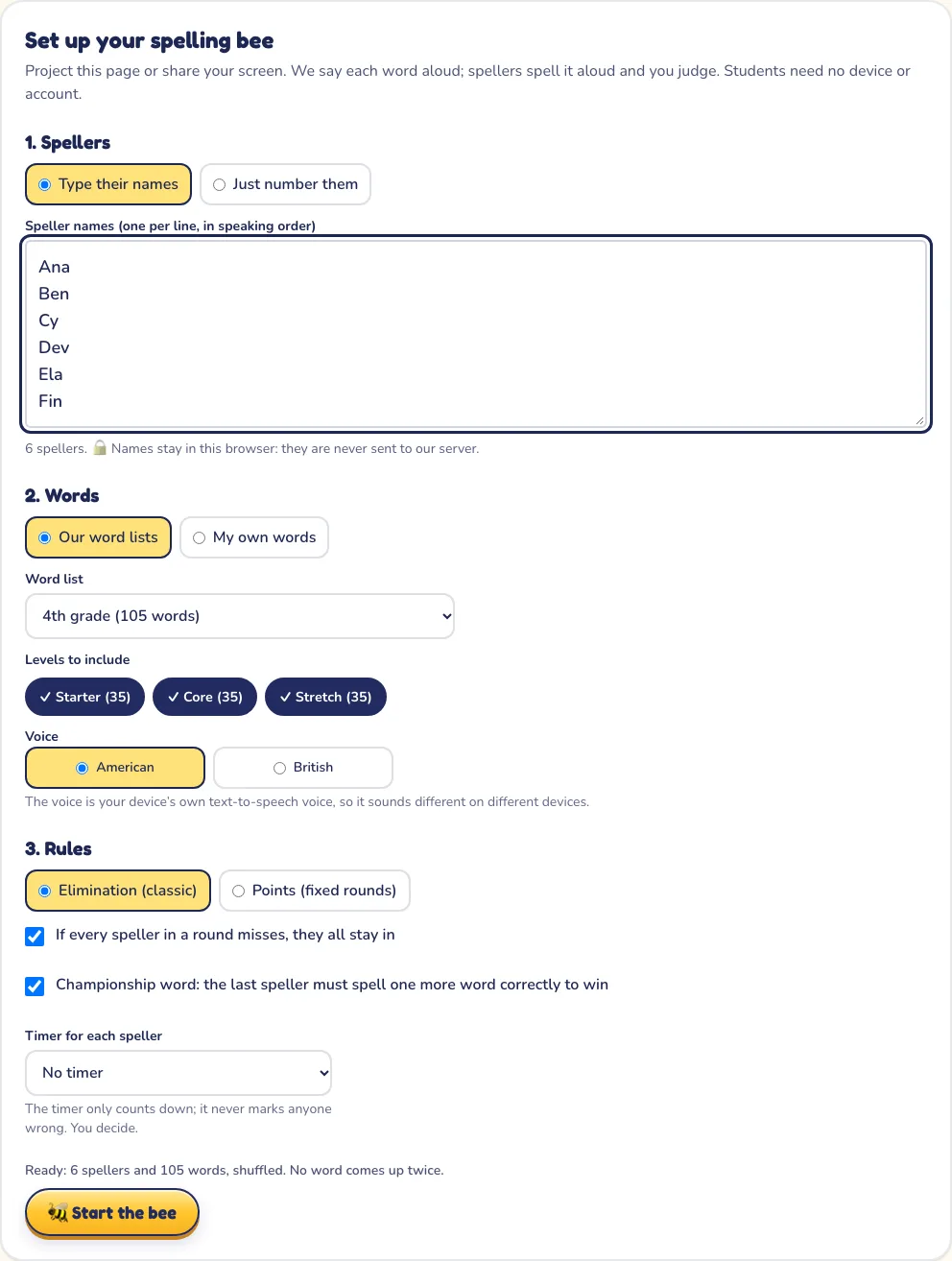
Type speller names (one per line) or choose Just number them. Under Words, pick a grade list or paste this week's words.
What you should see: The form says how many spellers and words are ready.
Setting up a bee: names, a word list and the format.
3
Start the bee
Press Start the bee. Explain the rules: listen, ask for the definition or a sentence if needed, then spell aloud.
What you should see: The first speller's name appears with the round number.
4
Run each turn
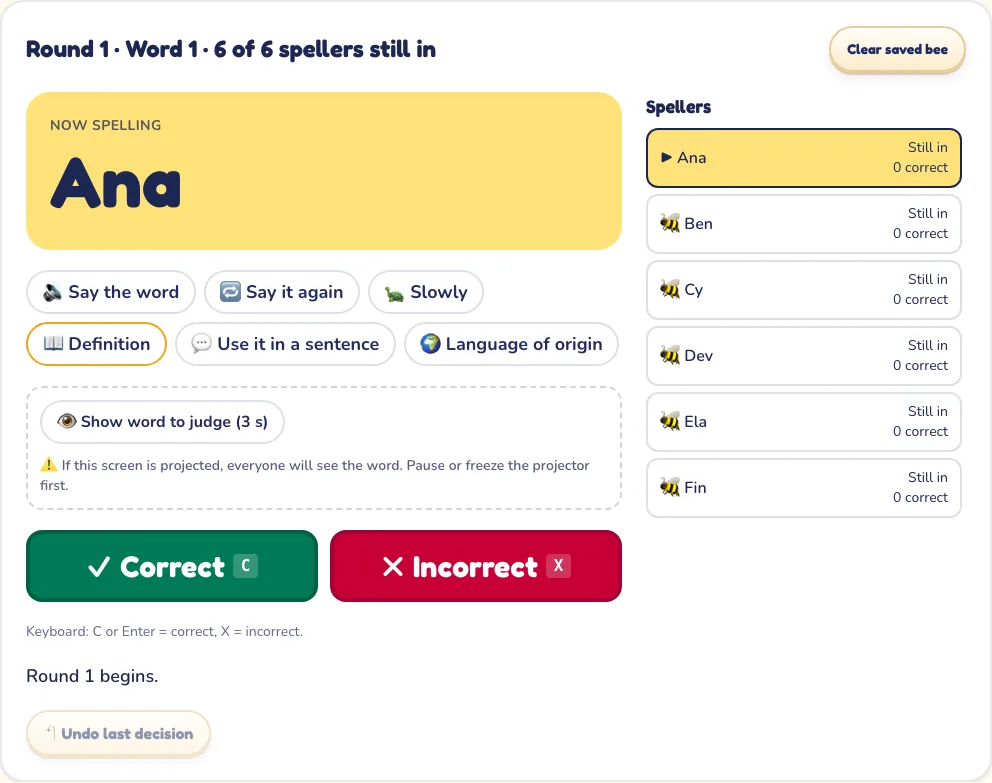
Press Say the word (and Definition, Use it in a sentence or Slowly when asked). Listen to the speller, then press Correct or Incorrect (keys C and X).
What you should see: The Host moves to the next speller and keeps track of who is still in.
A round in progress: the device says the word; you mark Correct or Incorrect.
5
Finish and review
When one speller is left (or after the points rounds), the Host shows the winner. Press Print results for the words used and missed.
What you should see: A printable results sheet to review difficult words with the class.
Good to know
Runs on one screen; students do not play on their own devices.
The voice is the device's text-to-speech: check unusual words first.
Names stay in your browser; nothing is saved by us.
If something goes wrong
No sound
Check the device volume and the board's audio; try another browser (voices differ by device).
A word sounds wrong
Use Say it again or Slowly, or read the word yourself; remove it from your list next time.
The projector shows the word
Freeze the projector before pressing Show word to judge.
Checked against Spelling Better 2.3.6 (73) and the live website on 28 November 2026. Screens marked “sample data” show example players and questions.
Free printable Grade 10 worksheets
Real worksheets made from this page's weekly lists, each with an answer key. Preview, print or save as PDF, or open one in its tool to change the words.
Formal or Informal? Matching and Rewriting
Match ten formal words to their meanings, then write four formal sentences you could use in an email or report.
Students who have the Spelling Better app can keep practising spelling and vocabulary with its quizzes and word games at home. This is optional extra practice: the app uses its own word lists, not the words from this lesson.
Made with the free lesson plan generator at spellingbetter.com. A template-based starting point: change anything that does not suit your class.
Able or Ible? Spelling Tricky Endings, with Small-Group Stations
55 minutes · Students learn the tendencies behind -able/-ible, -ance/-ence and -cede/-ceed/-sede, then practise in rotating stations.
Able or Ible? Spelling Tricky Endings, with Small-Group Stations
Students learn the tendencies behind -able/-ible, -ance/-ence and -cede/-ceed/-sede, then practise in rotating stations.
Objectives
By the end of the lesson, students should be able to:
Spell the fifteen week 3 words with the correct ending.
Explain one tendency for -able and -ible and name an exception.
Remember the three -ceed words and the one common -sede word.
Materials
Week 3 word list
Ending cards
Scramble worksheet
Dictation script
Optional: student devices with the Spelling Better app
Target words
irresistible
indispensable
inevitable
accessible
negligible
permissible
relevance
persistence
resemblance
existence
precede
proceed
concede
exceed
supersede
Timing
Time
Stage
Minutes
0–7 min
Ending Verdicts
7
7–17 min
Tendencies, not laws
10
17–25 min
Build the word
8
25–45 min
Three stations
20
45–51 min
Quick check
6
51–55 min
My tricky ending
4
Whole lesson
55
Lesson stages
1. Ending Verdicts7 min (0–7 min)
Find out what students already know about the endings.
Play five rounds of Ending Verdicts with stems from the list.
Note which endings cause the most disagreement.
2. Tendencies, not laws10 min (7–17 min)
Give students useful guides while being honest about exceptions.
Show -able after whole words (depend, dependable) and -ible after stems that are not words on their own (vis-ible), then point to inevitable as an exception.
Teach the -ceed set: proceed, exceed, succeed. Supersede is the one common -sede word. Most others end in -cede.
Link -ance and -ence words to related forms (relevant → relevance, persistent → persistence).
3. Build the word8 min (17–25 min)
Practise applying the guides together.
Write six stems on the board; students predict the ending and say which guide they used.
Check each one against the list and discuss any guide that failed.
4. Three stations20 min (25–45 min)
Practise in varied ways in small groups.
Station A: the scramble and look-cover-write worksheet.
Station B: partner dictation of the week 3 words.
Station C (optional, supervised): groups of 2–4 who have the app play an Audio Quiz room at B2 with Mix it up; each player uses their own device, account and entry coins. Groups without the app play Ending Verdicts in pairs instead.
Rotate every 6–7 minutes.
Tip: Station C is extra practice only; the app cannot load the week's list, so the list work happens at A and B.
5. Quick check6 min (45–51 min)
Check spelling of the endings.
Read eight words from the list aloud; students write them.
Students mark their own work and circle any ending they got wrong.
6. My tricky ending4 min (51–55 min)
Personal focus for the week.
Each student writes the ending they find hardest and one memory trick for it.
Share two tricks with the class.
Differentiation
Support: Give students the ending already sorted into columns on the word list, so they practise one ending family at a time.
Stretch: Students find five more words for each ending, test the -able/-ible tendency on them and report the exceptions.
Assessment
Use the quick check to see which ending family each student finds hardest, and plan Friday's dictation around those words.
Homework
Write a short paragraph about a rule you would change at school, using at least six words from the week 3 list. Check every ending.
Students who have the Spelling Better app can keep practising spelling and vocabulary with its quizzes and word games at home. This is optional extra practice: the app uses its own word lists, not the words from this lesson.
Made with the free lesson plan generator at spellingbetter.com. A template-based starting point: change anything that does not suit your class.
Collect three short texts with different registers (a message, a notice, a news article). For each, list three words that show the register and suggest a more formal or less formal alternative.
Root collection
online · about 20 min
Choose two roots from the week 2 list and find five more English words for each. Write the meaning of each word and underline the root.
Study three pairs of commonly confused words (for example precede and proceed), write a sentence for each word, and underline the part that tells them apart.
With someone at home, look at adverts, product labels or notices and find three euphemisms or words with a strong connotation. Write each one, what it really means and why it was chosen.
Weekend opinion piece
weekend · about 30 min
Write a short opinion piece (about 200 words) on a topic you care about. Include a counterargument and a rebuttal, and use at least five words from the week 4 list correctly.
Students who have the Spelling Better app can do extra practice with its spelling quizzes, vocabulary quizzes, flashcards and word games. The app uses its own word lists and does not report back to teachers.
A week of English practice for 10th grade
A five-day tenth-grade plan for the week 3 list of tricky endings, moving from the guides behind each ending to a dictation and a personal error review. Any of the other lists fits the same shape.
Monday25 min
Pretest and tendencies
Give a quick pretest of the fifteen words, then teach the -able/-ible, -ance/-ence and -cede/-ceed/-sede guides with their exceptions.
Tuesday20 min
Scramble and practise
Students complete the scramble worksheet with definition hints, then use look, cover, write, check on the eight words they find hardest.
☐ I know the three -ceed words and the one common -sede word.
☐ I finished the scramble and look, cover, write, check.
☐ I sorted my dictation mistakes by pattern.
☐ I chose three words and a strategy for next week.
spellingbetter.com/for-teachers/grades/
Grade 10 teacher questions
Is there a 10th grade word list page on Spelling Better?
Not a separate page. The four weekly lists on this page are written for tenth grade, with meanings and example sentences. For more, the word roots page (/word-roots/) helps with the roots week, the confusing words page (/confusing-words/) covers pairs like precede and proceed, and the hard spelling bee words page suits strong spellers.
Why teach formal and informal register in 10th grade?
Tenth graders write more formal essays, emails and applications, but most of their everyday language is casual. Teaching register as a choice for an audience, rather than as right and wrong, helps them switch confidently. The week 1 list pairs each formal word with an everyday partner so the switch is concrete.
Is there a reliable rule for -able and -ible?
There is a useful tendency rather than a rule: -able often follows a complete English word (dependable, acceptable), and -ible often follows a stem that is not a word on its own (visible, negligible). There are exceptions, such as inevitable, so students should learn the common words and check new ones in a dictionary.
How can students use roots without guessing meanings wrongly?
Treat roots as clues, not answers. Students should use the root together with the sentence around the word, make a best guess, and then confirm it in a dictionary. Activities such as Neologism Lab help because students have to explain how each part adds to the meaning.
Can tenth graders use Spelling Better app rooms in class?
Yes, as a small-group station. Audio Quiz rooms and Group Battle hold 2–4 players including the host, who joins the game. Each student needs the app on their own device, their own account and enough in-app coins for the entry, and results are not saved. For the whole class at once, the free Spelling Bee Host on one screen works better.
What if the lists do not match my class's level?
Adjust freely. For students who need support, start with the week 1 formal words and the commonly misspelled words page. For advanced students, add more roots, use the adult and hard word lists in the Spelling Bee Host, or ask them to build their own lists from the texts the class is reading.
Continue practising with Spelling Better
Students can practise spelling and vocabulary at their own level in the app, on their own phone or tablet.
Spelling Better is free to download for iPhone, iPad and Android. Group rooms use in-app coins. Premium is free for everyone until 31 December 2026.