

Skip to content
Spelling Better

Interactive Vocabulary Games for ESL and EFL Classrooms

Games that help English learners hear, recognise, spell and use new words, at every level, in the classroom or online.

What works for English learners

  • Hear it before you spell it. Learners need the sound of a word, not just its letters. Read words aloud, or let a recorded or device voice do it.
  • Recognise, then recall. Choosing the right spelling from options is easier than writing a word from memory; move from one to the other.
  • Meaning first. Every word in a game should come with its meaning and an example sentence.
  • Low-stress competition. Teams and points rounds keep everyone playing; avoid formats where weaker students are out early.

Games for beginners

Short everyday words, lots of listening and repeating, picture and gesture support, and games where students recognise a word before they produce it.

Five-Minute Spelling Warm-Up

Teacher-led · no devices

A quick, low-stakes start to any lesson: hear three to five words, spell them, check them together.

5–10 min · ages 5-7, 8-10, 11-13, 14-18, adult · beginner, intermediate, advanced · individual, pair, whole class · in-person or online

How to run it

Learning goal: Students listen carefully to a word, write it from memory, then compare their spelling with the correct one and notice the tricky part.

You need: A short word list (three to five words), Paper, mini whiteboards or a notebook page, Board, projector or shared screen to reveal the answers

Set-up
  1. Pick three to five words: one or two from this week's list, one review word and one stretch word.
  2. Write the answers somewhere hidden (a covered part of the board or a second slide).
  3. Ask students to number a page from 1 to 5 before you start.
Rules
  • Say each word, use it in a short sentence, then say the word again.
  • Students write the word once. No talking until all words are done.
  • Reveal the answers. Students tick correct words and circle the letters they missed.
  • Ask two or three students to share their tricky letter and how they will remember it.
  • Nobody is scored out loud; the warm-up is for noticing, not for marks.

Example round: Teacher: "Friend. My friend sat next to me at lunch. Friend." Students write it. After all five words, the teacher reveals F-R-I-E-N-D, and a student shares: "I wrote frend. I'll remember that a friend is with me to the end: fri-END."

Make it easier: Use three short words with a familiar pattern (for example ship, shop, shut) and let students check with a partner before the reveal. Make it harder: Use longer review words such as necessary or rhythm and ask students to write a second word from the same word family. For English learners: Show a picture or act out each word before saying it, and say the sentence slowly twice.

No app needed. The free guide and graded word lists on spellingbetter.com give you ready-made words for each level.

Use: Five-minute warm-up guide · Graded spelling word lists · Commonly misspelled words
Classic Classroom Spelling Bee

Free browser tool

An oral spelling bee with elimination rounds, run from one screen with the free Spelling Bee Host.

20–45 min · ages 8-10, 11-13, 14-18, adult · beginner, intermediate, advanced · individual, whole class · in-person or online

How to run it

Learning goal: Students listen to a word, ask useful questions about it (definition, sentence, origin) and spell it aloud clearly under gentle pressure.

You need: One teacher device (laptop, tablet or projector) with the Spelling Bee Host open, Speakers if the room is large, Printed rules and a score sheet (optional)

Set-up
  1. Open the Spelling Bee Host on your device and choose a word level that suits the class.
  2. Read the rules aloud: say the word, spell it, say the word again; once a letter is said it cannot be changed.
  3. Line students up or seat them in speaking order. Online, post the speaking order in the chat.
  4. Decide how many words each round has and how a tie at the end will be broken.
Rules
  • The Host says the word aloud. The speller may ask for the definition, a sentence or the word's origin, and the Host gives it.
  • The speller says the word, spells it letter by letter, then says the word again.
  • A correct spelling stays in; a wrong spelling is out, and the Host keeps track of who is still in.
  • If every speller in a round misses, they all stay in and the round is replayed.
  • When two spellers are left and one misses, the other must spell that word correctly and then one more word to win.

Example round: The Host says "necessary". The speller asks for the definition (needed; required) and a sentence ("Water is necessary for plants to grow."), then says: "Necessary, N-E-C-E-S-S-A-R-Y, necessary." Correct, so the speller stays in.

Make it easier: Use a lower grade list, allow students to write the word in the air or on paper before spelling aloud, and give everyone two lives. Make it harder: Use the hard word list and require spellers to give the part of speech before spelling. For English learners: Let spellers hear the word twice and ask for the sentence every time; practice the letter names (especially A, E, I, G and J) in a warm-up first.

The free Spelling Bee Host on spellingbetter.com runs on one teacher device: it says each word, gives the definition, a sentence and the origin, and tracks who is out. No accounts are needed.

Use: Spelling Bee Host · Printable spelling bee rules · Spelling bee score sheet · Graded spelling word lists

Team Spelling Relay

Teacher-led · no devices

Teams take turns at the board, each player adding the next letter until the word is complete.

10–25 min · ages 5-7, 8-10, 11-13, 14-18 · beginner, intermediate · teams · in-person

How to run it

Learning goal: Students build a word one letter at a time, so every player must hold the whole spelling in mind and check what teammates have written.

You need: Board space for each team (or large paper and markers), A word list for the week or unit, A timer (optional)

Set-up
  1. Split the class into teams of four to six and line each team up facing its section of the board.
  2. Give the first player in each line a marker.
  3. Agree on a signal for "done", such as the last player raising the marker.
Rules
  • The teacher says a word and a sentence. The first player writes the first letter and passes the marker back.
  • Each player adds one letter. A player may fix one earlier mistake instead of adding a letter.
  • The team that finishes a correct spelling first scores two points; every other correct spelling scores one.
  • No calling out letters from the line. Teams that shout lose their turn for that word.
  • Rotate so a different player starts each word.

Example round: Word: "because". Team Bees writes B, E, C, A, U, S, E across seven turns. Team Wasps writes B, E, C, U, and the next player uses their turn to fix the U to A before adding U, S, E. Both are correct; Bees finish first and score two points, Wasps score one.

Make it easier: Use three- and four-letter words and let each team see the word written on a card for three seconds first. Make it harder: Use longer words and have each player add a whole syllable instead of one letter, saying it aloud as they write. For English learners: Show a picture of each word and let teams say the word together before the first player writes.

Use: 1st grade spelling words · 3rd grade spelling words · 5th grade spelling bee words

Games for intermediate

Word families, prefixes and suffixes, using new words in sentences, and spelling words students can already say.

Five-Minute Spelling Warm-Up

Teacher-led · no devices

A quick, low-stakes start to any lesson: hear three to five words, spell them, check them together.

5–10 min · ages 5-7, 8-10, 11-13, 14-18, adult · beginner, intermediate, advanced · individual, pair, whole class · in-person or online

How to run it

Learning goal: Students listen carefully to a word, write it from memory, then compare their spelling with the correct one and notice the tricky part.

You need: A short word list (three to five words), Paper, mini whiteboards or a notebook page, Board, projector or shared screen to reveal the answers

Set-up
  1. Pick three to five words: one or two from this week's list, one review word and one stretch word.
  2. Write the answers somewhere hidden (a covered part of the board or a second slide).
  3. Ask students to number a page from 1 to 5 before you start.
Rules
  • Say each word, use it in a short sentence, then say the word again.
  • Students write the word once. No talking until all words are done.
  • Reveal the answers. Students tick correct words and circle the letters they missed.
  • Ask two or three students to share their tricky letter and how they will remember it.
  • Nobody is scored out loud; the warm-up is for noticing, not for marks.

Example round: Teacher: "Friend. My friend sat next to me at lunch. Friend." Students write it. After all five words, the teacher reveals F-R-I-E-N-D, and a student shares: "I wrote frend. I'll remember that a friend is with me to the end: fri-END."

Make it easier: Use three short words with a familiar pattern (for example ship, shop, shut) and let students check with a partner before the reveal. Make it harder: Use longer review words such as necessary or rhythm and ask students to write a second word from the same word family. For English learners: Show a picture or act out each word before saying it, and say the sentence slowly twice.

No app needed. The free guide and graded word lists on spellingbetter.com give you ready-made words for each level.

Use: Five-minute warm-up guide · Graded spelling word lists · Commonly misspelled words

Classic Classroom Spelling Bee

Free browser tool

An oral spelling bee with elimination rounds, run from one screen with the free Spelling Bee Host.

20–45 min · ages 8-10, 11-13, 14-18, adult · beginner, intermediate, advanced · individual, whole class · in-person or online

How to run it

Learning goal: Students listen to a word, ask useful questions about it (definition, sentence, origin) and spell it aloud clearly under gentle pressure.

You need: One teacher device (laptop, tablet or projector) with the Spelling Bee Host open, Speakers if the room is large, Printed rules and a score sheet (optional)

Set-up
  1. Open the Spelling Bee Host on your device and choose a word level that suits the class.
  2. Read the rules aloud: say the word, spell it, say the word again; once a letter is said it cannot be changed.
  3. Line students up or seat them in speaking order. Online, post the speaking order in the chat.
  4. Decide how many words each round has and how a tie at the end will be broken.
Rules
  • The Host says the word aloud. The speller may ask for the definition, a sentence or the word's origin, and the Host gives it.
  • The speller says the word, spells it letter by letter, then says the word again.
  • A correct spelling stays in; a wrong spelling is out, and the Host keeps track of who is still in.
  • If every speller in a round misses, they all stay in and the round is replayed.
  • When two spellers are left and one misses, the other must spell that word correctly and then one more word to win.

Example round: The Host says "necessary". The speller asks for the definition (needed; required) and a sentence ("Water is necessary for plants to grow."), then says: "Necessary, N-E-C-E-S-S-A-R-Y, necessary." Correct, so the speller stays in.

Make it easier: Use a lower grade list, allow students to write the word in the air or on paper before spelling aloud, and give everyone two lives. Make it harder: Use the hard word list and require spellers to give the part of speech before spelling. For English learners: Let spellers hear the word twice and ask for the sentence every time; practice the letter names (especially A, E, I, G and J) in a warm-up first.

The free Spelling Bee Host on spellingbetter.com runs on one teacher device: it says each word, gives the definition, a sentence and the origin, and tracks who is out. No accounts are needed.

Use: Spelling Bee Host · Printable spelling bee rules · Spelling bee score sheet · Graded spelling word lists

Team Spelling Relay

Teacher-led · no devices

Teams take turns at the board, each player adding the next letter until the word is complete.

10–25 min · ages 5-7, 8-10, 11-13, 14-18 · beginner, intermediate · teams · in-person

How to run it

Learning goal: Students build a word one letter at a time, so every player must hold the whole spelling in mind and check what teammates have written.

You need: Board space for each team (or large paper and markers), A word list for the week or unit, A timer (optional)

Set-up
  1. Split the class into teams of four to six and line each team up facing its section of the board.
  2. Give the first player in each line a marker.
  3. Agree on a signal for "done", such as the last player raising the marker.
Rules
  • The teacher says a word and a sentence. The first player writes the first letter and passes the marker back.
  • Each player adds one letter. A player may fix one earlier mistake instead of adding a letter.
  • The team that finishes a correct spelling first scores two points; every other correct spelling scores one.
  • No calling out letters from the line. Teams that shout lose their turn for that word.
  • Rotate so a different player starts each word.

Example round: Word: "because". Team Bees writes B, E, C, A, U, S, E across seven turns. Team Wasps writes B, E, C, U, and the next player uses their turn to fix the U to A before adding U, S, E. Both are correct; Bees finish first and score two points, Wasps score one.

Make it easier: Use three- and four-letter words and let each team see the word written on a card for three seconds first. Make it harder: Use longer words and have each player add a whole syllable instead of one letter, saying it aloud as they write. For English learners: Show a picture of each word and let teams say the word together before the first player writes.

Use: 1st grade spelling words · 3rd grade spelling words · 5th grade spelling bee words

Games for advanced

Academic and less common words, word roots, near-synonyms, and spelling words heard for the first time.

Five-Minute Spelling Warm-Up

Teacher-led · no devices

A quick, low-stakes start to any lesson: hear three to five words, spell them, check them together.

5–10 min · ages 5-7, 8-10, 11-13, 14-18, adult · beginner, intermediate, advanced · individual, pair, whole class · in-person or online

How to run it

Learning goal: Students listen carefully to a word, write it from memory, then compare their spelling with the correct one and notice the tricky part.

You need: A short word list (three to five words), Paper, mini whiteboards or a notebook page, Board, projector or shared screen to reveal the answers

Set-up
  1. Pick three to five words: one or two from this week's list, one review word and one stretch word.
  2. Write the answers somewhere hidden (a covered part of the board or a second slide).
  3. Ask students to number a page from 1 to 5 before you start.
Rules
  • Say each word, use it in a short sentence, then say the word again.
  • Students write the word once. No talking until all words are done.
  • Reveal the answers. Students tick correct words and circle the letters they missed.
  • Ask two or three students to share their tricky letter and how they will remember it.
  • Nobody is scored out loud; the warm-up is for noticing, not for marks.

Example round: Teacher: "Friend. My friend sat next to me at lunch. Friend." Students write it. After all five words, the teacher reveals F-R-I-E-N-D, and a student shares: "I wrote frend. I'll remember that a friend is with me to the end: fri-END."

Make it easier: Use three short words with a familiar pattern (for example ship, shop, shut) and let students check with a partner before the reveal. Make it harder: Use longer review words such as necessary or rhythm and ask students to write a second word from the same word family. For English learners: Show a picture or act out each word before saying it, and say the sentence slowly twice.

No app needed. The free guide and graded word lists on spellingbetter.com give you ready-made words for each level.

Use: Five-minute warm-up guide · Graded spelling word lists · Commonly misspelled words

Classic Classroom Spelling Bee

Free browser tool

An oral spelling bee with elimination rounds, run from one screen with the free Spelling Bee Host.

20–45 min · ages 8-10, 11-13, 14-18, adult · beginner, intermediate, advanced · individual, whole class · in-person or online

How to run it

Learning goal: Students listen to a word, ask useful questions about it (definition, sentence, origin) and spell it aloud clearly under gentle pressure.

You need: One teacher device (laptop, tablet or projector) with the Spelling Bee Host open, Speakers if the room is large, Printed rules and a score sheet (optional)

Set-up
  1. Open the Spelling Bee Host on your device and choose a word level that suits the class.
  2. Read the rules aloud: say the word, spell it, say the word again; once a letter is said it cannot be changed.
  3. Line students up or seat them in speaking order. Online, post the speaking order in the chat.
  4. Decide how many words each round has and how a tie at the end will be broken.
Rules
  • The Host says the word aloud. The speller may ask for the definition, a sentence or the word's origin, and the Host gives it.
  • The speller says the word, spells it letter by letter, then says the word again.
  • A correct spelling stays in; a wrong spelling is out, and the Host keeps track of who is still in.
  • If every speller in a round misses, they all stay in and the round is replayed.
  • When two spellers are left and one misses, the other must spell that word correctly and then one more word to win.

Example round: The Host says "necessary". The speller asks for the definition (needed; required) and a sentence ("Water is necessary for plants to grow."), then says: "Necessary, N-E-C-E-S-S-A-R-Y, necessary." Correct, so the speller stays in.

Make it easier: Use a lower grade list, allow students to write the word in the air or on paper before spelling aloud, and give everyone two lives. Make it harder: Use the hard word list and require spellers to give the part of speech before spelling. For English learners: Let spellers hear the word twice and ask for the sentence every time; practice the letter names (especially A, E, I, G and J) in a warm-up first.

The free Spelling Bee Host on spellingbetter.com runs on one teacher device: it says each word, gives the definition, a sentence and the origin, and tracks who is out. No accounts are needed.

Use: Spelling Bee Host · Printable spelling bee rules · Spelling bee score sheet · Graded spelling word lists

Partner Word Challenge

Teacher-led · no devices

Partners quiz each other from the same list, then swap roles and coach the words that were missed.

10–20 min · ages 5-7, 8-10, 11-13, 14-18, adult · beginner, intermediate, advanced · pair · in-person or online

How to run it

Learning goal: Students read words aloud clearly for a partner, spell from listening, and explain a spelling pattern to someone else.

You need: One word list per pair (8 to 12 words), Paper or mini whiteboards, A pencil in a different color for corrections

Set-up
  1. Pair students and give each pair one list. Partner A holds the list first.
  2. Model how to read a word: say it, use it in a sentence, say it again.
  3. Online, put pairs in breakout rooms and share the list with only one partner at a time.
Rules
  • Partner A reads six words; Partner B writes them without looking at the list.
  • Partner B checks against the list and corrects any mistakes in the other color.
  • For each missed word, Partner A gives one tip (a pattern, a word inside the word, or a memory trick).
  • Swap roles and repeat with the other six words.
  • Finish by retrying only the missed words, so each pair ends on a success.

Example round: Partner A reads "beautiful". Partner B writes "butiful". They check: the correct spelling is B-E-A-U-T-I-F-U-L. Partner A's tip: "Big Elephants Are Usually Beautiful" gives the first four letters, B-E-A-U. On the retry, Partner B spells it correctly.

Make it easier: Use six words in total and let the listener see the first letter of each word. Make it harder: The listener must also write a sentence with each word, and the reader checks the meaning. For English learners: Pair a stronger reader with a newer speaker, and let the listener ask for the word to be repeated as often as needed.

No app needed. For extra practice at home, students who have the Spelling Better app can use the Spelling Bee Simulator, which says a word and lets them spell it.

Use: Graded spelling word lists · 2nd grade spelling words · Commonly misspelled words

Listening and spelling practice

The free online spelling test reads words aloud in an American or a British voice (your device’s own voice) and lets learners hear the word slowly, the meaning and an example sentence. For your own vocabulary list, use the spelling test generator.

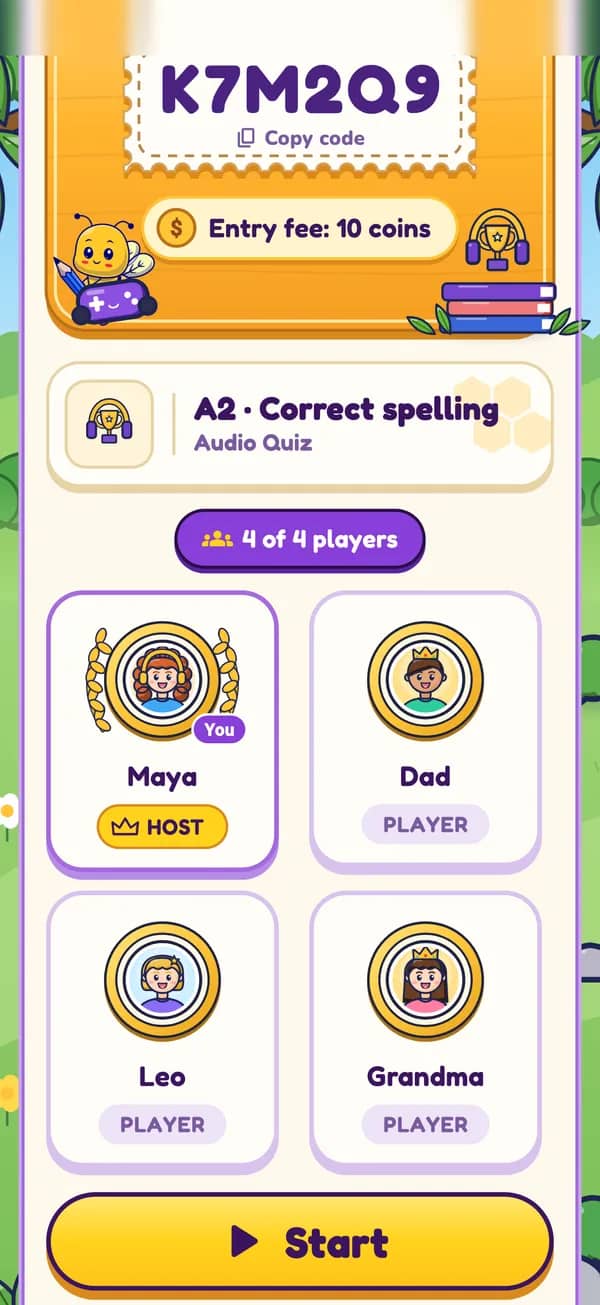
  • An Audio Quiz group room lobby in Spelling Better (demo data)

    Audio Quiz · Play with Friends

    Live group room · app

    A live listening room: hear each word and choose the correct spelling. The host picks a CEFR level and skill.

    Players
    2–4 players, each on their own phone or tablet
    Practises
    Listening to a spoken word and recognising its correct spelling.
    In class
    ESL groups at the same level; a listening station in a rotation.
    Time
    About 5–6 min per game
    Ages
    8+ (every player needs a Spelling Better account)

    Screenshot with sample players.

    How to host an Audio Quiz room
  • Read-aloud spelling test

    Individual or whole class · browser

    Each word is read aloud; type it or write it down. Grade 1–8, adult and hard lists, American or British voice.

    Players
    Any
    Practises
    Spelling from hearing.
    In class
    Project it and students write on paper, or each student practises on a device.
    Time
    5–15 min
    Ages
    6–18, adults
    Open the spelling test

In the app’s Audio Quiz rooms, the host chooses a CEFR level (A1 to C2) and a skill. The app sorts its words by these levels; it is not an official CEFR test. Room words are read with an American recording.

Games for online English lessons

Share your screen and these work in any video lesson.

Five-Minute Spelling Warm-Up

Teacher-led · no devices

A quick, low-stakes start to any lesson: hear three to five words, spell them, check them together.

5–10 min · ages 5-7, 8-10, 11-13, 14-18, adult · beginner, intermediate, advanced · individual, pair, whole class · in-person or online

How to run it

Learning goal: Students listen carefully to a word, write it from memory, then compare their spelling with the correct one and notice the tricky part.

You need: A short word list (three to five words), Paper, mini whiteboards or a notebook page, Board, projector or shared screen to reveal the answers

Set-up
  1. Pick three to five words: one or two from this week's list, one review word and one stretch word.
  2. Write the answers somewhere hidden (a covered part of the board or a second slide).
  3. Ask students to number a page from 1 to 5 before you start.
Rules
  • Say each word, use it in a short sentence, then say the word again.
  • Students write the word once. No talking until all words are done.
  • Reveal the answers. Students tick correct words and circle the letters they missed.
  • Ask two or three students to share their tricky letter and how they will remember it.
  • Nobody is scored out loud; the warm-up is for noticing, not for marks.

Example round: Teacher: "Friend. My friend sat next to me at lunch. Friend." Students write it. After all five words, the teacher reveals F-R-I-E-N-D, and a student shares: "I wrote frend. I'll remember that a friend is with me to the end: fri-END."

Make it easier: Use three short words with a familiar pattern (for example ship, shop, shut) and let students check with a partner before the reveal. Make it harder: Use longer review words such as necessary or rhythm and ask students to write a second word from the same word family. For English learners: Show a picture or act out each word before saying it, and say the sentence slowly twice.

No app needed. The free guide and graded word lists on spellingbetter.com give you ready-made words for each level.

Use: Five-minute warm-up guide · Graded spelling word lists · Commonly misspelled words

Classic Classroom Spelling Bee

Free browser tool

An oral spelling bee with elimination rounds, run from one screen with the free Spelling Bee Host.

20–45 min · ages 8-10, 11-13, 14-18, adult · beginner, intermediate, advanced · individual, whole class · in-person or online

How to run it

Learning goal: Students listen to a word, ask useful questions about it (definition, sentence, origin) and spell it aloud clearly under gentle pressure.

You need: One teacher device (laptop, tablet or projector) with the Spelling Bee Host open, Speakers if the room is large, Printed rules and a score sheet (optional)

Set-up
  1. Open the Spelling Bee Host on your device and choose a word level that suits the class.
  2. Read the rules aloud: say the word, spell it, say the word again; once a letter is said it cannot be changed.
  3. Line students up or seat them in speaking order. Online, post the speaking order in the chat.
  4. Decide how many words each round has and how a tie at the end will be broken.
Rules
  • The Host says the word aloud. The speller may ask for the definition, a sentence or the word's origin, and the Host gives it.
  • The speller says the word, spells it letter by letter, then says the word again.
  • A correct spelling stays in; a wrong spelling is out, and the Host keeps track of who is still in.
  • If every speller in a round misses, they all stay in and the round is replayed.
  • When two spellers are left and one misses, the other must spell that word correctly and then one more word to win.

Example round: The Host says "necessary". The speller asks for the definition (needed; required) and a sentence ("Water is necessary for plants to grow."), then says: "Necessary, N-E-C-E-S-S-A-R-Y, necessary." Correct, so the speller stays in.

Make it easier: Use a lower grade list, allow students to write the word in the air or on paper before spelling aloud, and give everyone two lives. Make it harder: Use the hard word list and require spellers to give the part of speech before spelling. For English learners: Let spellers hear the word twice and ask for the sentence every time; practice the letter names (especially A, E, I, G and J) in a warm-up first.

The free Spelling Bee Host on spellingbetter.com runs on one teacher device: it says each word, gives the definition, a sentence and the origin, and tracks who is out. No accounts are needed.

Use: Spelling Bee Host · Printable spelling bee rules · Spelling bee score sheet · Graded spelling word lists

Partner Word Challenge

Teacher-led · no devices

Partners quiz each other from the same list, then swap roles and coach the words that were missed.

10–20 min · ages 5-7, 8-10, 11-13, 14-18, adult · beginner, intermediate, advanced · pair · in-person or online

How to run it

Learning goal: Students read words aloud clearly for a partner, spell from listening, and explain a spelling pattern to someone else.

You need: One word list per pair (8 to 12 words), Paper or mini whiteboards, A pencil in a different color for corrections

Set-up
  1. Pair students and give each pair one list. Partner A holds the list first.
  2. Model how to read a word: say it, use it in a sentence, say it again.
  3. Online, put pairs in breakout rooms and share the list with only one partner at a time.
Rules
  • Partner A reads six words; Partner B writes them without looking at the list.
  • Partner B checks against the list and corrects any mistakes in the other color.
  • For each missed word, Partner A gives one tip (a pattern, a word inside the word, or a memory trick).
  • Swap roles and repeat with the other six words.
  • Finish by retrying only the missed words, so each pair ends on a success.

Example round: Partner A reads "beautiful". Partner B writes "butiful". They check: the correct spelling is B-E-A-U-T-I-F-U-L. Partner A's tip: "Big Elephants Are Usually Beautiful" gives the first four letters, B-E-A-U. On the retry, Partner B spells it correctly.

Make it easier: Use six words in total and let the listener see the first letter of each word. Make it harder: The listener must also write a sentence with each word, and the reader checks the meaning. For English learners: Pair a stronger reader with a newer speaker, and let the listener ask for the word to be repeated as often as needed.

No app needed. For extra practice at home, students who have the Spelling Better app can use the Spelling Bee Simulator, which says a word and lets them spell it.

Use: Graded spelling word lists · 2nd grade spelling words · Commonly misspelled words

For a spoken spelling bee over video, share the Spelling Bee Host: it reads each word and the clues, and you mark each answer.

For language schools and institutes

  • End-of-unit review: a points-format bee with the unit’s word list in the Spelling Bee Host or test generator.
  • Level-matched groups: students at the same level play Audio Quiz rooms of up to four, each on their own phone with the app.
  • Clubs and events: a monthly vocabulary competition with the free team scorecard.

Planning a 30-minute lesson? Start from the free 30-minute vocabulary lesson plan, which includes notes for English learners. For whole-school use, see Spelling Better for Schools.

Give your learners more practice

Spelling Better helps learners hear, spell and remember English words, free to download for iPhone, iPad and Android.

Spelling Better is free to download for iPhone, iPad and Android. Group rooms use in-app coins. Premium is free for everyone until 31 December 2026.

Direct store links: App Store · Google Play