8th Grade Vocabulary Games, Word Origin Activities and English Worksheets
Four weekly lists for eighth graders: the words even adults misspell, key words from science, math and history, English words borrowed from around the world, and precise words for debate. With games, worksheets, lesson plans, homework and a free whole-class spelling bee.
Children in 8th grade are usually 13–14 years old; in England and Wales this is often Year 9, and in many other countries Grade 8 or a middle year of secondary school. Every class is different: use an easier or harder grade’s lists whenever they fit your students better.
What 8th grade students can practise
Tricky spellings
Spell commonly misspelled words such as necessary, embarrass and accommodate by finding the 'trouble spot' in each word and using a memory trick for it.
Subject vocabulary
Spell and explain key words from science, math and social studies, such as ecosystem, coefficient and constitution, and use them correctly in those subjects.
Word origins
Explain where borrowed and eponymous words come from (for example tsunami from Japanese and boycott from a person's name) and how origin can help with spelling.
Nuance and argument
Use words such as concede, refute, credible and bias accurately when discussing and writing arguments.
Connotation
Explain how a word's connotation can make writing sound fair or one-sided, and rewrite sentences to change their tone.
Independent checking
Check spelling in their own writing by looking for double letters, silent letters and borrowed spellings before handing work in.
Spelling patterns and word study: double letters (accommodate, embarrass) · silent and unusual letters (rhythm, conscience) · ie and ei · subject words with Greek and Latin parts · words named after people · borrowed spellings (French, Japanese, Hindi) · precise words for argument.
These are suggested focus areas for this age, not an official curriculum. Adapt them to your own scheme of work.
Classroom games and activities for 8th grade
Teacher-led activities with full rules and an example round. None of them needs the app.
Spelling Clinic
15–20 min · pair · All levels; especially useful for students who repeat the same mistakes
Objective: Pairs act as 'spelling doctors', diagnosing what went wrong in common misspellings and prescribing a memory trick.
You need
'Patient cards' with one misspelled word each
Clinic record sheet: misspelling, diagnosis, correct spelling, prescription (memory trick)
Before you start
Write ten patient cards with realistic misspellings of Week 1 words, such as 'neccessary', 'embarass', 'accomodate', 'seperate' and 'definately'.
Model one diagnosis on the board.
How to play
Each pair draws a patient card.
They write the diagnosis: which letters are missing, doubled or swapped.
They write the correct spelling and check it against the list.
They write a prescription: a memory trick that would stop the mistake happening again.
After ten minutes, pairs present their best prescription; the class votes for the most memorable one.
Example round: Patient card: "accomodate". Diagnosis: "missing one m; it needs double c and double m." Correct: accommodate. Prescription: "It's big enough to accommodate two cots and two mattresses." Another pair treats "seperate": "There's a rat in separate."
Easier: Underline the part of the misspelling that is wrong so pairs only need to fix it and write a trick. Harder: Pairs write their own patient cards from words they have misspelled in their own writing this term.
20–30 min · small-group · On-level; groups mix confident readers with curious guessers
Objective: Small groups 'travel' between language stations, guessing which language each English word came from and stamping their passports.
You need
A paper 'passport' per group with a page per station
Five station cards: named after people (sandwich, cardigan, boycott, silhouette); European languages (kindergarten, rendezvous, robot); Asian languages (tsunami, bungalow, shampoo, pajamas); Arabic and Swahili (algebra, safari); languages of the Americas (chocolate, hurricane)
Stamps or stickers
Before you start
Set up the five stations around the room, each with its two to four Week 3 words and short clues about their origin (without naming the language or person).
Put the answers in an envelope at the teacher's desk.
How to play
Groups spend four minutes at each station.
For each word, they write the word, spell it correctly, and guess its language or person of origin from the clues.
Before leaving, they write one sentence that uses one of the station's words.
At the end, groups open the answers and earn a stamp for every correct origin and every correct spelling.
The group with the most stamps shares one surprising origin with the class.
Example round: Station card: "tsunami: harbor + wave; this island country has many earthquakes." The group writes Japanese. At the next station: "boycott: a land agent in Ireland in 1880 whose neighbors refused to work for him." They write "named after a person" and spell boycott with double t.
Easier: Give each station a choice of two languages to pick from. Harder: Groups must also find one more English word from the same language and explain its meaning.
15–25 min · pair · Above-level and on-level; a strong fit for media literacy lessons
Objective: Pairs rewrite neutral headlines to show bias in two directions, then back to neutral, learning how word choice changes meaning.
You need
Six neutral, school-friendly headlines on a slide
Paper with three columns: positive spin, negative spin, neutral
Before you start
Write neutral headlines about everyday school events, for example 'School changes lunch menu' and 'Students hold climate march'.
Review connotation and bias from Week 4.
How to play
Pairs choose three headlines.
For each one, they write a version with a positive spin and one with a negative spin, changing only a few words.
They underline every word they changed and label its connotation.
They explain in one sentence why the neutral version is more credible.
Pairs read one headline trio aloud; the class identifies the biased words.
Example round: Neutral: "School changes lunch menu." Positive spin: "School serves exciting new lunch menu." Negative spin: "School forces unpopular menu on students." Pair's note: "Forces and unpopular show bias against the school; the neutral version is more credible because it just states the fact."
Easier: Give a word bank of positive and negative words to choose from. Harder: Students find two real headlines about the same event and write a short paragraph comparing the connotations.
25–35 min · team, whole-class · Confident speakers; give quieter students the judge or scorekeeper role
Objective: Two teams debate a light topic and score points for using target words precisely, as judged by a panel of classmates.
You need
A debate topic
Week 4 word cards for each team
Judge score sheets
A timer
Before you start
Choose a light topic such as 'Schools should start an hour later' or 'Every student should learn to cook'.
Split the class into two teams and a panel of three to five judges.
How to play
Each team gets the 15 Week 4 words as cards. The 'quota' is to use at least eight of them in the debate.
Teams take turns: opening statement (one minute), two rebuttals (one minute each) and a closing (one minute).
Judges tick each word when it is used correctly and precisely; a word used wrongly scores nothing.
After the debate, judges write three of the words used on the board; the team that used each one must spell it aloud.
The winner is the team with the most correct words, not the most persuasive speech.
Example round: Team A: "I concede that some students like early starts, but the evidence is compelling: tired students learn less." Judges tick concede and compelling. Team B: "That claim is ambiguous: tired from what?" Judges tick ambiguous. Later Team B must spell ambiguous aloud: A-M-B-I-G-U-O-U-S.
Easier: Lower the quota to five words and let teams prepare their opening in writing. Harder: Raise the quota to ten and require one counterargument and one refutation from each team.
15–20 min · individual, whole-class · All levels; let students choose between two cards
Objective: Students explain a subject word to the class in 30 seconds while classmates write and spell the word on whiteboards.
You need
Cards with Week 2 subject words, face down
Mini whiteboards
A visible timer
Before you start
Write each Week 2 word on a card.
Agree the rule: the explainer may draw or gesture but never says the word.
How to play
A student draws a card and has 30 seconds to explain the word without saying it or any part of it.
The rest of the class listens and writes the word on whiteboards as soon as they know it.
When time is up, everyone holds up their boards; the explainer reveals the card.
One point to the explainer for each classmate who spelled the word correctly, so clear explanations earn more.
Rotate until every word has been explained once.
Example round: Card: circumference. The explainer draws a circle and traces its edge: "In math, it's the distance all the way round the outside of this shape. Not the diameter." Most boards show circumference; three show circumfrence. The class claps the four syllables: cir-cum-fer-ence.
Easier: Allow 60 seconds and let the explainer say which subject the word comes from. Harder: The explainer must also use the word's Greek or Latin part as a clue (circum means around).
20–30 min · whole-class, individual · Mixed classes; the trouble spot task keeps everyone working
Objective: A whole-class spelling bee in which every non-speller writes the word's 'trouble spot', so the whole room practises each word.
You need
One teacher device with the free Spelling Bee Host on the projector
Mini whiteboards for the class
Score sheet
Before you start
Choose the 8th grade list for a bee with every student as a speller, or paste the 14 Week 1 words and enter four teams as spellers (Elimination needs three words per speller).
Explain 'trouble spot': the part of the word people most often get wrong.
How to play
The Host reads the word aloud and the speller spells it, asking for a meaning or sentence if they wish.
While the speller thinks, everyone else writes only the trouble spot letters on their whiteboard (for example 'mm' for accommodate).
After the teacher marks the spelling in the Host, the class shows their boards.
Students whose trouble spot matches the class's most common answer earn a point on their own score.
Spellers who are out join the whiteboard group, so nobody sits idle.
Example round: The Host reads "rhythm". Jonah spells R-H-Y-T-H-M: correct. Most boards show "rh" or "no vowels", and the class agrees both are good trouble spots. Next, "conscience": boards show "science inside".
Easier: Show the word's length as dashes on the board before each speller starts. Harder: Switch to the Week 3 word origins list, and give a bonus if the speller names the word's language of origin.
Read-aloud tests by grade; the device says each word.
Grade 8 spelling and vocabulary words, week by week
Four original weekly lists with meanings and example sentences. Copy or print a list, or turn it into a worksheet, flashcards or a read-aloud spelling test in one click.
Week 1 · Double letters and unusual spellings
Week 1: Words that trip everyone up
Objective: Students spell commonly misspelled words by spotting the trouble spot in each word and choosing a memory trick for it.
Week 1: Words that trip everyone up: words, meanings and example sentences
Word
Meaning
Example
Listen
necessaryadjective · one c, double s
Needed; something you must have or do.
Is it necessary to bring a calculator to the test?
occasionnoun · double c, one s
A special event, or a particular time when something happens.
Her grandmother's birthday was a big occasion for the whole family.
embarrassverb · double r, double s
To make someone feel awkward or ashamed in front of others.
Please don't embarrass me in front of my friends.
accommodateverb · double c, double m
To have enough room for someone or something; to provide what someone needs.
The hall can accommodate two hundred people.
recommendverb · one c, double m
To suggest that something is good or worth trying.
I recommend this book to anyone who likes mysteries.
occurrencenoun · double c, double r, -ence
Something that happens.
Thunderstorms are a common occurrence here in summer.
committeenoun · double m, double t, double e
A small group of people chosen to plan or decide things for a larger group.
The dance committee chose a space theme.
definitelyadverb · finite inside, no a
Certainly; without any doubt.
I will definitely finish my project by Friday.
separateverb · there's a rat in it
To split things or people apart.
Separate the recycling from the trash before you take it out.
rhythmnoun · rh at the start, no a, e, i, o, u
A strong, regular pattern of beats or sounds.
Clap along to the rhythm of the song.
consciencenoun · con + science
The feeling inside you that tells you what is right and wrong.
My conscience told me to hand in the wallet I found.
privilegenoun · no d before the g
A special right or advantage that only some people have.
Using the art room at lunch is a privilege for the art club.
foreignadjective · ei after r, silent g
From or belonging to another country.
She is learning a foreign language at night school.
mischievousadjective · -vous, not -vious
Playful in a slightly naughty way that causes small trouble.
The mischievous puppy hid my sock under the sofa.
Practice ideas
Trouble spot hunt: students write each word, highlight the part most people get wrong and compare highlights with a partner.
Memory trick swap: each student invents a trick for three words (separate has 'a rat' in it; a committee needs double m, double t, double e) and teaches one to the class.
Dictation with a twist: read a sentence using two list words; students write it, then check their own work against the list before handing it in.
Look through the commonly misspelled words page for three more words that follow the same double-letter patterns.
Week 2 · Subject vocabulary across the curriculum
Week 2: Words from science, math and history
Objective: Students spell and explain key subject words and use each one correctly in a sentence about that subject.
Week 2: Words from science, math and history: words, meanings and example sentences
Word
Meaning
Example
Listen
photosynthesisnoun · photo (light) + synthesis
The process plants use to make their food from sunlight, water and carbon dioxide.
Photosynthesis takes place mainly in the leaves of a plant.
ecosystemnoun · eco (home)
All the living things in an area and how they interact with each other and their surroundings.
A pond is a small ecosystem full of plants, insects and frogs.
moleculenoun · -cule (small)
The smallest unit of a substance, made of atoms joined together.
A water molecule has two hydrogen atoms and one oxygen atom.
velocitynoun · -ity
How fast something moves in a particular direction.
The ball's velocity increased as it rolled down the ramp.
precipitationnoun · -tion
Water that falls from clouds as rain, snow, sleet or hail.
Precipitation was low this month, so the river dropped.
equationnoun · equa (equal) + -tion
A math statement showing that two amounts or expressions are equal.
Solve the equation to find the value of x.
coefficientnoun · co + efficient
In algebra, the number written in front of a letter that it multiplies.
In the term 5x, the coefficient is 5.
perpendicularadjective · -ular
Meeting another line or surface at a right angle.
The two streets are perpendicular to each other.
circumferencenoun · circum (around) + -ence
The distance all the way around the edge of a circle.
Measure the circumference of the jar with a piece of string.
democracynoun · demo (people) + cracy (rule)
A system of government in which the people choose their leaders, usually by voting.
In a democracy, citizens elect their leaders.
constitutionnoun · -tution
The set of basic laws and principles for a country or organization.
The student council wrote a constitution with five rules.
revolutionnoun · -tion
A sudden, big change, especially in how a country is governed; also one full turn.
The Industrial Revolution changed how goods were made.
A large, organized society with cities, government, writing and culture.
The Maya civilization built huge stone cities.
migrationnoun · -tion
The movement of people or animals from one place to another, often in large groups.
The migration of monarch butterflies covers thousands of miles.
Practice ideas
Subject sort: students sort the words into science, math and history columns, then add one more word they have met in each subject this term.
Explain it simply: students write a definition for a younger student (age 8) for four words, without using the word itself.
Word parts: underline the Greek or Latin parts (photo, eco, circum, demo, cracy) and look one up on the word roots page.
Ask each subject teacher for one sentence they would use with a list word, and practise spelling the word inside that sentence.
Week 3 · Word origins: borrowed words and eponyms
Week 3: Where English words come from
Objective: Students spell words borrowed from other languages or named after people and explain how each word's origin connects to its meaning or spelling.
Week 3: Where English words come from: words, meanings and example sentences
Word
Meaning
Example
Listen
sandwichnoun · named after the Earl of Sandwich
Two slices of bread with a filling such as cheese or salad between them.
I packed a cheese sandwich for the field trip.
cardigannoun · named after the Earl of Cardigan
A knitted sweater that fastens down the front with buttons.
She wore a warm cardigan over her T-shirt.
boycottverb · named after Charles Boycott
To refuse to buy, use or take part in something as a protest.
The students voted to boycott the vending machine until it sold healthier snacks.
silhouettenoun · named after a French official
A dark outline of a person or thing seen against a light background.
We saw the silhouette of a cat on the moonlit fence.
kindergartennoun · German: children's garden
A class or school for young children before or at the start of elementary school.
My little brother just started kindergarten.
tsunaminoun · Japanese: harbor wave
A huge, powerful sea wave, usually caused by an earthquake under the ocean.
Warning sirens help people leave the coast quickly if a tsunami is coming.
bungalownoun · Hindi and Gujarati: of Bengal
A house with only one floor.
My grandparents moved to a bungalow so they would not need stairs.
shampoonoun · Hindi: to press or massage
A liquid soap for washing hair.
This shampoo smells like coconut.
algebranoun · Arabic: al-jabr
A part of math that uses letters and symbols to stand for numbers.
In algebra we use x to stand for a number we don't know yet.
pajamasUK: pyjamasnoun · Persian and Urdu: leg clothing
Loose, comfortable clothes that you sleep in.
Our class wore pajamas to school for a charity reading day.
chocolatenoun · Nahuatl, through Spanish
A sweet food made from roasted cacao seeds.
We melted chocolate to dip the strawberries in.
safarinoun · Swahili: journey
A trip to watch or photograph wild animals in their natural home.
On safari, we spotted elephants at the watering hole.
hurricanenoun · Taíno, through Spanish
A very strong storm with powerful winds that forms over warm ocean water.
The hurricane brought heavy rain to the coast.
rendezvousnoun · French: present yourselves
A planned meeting at an agreed time and place.
Our rendezvous after the race is the big oak tree.
robotnoun · Czech: robota (forced work)
A machine that can carry out tasks on its own, often controlled by a computer.
The robot sorted the parcels faster than any person could.
Practice ideas
World map words: mark each word's language of origin on a map and draw a line to where English speakers use it today.
Spelling clues from origin: discuss how origin explains odd spellings: the ts in tsunami, the silent h in silhouette and the silent z and s in rendezvous.
Eponym detectives: students research one word named after a person (sandwich, cardigan, boycott, silhouette) and tell the story in three sentences.
Use the online spelling test, which can show a word's language of origin, to practise the words on the 8th grade list.
Week 4 · Words for argument, evidence and nuance
Week 4: Precise words for debate and nuance
Objective: Students use precise words for argument and connotation in discussion and writing, and spell them correctly.
Week 4: Precise words for debate and nuance: words, meanings and example sentences
Word
Meaning
Example
Listen
ambiguousadjective · -uous
Able to be understood in more than one way; not clear.
The ending was ambiguous, so we argued about what happened.
biasnoun · short and tricky: i before a
An unfair preference for or against someone or something.
Check the article for bias before you trust it.
credibleadjective · cred (believe) + -ible
Believable and able to be trusted.
Use credible sources, such as a respected encyclopedia, for your research.
skepticalUK: scepticaladjective · sk (US) / sc (UK)
Doubtful; not easily convinced that something is true.
I was skeptical about the advert's amazing claims.
compellingadjective · double l before -ing
So strong or interesting that you pay attention or agree.
She gave a compelling reason to start a recycling club.
concedeverb · -cede
To admit, sometimes unwillingly, that something is true or that you have lost.
He had to concede that his opponent made a good point.
counterargumentnoun · argue drops the e
A point that argues against another point or opinion.
A strong essay answers the counterargument instead of ignoring it.
refuteverb · -ute
To prove that a statement or idea is wrong.
Use evidence to refute the claim that homework has no benefits.
inferencenoun · -ence
A conclusion you reach from clues and evidence rather than from a direct statement.
From the muddy boots, my inference was that he had been outside.
subtleadjective · silent b
Not obvious; small and delicate, so it is easy to miss.
There is a subtle difference between the two shades of blue.
To give special importance or attention to something.
Underline key words to emphasize them.
nuancenoun · French, -ance
A small, delicate difference in meaning, feeling or color.
Good translators pay attention to every nuance.
subjectiveadjective · sub + ject + ive
Based on personal feelings or opinions rather than facts.
Which pizza topping is best is a subjective question.
connotationnoun · double n, -tion
The feeling or idea a word suggests beyond its basic dictionary meaning.
The word cheap often has a negative connotation.
articulateadjective · -ate
Able to express ideas clearly and well in words.
The articulate speaker explained the whole plan in two minutes.
Practice ideas
Argument frames: students complete 'Some people argue… However, I would refute this because…' and 'I concede that… but…' about a school issue.
Bias spotter: compare two short descriptions of the same event and underline the words that show bias or a strong connotation.
Nuance pairs: discuss skeptical and cynical, subtle and hidden, credible and popular, and write a sentence that shows the difference in each pair.
Record a 60-second argument on a school topic and listen back for how many list words you used and whether each was used precisely.
Your browser has no speech voice, so the listen buttons are hidden.
Need a longer list? See the full 8th grade spelling words, with a read-aloud test for every level.
Turn these words into a classroom game: paste a week’s list into the free Spelling Bee Host and run a spoken bee on the board, or see how to host a live game below.
How to host live word games for Grade 8 students
Suggested game session for 8th grade
Eighth graders preparing for school or class bees need practice spelling aloud under a little pressure, and the free browser Spelling Bee Host runs a whole-class bee from one projected screen, with no student devices or accounts.
Game
Spelling Bee Host (in your browser)
Settings to try
For a bee with every student as a speller, choose the 8th grade list. For focused review, paste this week's list and enter 4–6 teams as spellers: the Host needs a word per speller per round (three each in Elimination).
Vocabulary focus
Tricky spellings and borrowed words, where asking for the meaning, a sentence or the language of origin helps spellers make good choices.
Warm-up
Ask the class to spell three words from last week on whiteboards and name each trouble spot before the first speller steps up.
Session length
20–35 minutes
Format
Whole-class elimination or points rounds; students who are out keep score or write each word on whiteboards so they keep practising.
Supervision
The teacher runs the Host and marks each spelling. Words on the site's lists come with a meaning and sentence; for pasted words, read them from this page. Students need no device.
Afterwards
List every word that was missed, then turn them into a find-the-mistake or dictation sheet for the next lesson.
Independent practice
Students can practise at home with the online spelling test on spellingbetter.com using the 8th grade list, or paste this week's words into the spelling test generator.
For a small group of 2–4 students who each have the Spelling Better app and their own account, a Group Battle room (host picks a quiz category suited to the class; 10 multiple-choice questions) makes a review station. Rooms cost in-app coins and the host plays too.
Session length and grouping are teaching suggestions, not app settings. The app has no grade setting.
Step by step: Spelling Bee Host (in your browser)
Best for: A whole class on one screen, from kindergarten up. Free, no accounts, no student devices.
Players: 2–60 spellers on one screen
Devices: Any computer, laptop or interactive whiteboard with a modern browser and speakers
Cost: Free. No sign-up.
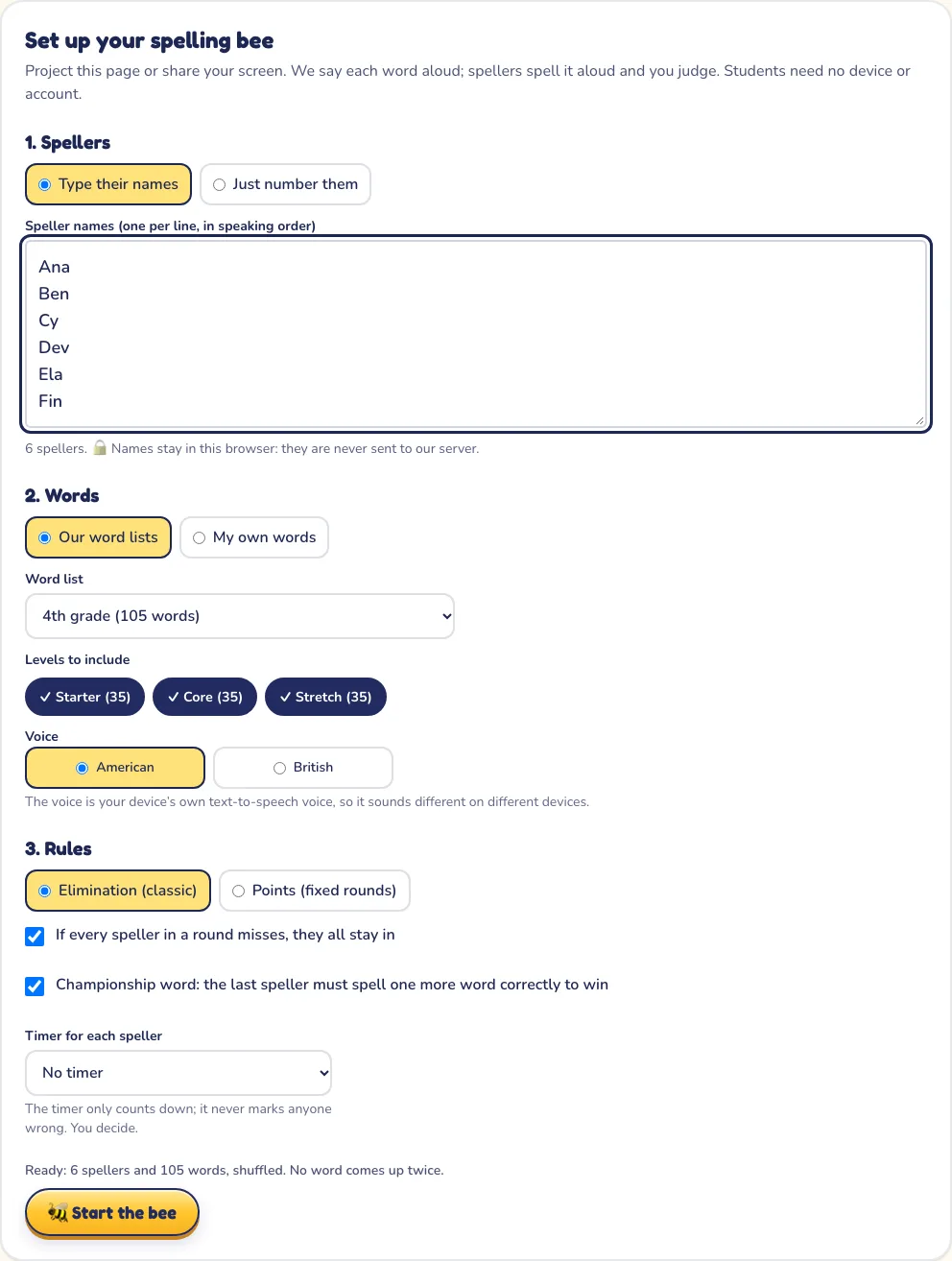
Settings you can choose: Speller names, or just a number of spellers; A word list by grade (1st–8th grade, plus harder and adult lists) or your own words; American or British device voice; Format: Elimination (classic) or Points (fixed rounds); optional answer timer.
1
Open the Spelling Bee Host
On the classroom computer, open the Spelling Bee Host page. Connect speakers or the board's sound.
What you should see: The setup form appears.
2
Add spellers and words
Type speller names (one per line) or choose Just number them. Under Words, pick a grade list or paste this week's words.
What you should see: The form says how many spellers and words are ready.
Setting up a bee: names, a word list and the format.
3
Start the bee
Press Start the bee. Explain the rules: listen, ask for the definition or a sentence if needed, then spell aloud.
What you should see: The first speller's name appears with the round number.
4
Run each turn
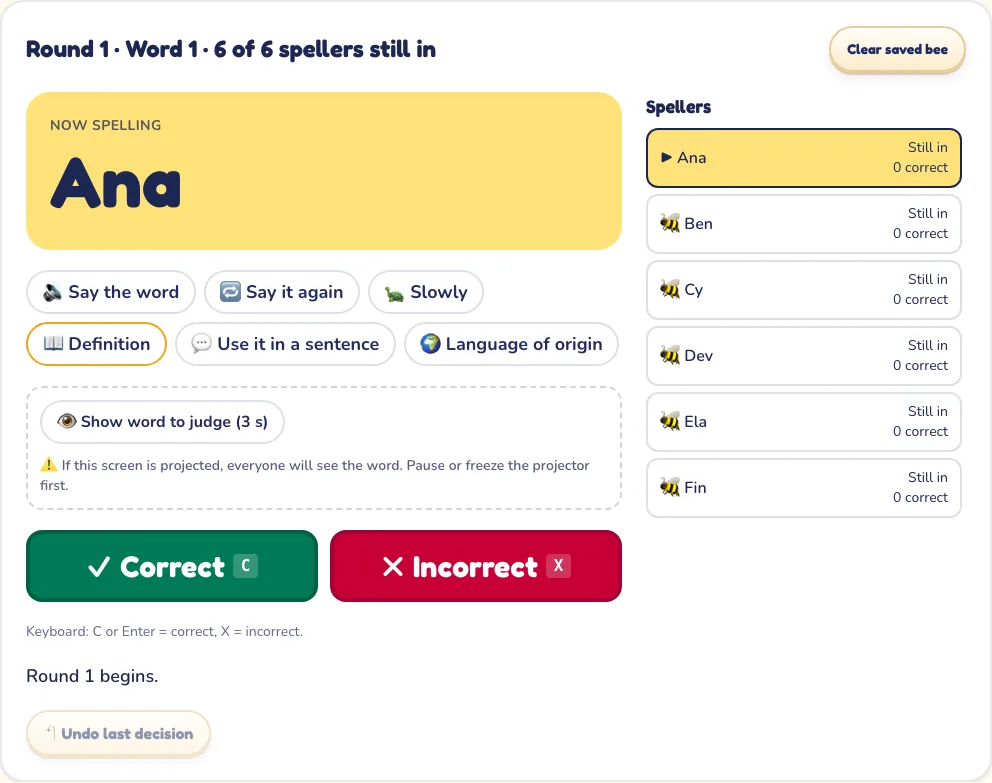
Press Say the word (and Definition, Use it in a sentence or Slowly when asked). Listen to the speller, then press Correct or Incorrect (keys C and X).
What you should see: The Host moves to the next speller and keeps track of who is still in.
A round in progress: the device says the word; you mark Correct or Incorrect.
5
Finish and review
When one speller is left (or after the points rounds), the Host shows the winner. Press Print results for the words used and missed.
What you should see: A printable results sheet to review difficult words with the class.
Good to know
Runs on one screen; students do not play on their own devices.
The voice is the device's text-to-speech: check unusual words first.
Names stay in your browser; nothing is saved by us.
If something goes wrong
No sound
Check the device volume and the board's audio; try another browser (voices differ by device).
A word sounds wrong
Use Say it again or Slowly, or read the word yourself; remove it from your list next time.
The projector shows the word
Freeze the projector before pressing Show word to judge.
Checked against Spelling Better 2.3.6 (73) and the live website on 28 November 2026. Screens marked “sample data” show example players and questions.
Free printable Grade 8 worksheets
Real worksheets made from this page's weekly lists, each with an answer key. Preview, print or save as PDF, or open one in its tool to change the words.
Commonly Misspelled Words: Look, Cover, Write
Before the missing letters part, ask students to circle each word's trouble spot on the look, cover, write table.
Students who have the Spelling Better app can keep practising spelling and vocabulary with its quizzes and word games at home. This is optional extra practice: the app uses its own word lists, not the words from this lesson.
Made with the free lesson plan generator at spellingbetter.com. A template-based starting point: change anything that does not suit your class.
Trouble Spots: Tricky Spellings and a Spelling Bee
60 minutes · Students find the trouble spots in commonly misspelled words, invent memory tricks and finish with a whole-class spelling bee in the free Spelling Bee Host.
Trouble Spots: Tricky Spellings and a Spelling Bee
Students find the trouble spots in commonly misspelled words, invent memory tricks and finish with a whole-class spelling bee in the free Spelling Bee Host.
Objectives
By the end of the lesson, students should be able to:
Identify the trouble spot in each Week 1 word.
Create memory tricks for at least three words.
Spell the Week 1 words aloud and in writing.
Materials
Week 1 word list
Spelling Clinic patient cards
Mini whiteboards
Teacher device with the free Spelling Bee Host
Projector or large screen
Score sheet
Target words
necessary
occasion
embarrass
accommodate
recommend
occurrence
committee
definitely
separate
rhythm
conscience
privilege
foreign
mischievous
Timing
Time
Stage
Minutes
0–5 min
Spot the error
5
5–15 min
Trouble spots
10
15–23 min
Memory tricks
8
23–35 min
Spelling Clinic
12
35–55 min
Trouble Spot Spelling Bee
20
55–60 min
My three
5
Whole lesson
60
Lesson stages
1. Spot the error5 min (0–5 min)
Show that even common words are often misspelled.
Write 'definately', 'seperate' and 'neccessary' on the board.
Students correct each one on whiteboards.
2. Trouble spots10 min (5–15 min)
Teach the idea of a trouble spot.
Go through the 14 words and highlight each word's trouble spot together.
Group the words: double letters (embarrass, committee), silent or unusual letters (rhythm, foreign), and look-alike endings (mischievous).
3. Memory tricks8 min (15–23 min)
Build strategies for remembering spellings.
Share three example tricks (a rat in separate, finite in definitely, science in conscience).
Pairs invent a trick for two more words and share.
4. Spelling Clinic12 min (23–35 min)
Practise diagnosing and fixing misspellings.
Pairs draw patient cards and complete the clinic sheet.
Pairs present their best prescription to the class.
Students who have the Spelling Better app can keep practising spelling and vocabulary with its quizzes and word games at home. This is optional extra practice: the app uses its own word lists, not the words from this lesson.
Made with the free lesson plan generator at spellingbetter.com. A template-based starting point: change anything that does not suit your class.
Ask someone at home to name three foods or objects. Together, look up where each word comes from and write the word, its origin and one interesting fact.
Take the online spelling test on spellingbetter.com with the 8th grade list, or paste this week's words into the spelling test generator. Note your score and missed words in your planner and practise those words three times.
In your English club or study group, quiz each other on this week's words: one person reads a meaning, the others write the word. Swap roles after five words and compare your spellings.
Students who have the Spelling Better app can do extra practice with its spelling quizzes, vocabulary quizzes, flashcards and word games. The app uses its own word lists and does not report back to teachers.
A week of English practice for 8th grade
A five-day plan that fits any of the four lists, mixing spelling strategy, subject use and discussion, with a whole-class bee or check on Friday.
Monday20 min
Meet the words
Introduce the list, discuss each meaning and highlight the trouble spot, word part or origin in every word.
Tuesday15 min
Strategies
Invent memory tricks for the five hardest words and complete a missing letters or find-the-mistake sheet.
Write a short piece (an argument, a subject explanation or a travel note) using at least six list words, then check every spelling with a partner.
Friday25 min
Trouble Spot Spelling Bee
Run a team bee in the free Spelling Bee Host with the week's words pasted in (enter 4–6 teams as spellers so the words cover two points rounds), or give a written dictation.
☐ I can find the trouble spot in each word on this week's list.
☐ I have a memory trick for my three hardest words.
☐ I can explain what every word means.
☐ I used at least six list words in my own writing.
☐ I spelled at least twelve words correctly in the Friday check.
☐ I checked my writing for double letters and silent letters.
spellingbetter.com/for-teachers/grades/
Grade 8 teacher questions
What vocabulary do 8th graders need?
Eighth graders meet more specialized words in every subject and are asked to argue and analyze in writing. These lists cover commonly misspelled words, key science, math and history words, word origins and precise words for debate. Use easier or harder lists to suit each class, since a grade level is only a starting point.
Origins explain spellings that otherwise look random, such as the ts in tsunami or the ette in silhouette, and they make words more memorable. Students can also ask for a word's language of origin in a spelling bee, so knowing common patterns from French, Greek or Latin helps them make good guesses.
How do I help students who keep misspelling the same words?
Ask them to find the exact trouble spot in each word, such as the double m in accommodate, and invent a personal memory trick for it. Games like the Spelling Clinic, short daily dictations and a weekly check of their own writing usually work better than copying the word many times.
Can I run a spelling bee for my whole 8th grade class?
Yes, with the free browser Spelling Bee Host. Project it from one device, pick the 8th grade list or paste your own words (with a short list, enter teams as spellers), and the device's voice reads each word while students spell aloud. Students need no device or account.
Is the Spelling Better app useful for 8th grade?
Students who have the Spelling Better app can do extra practice with its spelling quizzes, vocabulary quizzes, flashcards and word games. Its live rooms suit small supervised groups of 2–4, because each player needs their own device and account and rooms cost in-app coins. The app does not let you load your own word list.
Continue practising with Spelling Better
Students can practise spelling and vocabulary at their own level in the app, on their own phone or tablet.
Spelling Better is free to download for iPhone, iPad and Android. Group rooms use in-app coins. Premium is free for everyone until 31 December 2026.