7th Grade Vocabulary Games, Figurative Language Activities and Worksheets
Four weekly lists for seventh graders: building new words with suffixes, naming figurative language, choosing between words with similar meanings and spelling -able and -ible endings. Each list comes with games, printable worksheets, lesson plans and homework ideas.
Children in 7th grade are usually 12–13 years old; in England and Wales this is often Year 8, and in many other countries Grade 7 or an early year of secondary school. Every class is different: use an easier or harder grade’s lists whenever they fit your students better.
What 7th grade students can practise
Word formation
Build adjectives and nouns with -ous, -ive, -ity and -ment, and spell the changes at the join (courage + ous keeps the e, generous becomes generosity).
Figurative language
Name and explain similes, metaphors, personification, hyperbole, idioms, alliteration and onomatopoeia in poems, stories and everyday speech.
Word relationships
Compare words with similar meanings and different feelings, such as thrifty and stingy, and choose the one that fits the writer's purpose.
Spelling patterns
Decide between -able and -ible endings using patterns and memory tricks, and spell common words with each ending correctly.
Literal and figurative
Explain the difference between what words say literally and what they mean figuratively, using idioms and metaphors as examples.
Writing
Use precise adjectives and at least one figure of speech in a short descriptive paragraph, checked for spelling.
Spelling patterns and word study: suffixes -ous, -ive, -ity, -ment, -ence · keeping or dropping e before a suffix · figurative language terms · positive and negative connotation · -able and -ible · words with silent or unusual letters.
These are suggested focus areas for this age, not an official curriculum. Adapt them to your own scheme of work.
Classroom games and activities for 7th grade
Teacher-led activities with full rules and an example round. None of them needs the app.
Suffix Chain Challenge
10–15 min · pair · On-level and above; strong spellers can take the longer chains
Objective: Pairs stretch one base word into as many correctly spelled forms as they can, noticing the spelling changes at each join.
You need
Paper or mini whiteboards
A dictionary per pair
Before you start
Choose six base words from Week 1: create, decide, generous, courage, achieve, depend.
Draw a sample chain on the board using one other word, such as act → active → activity → actively.
How to play
Give pairs one base word and three minutes.
They write a chain of real words that grow from the base, each with a new suffix (or prefix plus suffix).
After time, pairs check each word in a dictionary.
One point for each correctly spelled real word; a misspelled word scores nothing until it is fixed.
Pairs underline any letter that changed or dropped at the join and explain it to another pair.
Example round: Base word: decide. A pair writes decision, decisive, decisively, indecisive and indecisiveness. All five are real and spelled correctly: five points. They underline the change from d to s and say: "The d turns into an s before -ion and -ive."
Easier: Give a list of suffixes (-ive, -ion, -ly, -ness) for students to try on the base word. Harder: Pairs must use every word in their chain in one connected paragraph about a character.
10–20 min · small-group · All levels; the sentence rule slows the game down for careful thinkers
Objective: Small groups play a fast card game that pairs a positive word with its negative partner, then prove the difference in a sentence.
You need
A deck of 16–20 word cards per group (Week 3 words plus a few extra partners)
A tally sheet per group
Before you start
Make cards for five or more partner pairs: thrifty/stingy, confident/arrogant, inquisitive/nosy, determined/stubborn, renowned/notorious, plus extra pairs such as careful/fussy.
Add four 'neutral' cards (ancient, antique, timid, scrutinize) that never make a pair.
How to play
Groups of three or four shuffle the deck and place it face down.
Players take turns turning a card face up onto a shared pile.
When the top card is the positive or negative partner of the card under it, the first player to tap the pile and say 'Snap!' must say one sentence that shows the difference between the two words.
If the group agrees the sentence works, that player keeps the pair and writes both words on the tally sheet, spelled correctly.
A wrong snap or misspelled word sends the pair back into the middle of the deck.
When the deck runs out, the player with the most pairs wins.
Example round: Cards turned: antique, then inquisitive, then nosy. Ana taps the pile: "Snap! An inquisitive visitor asks the museum guide how the old clock works; a nosy visitor reads the guide's private messages." The group agrees, and Ana writes inquisitive and nosy on the tally sheet.
Easier: Play with the cards face up in a grid and let students find pairs at their own pace, like a memory game. Harder: Players must also say which word they would use in a polite letter and which in a complaint.
15–25 min · small-group · On-level; a good fit for English learners who meet idioms in everyday talk
Objective: Small groups decide whether sentences are literal or figurative, name the figure of speech and rewrite it literally.
You need
Strips of paper with 12 sentences (half literal, half figurative)
Group answer sheet with columns: literal or figurative, figure of speech, plain meaning
Before you start
Write 12 sentences mixing real facts and figures of speech, for example 'The thunder grumbled all night' and 'The thunder started at nine o'clock.'
Cut them into strips, one set per group.
How to play
Groups sort the strips into two piles: literal and figurative.
For every figurative sentence, they name the figure of speech using a Week 2 word and spell it correctly.
They rewrite each figurative sentence in plain, literal English.
Groups swap answer sheets and check each other's work against the teacher's key.
One point for each correct pile, one for each correctly named and spelled figure, one for a clear literal rewrite.
Example round: Strip: "The thunder grumbled all night." The group puts it in the figurative pile, writes personification, and rewrites it as "There was low thunder all night." Strip: "My backpack weighs a ton." They write hyperbole and rewrite: "My backpack is very heavy."
Easier: Use only three figures of speech (simile, metaphor, personification) and allow the Week 2 list on the table. Harder: Groups write two extra sentences of their own for another group to sort, including one idiom.
15–25 min · team · Above-level thinkers; scaffold with sentence frames for others
Objective: Teams complete and invent word analogies that show relationships such as opposites, part and whole, and shades of meaning.
You need
Analogies on a slide or board
Team answer cards
Score sheet
Before you start
Write eight analogies with a missing word, using Weeks 1–3, for example 'thrifty : stingy :: confident : ____'.
Prepare the sentence frame: '___ is to ___ as ___ is to ___ because…'.
How to play
Show one analogy at a time. Teams have one minute to agree on the missing word.
Teams write the word on their card, spelled correctly, and hold it up together.
A team scores one point for the right word and one more if its captain explains the relationship using the sentence frame.
After four rounds, each team invents one analogy for the others to solve.
A team-made analogy scores two points for its makers if at least one other team solves it.
Example round: Slide: "thrifty : stingy :: confident : ____". Team Blue writes arrogant. Captain: "Thrifty is to stingy as confident is to arrogant because each pair is the positive and negative side of the same trait." Two points. Next: "thrifty : stingy :: inquisitive : ____" (answer: nosy).
Easier: Offer three answer choices for each analogy. Harder: Teams must invent analogies that use the Week 4 -able and -ible words.
15–20 min · team, whole-class · All levels; teams share the thinking so no one is put on the spot
Objective: Teams bet points on whether they can choose the correct ending and spell the whole word, building careful, confident spelling.
You need
Mini whiteboards, one per team
A board to record points
Before you start
Use the Week 4 list plus four review words, such as edible, horrible, breakable and possible.
Give every team 10 starting points.
How to play
Say a word and use it in a sentence.
Before writing, each team writes a wager from 1 to 5 points in the corner of its board.
Teams write the full word. Hold up boards on the count of three.
A correct spelling wins the wagered points; a wrong one loses them.
After each word, a team that spelled it correctly shares the clue or pattern it used.
The team with the most points after ten words wins.
Example round: Teacher: "Legible. Please make your handwriting legible." Team A wagers 2 and writes legible: +2. Team B wagers 5 and writes legable: −5. Team A explains: "In legible, leg is a root meaning read, not a whole word, so it's probably -ible." The class checks the pattern from Week 4.
Easier: Show the word with the ending missing (leg____) so teams only choose the ending. Harder: Include harder words such as indispensable and irresistible, and ask teams to say the pattern before revealing the answer.
15–25 min · individual · On-level readers; give stronger readers a longer or older poem
Objective: Students search a short poem on their own for figurative language, label each device and explain its effect.
You need
A short, school-appropriate poem (12–20 lines) printed for each student
Colored pencils
A key: one colour per device
Before you start
Choose a poem that uses at least four devices from Week 2.
Write a colour key on the board, for example blue for simile, green for metaphor, orange for personification.
How to play
Students read the poem twice, once silently and once in a whisper.
They highlight every device in the matching colour.
Next to each highlight, they write the device's name, spelled correctly.
For two devices, they write one sentence explaining the feeling or picture it creates.
Finish by comparing highlights with a partner and resolving any disagreements.
Example round: In a poem about a storm, a student highlights "the sky cracked its knuckles" in orange and writes personification, then "the rain fell like gravel" in blue and writes simile. Effect note: "The simile makes the rain sound hard and loud."
Easier: Underline the lines that contain devices so students only need to name them. Harder: Students write a four-line poem of their own using three devices and swap it for a partner to hunt.
Read-aloud tests by grade; the device says each word.
Grade 7 spelling and vocabulary words, week by week
Four original weekly lists with meanings and example sentences. Copy or print a list, or turn it into a worksheet, flashcards or a read-aloud spelling test in one click.
Week 1 · Suffixes -ous, -ive, -ity, -ment, -ence
Week 1: Suffixes that build character words
Objective: Students build and spell adjectives and nouns that describe character, noticing what happens to the base word when a suffix is added.
Week 1: Suffixes that build character words: words, meanings and example sentences
Word
Meaning
Example
Listen
courageousadjective · -ous (keeps the e)
Brave when facing danger, pain or something difficult.
The courageous firefighter carried the puppy to safety.
generousadjective · -ous
Happy to give or share money, time or things with others.
Our neighbor is generous with the vegetables from her garden.
generositynoun · -ity (u is dropped)
The quality of being kind and willing to give or share.
Everyone thanked the bakery for its generosity after the flood.
mysteriousadjective · -ous (y becomes i)
Strange and hard to explain or understand.
A mysterious note was tucked inside the library book.
ambitiousadjective · -ious
Having a strong wish to succeed or to do something big.
She has an ambitious plan to read fifty books this year.
enthusiasticadjective · -ic
Full of excitement and interest.
The enthusiastic crowd sang along with the band.
creativeadjective · -ive (drops the e)
Good at thinking of new ideas or making new things.
The creative team turned cardboard boxes into a castle.
decisiveadjective · -ive (de becomes s)
Able to make choices quickly and firmly.
A decisive captain helps the team stay calm under pressure.
sensitiveadjective · -ive
Quick to notice or be affected by feelings, sounds or changes.
My dog is sensitive to loud noises like fireworks.
responsibilitynoun · -ity (-ible becomes -ibil)
A duty or job that you are trusted to do.
Feeding the class fish is my responsibility this week.
achievementnoun · -ment (keeps the e)
Something good that you managed to do through effort.
Finishing the charity run was a huge achievement for our class.
encouragementnoun · -ment
Words or actions that give someone confidence or hope.
With a little encouragement, he joined the drama club.
independencenoun · -ence
Being free to make your own choices and do things for yourself.
Riding the bus alone gave her a new sense of independence.
Practice ideas
Word family ladders: write create, generous and decide on the board and ask students to climb as many forms as they can (create, creative, creativity, creatively), spelling each one.
Rule finders: in pairs, students compare courage/courageous with create/creative and write their own rule for when the e stays.
Character cards: students pick a character from a class novel and describe them with four list words, giving evidence from the book for each.
Speed spell: read the base word (courage, achieve, responsible) and students write the list word that grows from it.
Week 2 · Figurative language terms
Week 2: The language of figurative writing
Objective: Students spell the terms for figurative language and identify each one in examples from poems, stories and everyday speech.
Week 2: The language of figurative writing: words, meanings and example sentences
Word
Meaning
Example
Listen
similenoun · ends in -ile, three syllables
A comparison of two things that uses the word like or as.
“As busy as a bee” is a simile.
metaphornoun · ph says f
A comparison that says one thing is another, without using like or as.
“The classroom was a zoo” is a metaphor for a noisy room.
personificationnoun · -ification
Giving human actions or feelings to an animal, object or idea.
“The wind whispered through the trees” is an example of personification.
hyperbolenoun · final e is said (hy-PER-bo-lee)
A huge exaggeration used for effect, not meant to be taken as true.
Saying “I've told you a million times” is hyperbole.
idiomnoun · Greek idios (own)
A phrase whose meaning is different from the meanings of its separate words.
“Break a leg” is an idiom that means good luck.
alliterationnoun · double l, -tion
Using the same first sound in several words close together.
“Busy bees buzz” uses alliteration.
onomatopoeianoun · Greek, oeia ending
A word that sounds like the noise it names, such as buzz or sizzle.
Comic books are full of onomatopoeia like bang and pow.
imagerynoun · image + -ry
Words that help the reader see, hear, smell, taste or feel something in their mind.
The poem's imagery made me smell the salty sea.
symbolnoun · y says i
Something that stands for a bigger idea, such as a dove for peace.
In the story, the lighthouse is a symbol of hope.
literaladjective · -al
Meaning exactly what the words say, with no hidden or imaginative meaning.
The literal meaning of “raining cats and dogs” would be very strange!
figurativeadjective · figure + ative (drop e)
Using words in an imaginative way, not with their exact everyday meaning.
“Heart of gold” is a figurative way to say someone is kind.
moodnoun · oo
The feeling that a piece of writing creates for the reader.
The dark forest scene has a spooky mood.
tonenoun · o-e
The writer's attitude, shown through the words they choose.
The letter's tone was polite but firm.
Practice ideas
Figure it out: give each pair ten lines from songs, adverts and poems (school-appropriate) and ask them to label each with a list word.
Make your own: students write one simile, one metaphor and one example of personification about the school day.
Literal sketches: students draw the literal meaning of an idiom such as 'spill the beans', then write its figurative meaning underneath.
Tricky spellings first: practise onomatopoeia, hyperbole and personification by splitting them into syllables and clapping each part.
Week 3 · Synonyms, connotation and shades of meaning
Week 3: Shades of meaning
Objective: Students compare pairs of words with similar meanings but different feelings and choose the best word for a sentence.
Week 3: Shades of meaning: words, meanings and example sentences
Word
Meaning
Example
Listen
thriftyadjective · positive shade
Careful with money and good at saving (a positive word).
Being thrifty, she saved her pocket money for a new bike.
stingyadjective · negative shade
Unwilling to share or spend money, even when it would be fair to (a negative word).
The stingy king never shared his feast with the villagers.
confidentadjective · positive shade
Sure of yourself and your abilities.
She felt confident before her speech because she had practiced.
arrogantadjective · negative shade
Acting as if you are better or more important than other people.
The arrogant player refused to pass the ball to anyone.
inquisitiveadjective · positive shade
Eager to find things out and ask questions.
The inquisitive toddler opened every drawer in the kitchen.
nosyadjective · negative shade
Too interested in other people's private business.
Our nosy cat peeks into every bag we bring home.
determinedadjective · positive shade
Having made a firm decision to keep going until you succeed.
The determined team practiced every morning before school.
stubbornadjective · negative shade
Refusing to change your mind, even when you should.
The stubborn goat would not cross the little bridge.
renownedadjective · positive shade
Famous and admired for something good.
A renowned chef visited our school to teach a cooking class.
notoriousadjective · negative shade
Well known for something bad.
That corner is notorious for traffic jams at rush hour.
ancientadjective · neutral: ci says sh
Very old; from a time long, long ago.
We studied ancient Egypt in history class.
antiqueadjective · neutral: -ique says eek
Old and valuable or interesting because of its age (used about objects).
Grandpa repaired an antique clock that belonged to his father.
The judges scrutinize each painting before choosing a winner.
timidadjective · can be gentle or negative
Shy and easily frightened.
The timid rabbit hid under the bush when we came near.
Practice ideas
Compliment or complaint: read a sentence using one of the words and students show thumbs up (positive), thumbs down (negative) or flat hand (neutral).
Rewrite the review: give students a short, neutral description of a character and ask them to rewrite it twice, once kindly and once unkindly, using list words.
Pair the partners: match each positive word with its negative partner (thrifty and stingy, confident and arrogant) and write a sentence that shows the difference.
Check the confusing words page together for other word pairs that are easy to mix up, and add two to the class word wall.
Week 4 · Words ending in -able and -ible
Week 4: -able or -ible?
Objective: Students spell common words ending in -able and -ible and use patterns and memory tricks to choose the right ending.
Week 4: -able or -ible?: words, meanings and example sentences
Word
Meaning
Example
Listen
reliableadjective · -able (y becomes i)
Able to be trusted to work well or do the right thing.
We need a reliable battery for the robot.
adjustableadjective · -able (whole word + able)
Able to be changed to fit different sizes or needs.
The desk chair has an adjustable seat.
noticeableadjective · -able (keeps the e)
Easy to see or spot.
After the rain, there was a noticeable change in the river.
comfortableadjective · -able (whole word + able)
Pleasant to wear, sit in or be in; relaxed.
These shoes are comfortable for long walks.
valuableadjective · -able (drops the e)
Worth a lot of money, or very useful and important.
The museum keeps valuable coins behind thick glass.
sustainableadjective · -able (whole word + able)
Able to continue for a long time without harming the environment.
Our school garden uses sustainable ideas like composting.
inevitableadjective · -able
Certain to happen; impossible to avoid.
With dark clouds overhead, rain seemed inevitable.
visibleadjective · -ible (root vis, see)
Able to be seen.
The stars were visible after the clouds cleared.
flexibleadjective · -ible
Able to bend easily without breaking; also able to change plans.
Rubber is flexible, so the tube can bend around corners.
incredibleadjective · -ible (root cred, believe)
So amazing that it is hard to believe.
The view from the top of the mountain was incredible.
responsibleadjective · -ible
In charge of something, or trusted to do the right thing.
Who is responsible for watering the class plants?
legibleadjective · -ible (root leg, read)
Clear enough to be read.
Write in legible handwriting so your partner can read it.
accessibleadjective · -ible (double c, double s)
Easy to reach, enter or use, including for people with disabilities.
The new ramp makes the library accessible to wheelchair users.
irresistibleadjective · -ible (double r)
So tempting or attractive that you cannot say no.
The smell of fresh bread from the bakery was irresistible.
Practice ideas
Whole word test: cover the ending. If what is left is a whole English word (adjust, comfort, sustain), the ending is usually -able. Students test all 14 words and find the ones that do not follow the pattern.
Memory tricks: students invent a trick for the three words they find hardest, such as 'an incredible credit card'.
Invention pitch: in pairs, students design an imaginary gadget and describe it in four sentences using at least five list words.
Sorting race: call out the words in random order; students write them in an -able or -ible column within 90 seconds, then check.
Your browser has no speech voice, so the listen buttons are hidden.
Need a longer list? See the full 7th grade spelling words, with a read-aloud test for every level.
Turn these words into a classroom game: paste a week’s list into the free Spelling Bee Host and run a spoken bee on the board, or see how to host a live game below.
How to host live word games for Grade 7 students
Suggested game session for 7th grade
Where seventh graders can use phones or tablets, an Audio Quiz room lets a small group of 2–4 listen to words and answer together, which suits a review station while the rest of the class works on paper.
Game
Audio Quiz room (Play with Friends, in the app)
Settings to try
Quiz topic: pick a level as a starting point to try (for example A2 or B1 for a first game; move up if it is too easy) and a skill, or choose Mix it up.
Vocabulary focus
Listening to a spoken word and choosing the right answer, such as the correct spelling, which supports this grade's work on tricky endings such as -able and -ible.
Warm-up
Before opening the app, the group spells five Week 4 words aloud to each other and says the ending pattern for each.
Session length
10–15 minutes per group
Format
One small group of 2–4 players in a room as one station in a rotation; the other stations use the printable worksheets and games on this page.
Supervision
Each player needs the app on their own phone or tablet and their own account; the host also plays, joins are by a 6-digit code typed in Join Room, and rooms cost in-app coins. An adult supervises and checks school device rules first.
Afterwards
Back at their desks, each player writes down two words from the game they were unsure about and checks them in a dictionary.
Independent practice
Students who have the Spelling Better app can do extra practice with its spelling quizzes, vocabulary quizzes, flashcards and word games.
For the whole class at once, use the free browser Spelling Bee Host instead: choose the 7th grade list, or paste this week's list and enter 4–6 teams as spellers (it needs a word per speller per round), project it, and students spell aloud with no device or account needed.
Session length and grouping are teaching suggestions, not app settings. The app has no grade setting.
Step by step: Audio Quiz room (Play with Friends, in the app)
Best for: Small groups of older students who each have a phone or tablet: listen to a word, choose the right spelling.
Players: 2–4 players including the host
Devices: iPhone, iPad and Android phones and tablets; every player on their own device
Cost: Uses in-app coins: the host sets the entry coins and every player pays them when the game starts.
Settings you can choose: Quiz topic: a level (A1 to C2) and a skill, or Mix it up; Entry coins.
1
Install Spelling Better and sign in
Every player installs Spelling Better (iPhone, iPad and Android phones and tablets) and signs in with their own account: email, Google, phone, or Apple on iPhone and iPad.
What you should see: Each player sees the app's Home screen with the tabs at the bottom.
2
Open Play with Friends
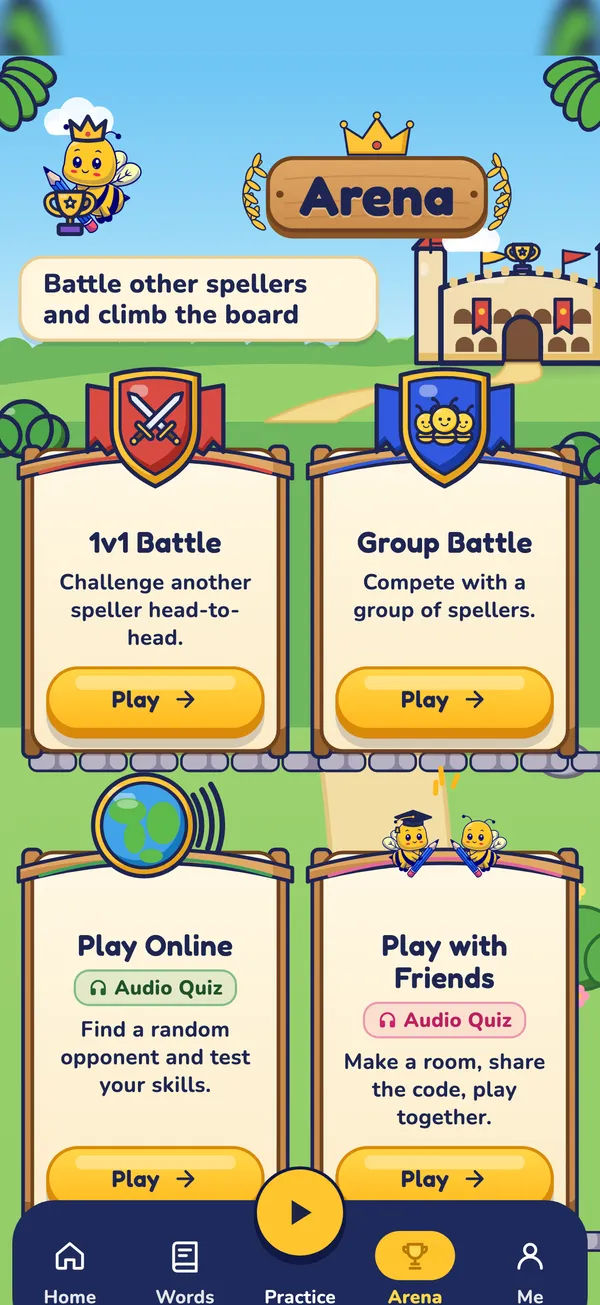
Tap Arena at the bottom, then Play with Friends.
What you should see: The room screen opens.
Arena: Group Battle and Play with Friends start group rooms. (sample data)
3
Create the room
Tap Create Room. Under Quiz topic, choose a level and a skill, or Mix it up; choose the Entry coins; tap Create Room.
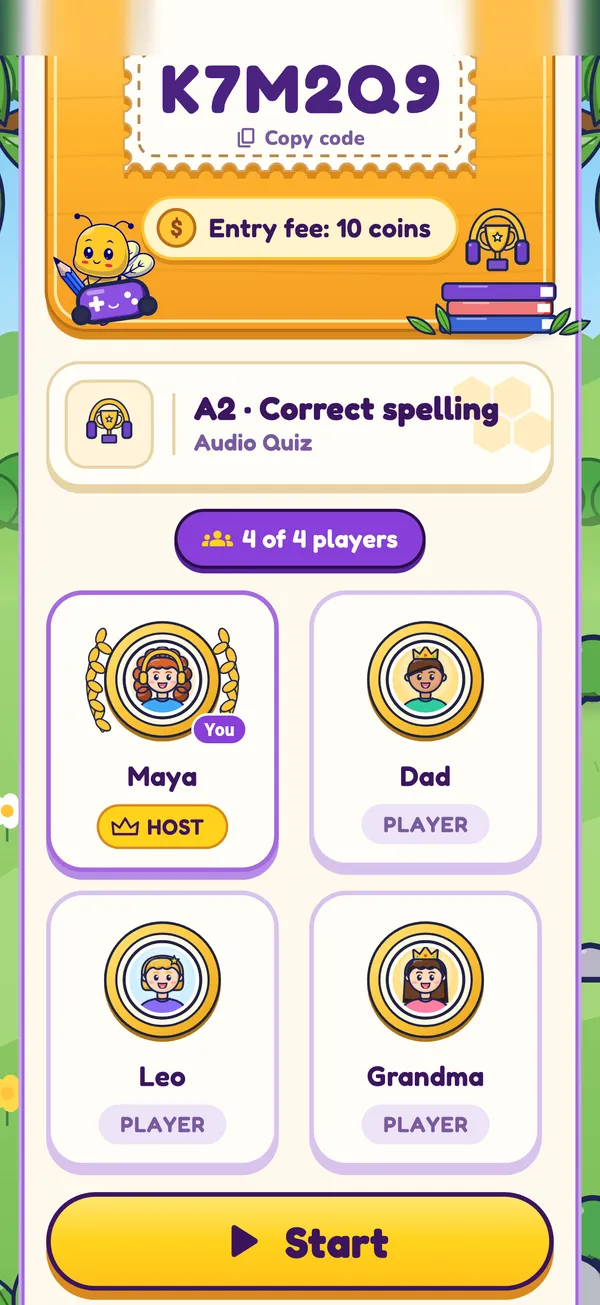
What you should see: The lobby shows a 6-digit room code.
4
Share the code
Copy the code, share it from the phone, or write it on the board.
What you should see: Players appear in the lobby as they join (up to 4).
A room lobby: share the code, wait for players, then Start. Real codes are digits. (sample data)
5
Start
When at least one other player has joined, the host taps Start.
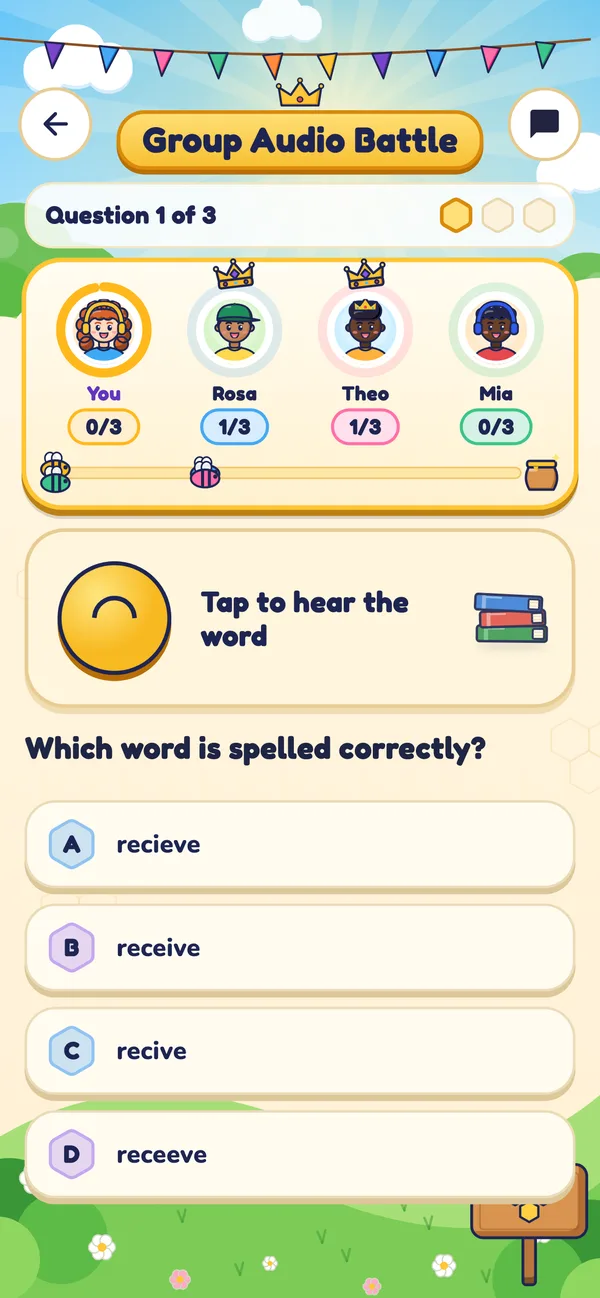
What you should see: Everyone hears the same words and chooses a spelling.
Audio rooms: players hear the word, then choose the spelling. (sample data)
6
Results and review
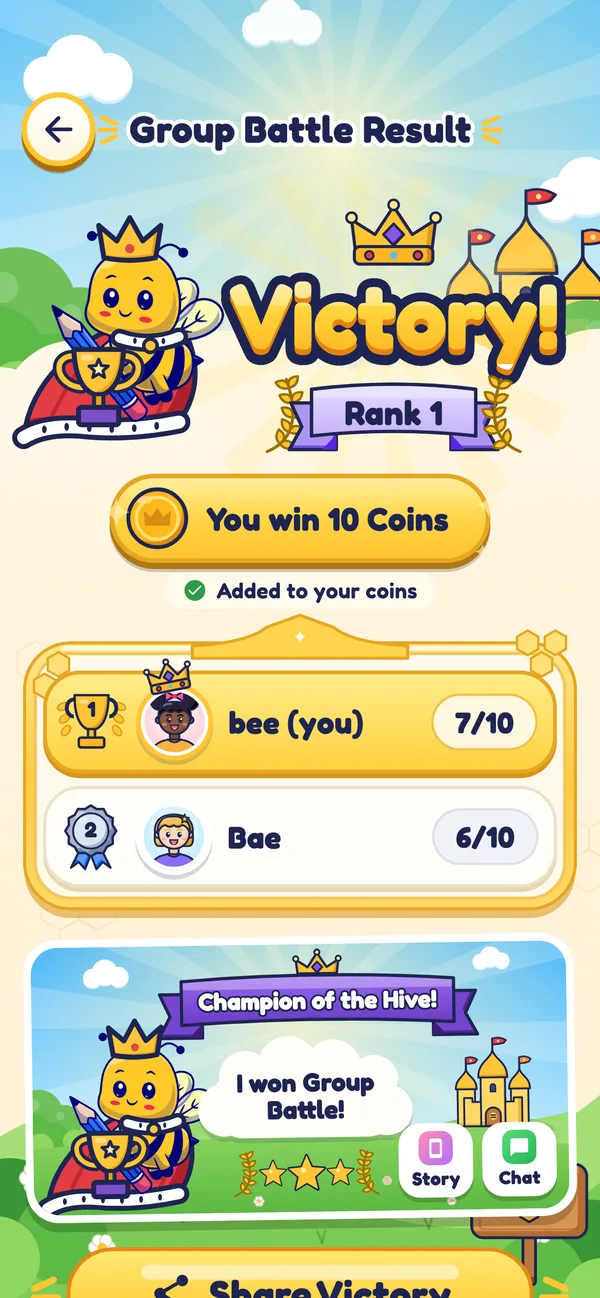
The result screen ranks players. Note scores yourself if you want a class record, then go over the words people missed.
What you should see: Rooms are not saved afterwards.
The result screen ranks players by correct answers. (sample data)
Student guide: how to join
1
Install Spelling Better and sign in
Every player installs Spelling Better (iPhone, iPad and Android phones and tablets) and signs in with their own account: email, Google, phone, or Apple on iPhone and iPad.
What you should see: Each player sees the app's Home screen with the tabs at the bottom.
2
Join the room
Tap Arena, then Play with Friends, then Join Room. In Join a Friend's Room, type the 6-digit code in Room code (or Paste code).
What you should see: The player appears in the host's lobby and waits for Start.
Checked against Spelling Better 2.3.6 (73) and the live website on 28 November 2026. Screens marked “sample data” show example players and questions.
Whole class on one screen instead: the free Spelling Bee Host
Best for: A whole class on one screen, from kindergarten up. Free, no accounts, no student devices.
Players: 2–60 spellers on one screen
Devices: Any computer, laptop or interactive whiteboard with a modern browser and speakers
Cost: Free. No sign-up.
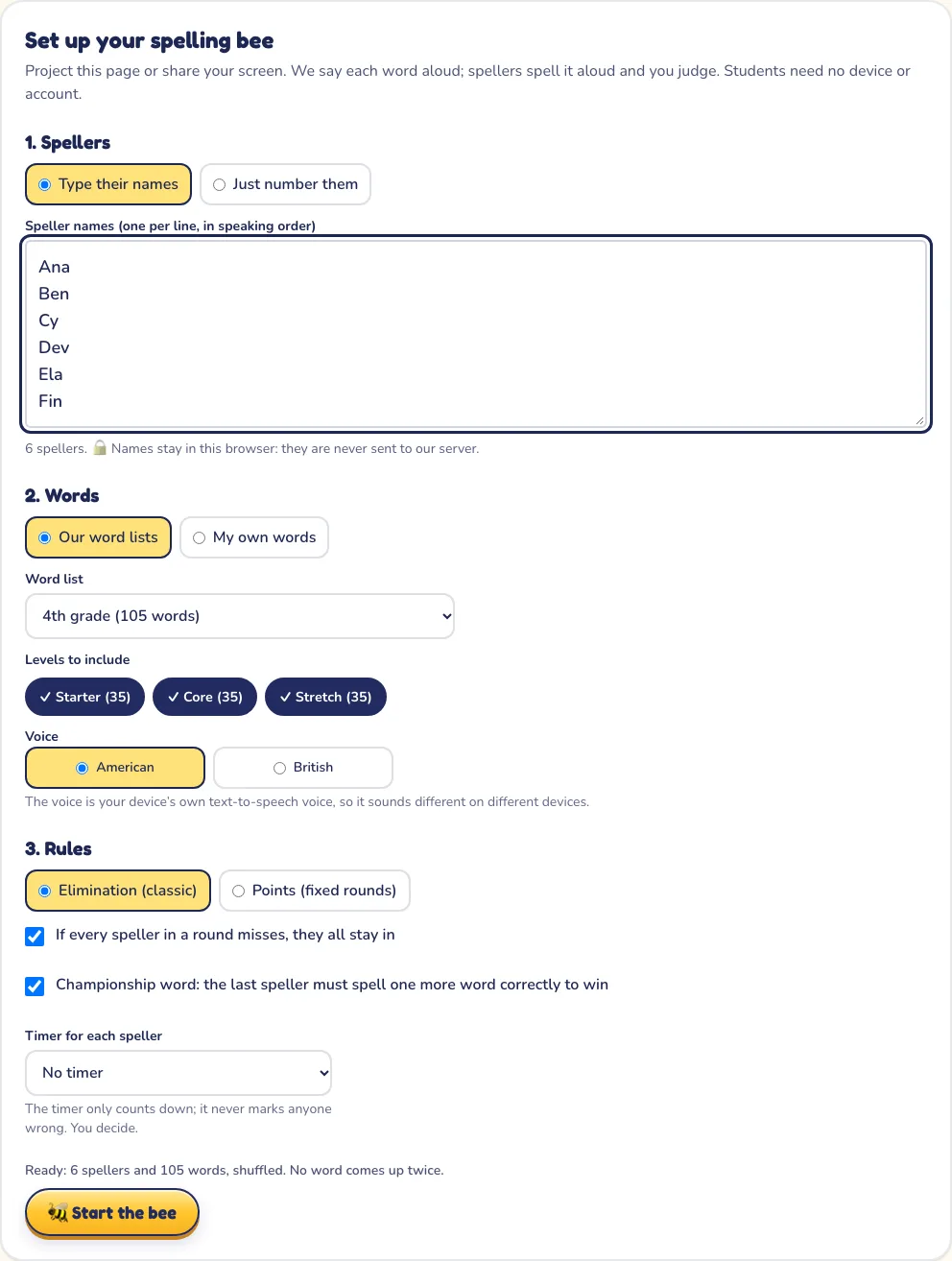
Settings you can choose: Speller names, or just a number of spellers; A word list by grade (1st–8th grade, plus harder and adult lists) or your own words; American or British device voice; Format: Elimination (classic) or Points (fixed rounds); optional answer timer.
1
Open the Spelling Bee Host
On the classroom computer, open the Spelling Bee Host page. Connect speakers or the board's sound.
What you should see: The setup form appears.
2
Add spellers and words
Type speller names (one per line) or choose Just number them. Under Words, pick a grade list or paste this week's words.
What you should see: The form says how many spellers and words are ready.
Setting up a bee: names, a word list and the format.
3
Start the bee
Press Start the bee. Explain the rules: listen, ask for the definition or a sentence if needed, then spell aloud.
What you should see: The first speller's name appears with the round number.
4
Run each turn
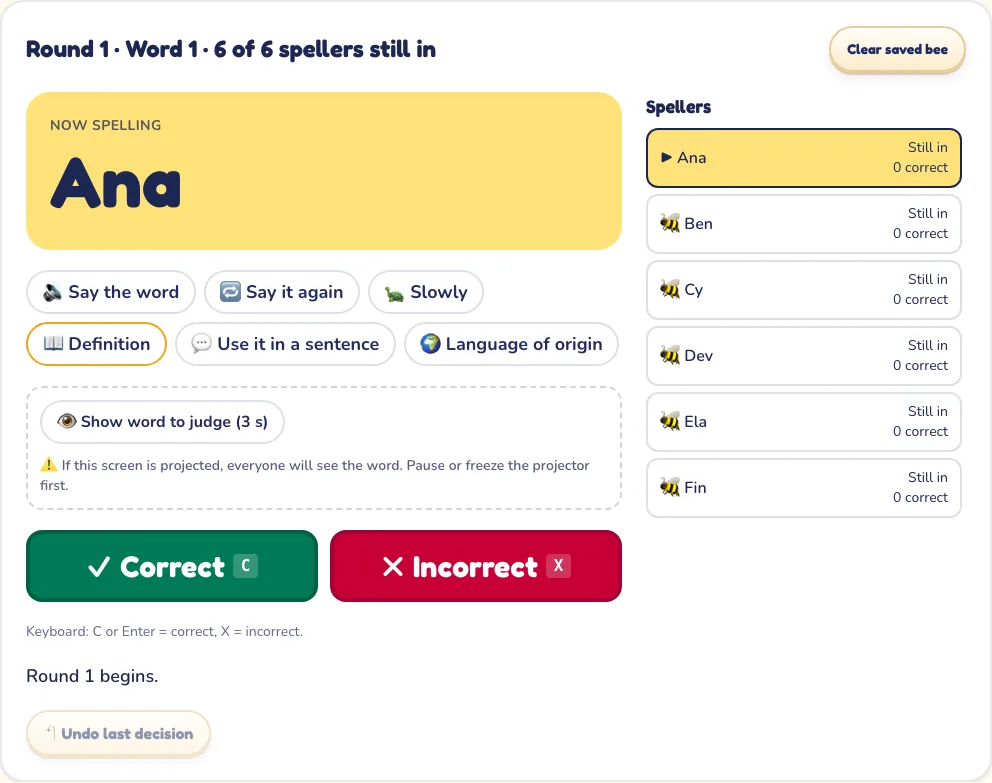
Press Say the word (and Definition, Use it in a sentence or Slowly when asked). Listen to the speller, then press Correct or Incorrect (keys C and X).
What you should see: The Host moves to the next speller and keeps track of who is still in.
A round in progress: the device says the word; you mark Correct or Incorrect.
5
Finish and review
When one speller is left (or after the points rounds), the Host shows the winner. Press Print results for the words used and missed.
What you should see: A printable results sheet to review difficult words with the class.
Good to know
Runs on one screen; students do not play on their own devices.
The voice is the device's text-to-speech: check unusual words first.
Names stay in your browser; nothing is saved by us.
If something goes wrong
No sound
Check the device volume and the board's audio; try another browser (voices differ by device).
A word sounds wrong
Use Say it again or Slowly, or read the word yourself; remove it from your list next time.
The projector shows the word
Freeze the projector before pressing Show word to judge.
Checked against Spelling Better 2.3.6 (73) and the live website on 28 November 2026. Screens marked “sample data” show example players and questions.
Free printable Grade 7 worksheets
Real worksheets made from this page's weekly lists, each with an answer key. Preview, print or save as PDF, or open one in its tool to change the words.
Character Suffixes: Look, Cover, Write and Missing Letters
After the missing letters, ask students to circle each suffix and write the base word beside it.
Character Suffixes: Look, Cover, Write and Missing Letters
Students who have the Spelling Better app can keep practising spelling and vocabulary with its quizzes and word games at home. This is optional extra practice: the app uses its own word lists, not the words from this lesson.
Made with the free lesson plan generator at spellingbetter.com. A template-based starting point: change anything that does not suit your class.
-able or -ible? Patterns, Practice and a Room Rotation
55 minutes · Students learn patterns for -able and -ible, practise in a team wager game and rotate through paper stations, with an optional supervised app room for one small group.
-able or -ible? Patterns, Practice and a Room Rotation
Students learn patterns for -able and -ible, practise in a team wager game and rotate through paper stations, with an optional supervised app room for one small group.
Objectives
By the end of the lesson, students should be able to:
Use the whole-word pattern to predict -able or -ible.
Spell at least ten of the Week 4 words correctly.
Explain the spelling of one exception.
Materials
Week 4 word list
Mini whiteboards
Printed word scramble and bingo sheets
Optional: up to 4 devices with the Spelling Better app, each signed in to its own student account
Target words
reliable
adjustable
noticeable
comfortable
valuable
sustainable
inevitable
visible
flexible
incredible
responsible
legible
accessible
irresistible
Timing
Time
Stage
Minutes
0–5 min
Endings sort
5
5–15 min
The whole-word clue
10
15–27 min
-able or -ible Wager
12
27–45 min
Station rotation
18
45–52 min
Ten-word check
7
52–55 min
My memory trick
3
Whole lesson
55
Lesson stages
1. Endings sort5 min (0–5 min)
Activate what students already know.
Write comfortable, visible, valuable and flexible on the board.
Ask: what do you notice about what is left when you cover the ending?
2. The whole-word clue10 min (5–15 min)
Teach the main pattern and its exceptions.
Show that adjust, comfort and sustain are whole words, so they take -able.
Show that vis and cred are not whole words, so they take -ible; the leg in legible is a Latin root meaning read, not the word leg.
Point out exceptions: flex, access and resist are whole words but take -ible (flexible, accessible, irresistible), and inevitable takes -able. Valuable drops the e from value.
3. -able or -ible Wager12 min (15–27 min)
Practise choosing endings in teams.
Teams start with 10 points and wager on each word.
Play eight words from the list.
After each word, the winning team explains its thinking.
Station 1: word scramble sheet. Station 2: bingo with a partner calling meanings. Station 3: write an invention pitch using five list words.
Optional Station 4, only if devices and accounts are ready: one supervised group of 2–4 plays an Audio Quiz room in the Spelling Better app (rooms cost in-app coins; the host plays too).
Rotate every six minutes, covering three stations.
Tip: Station 4 is optional; the lesson works fully with the paper stations alone.
5. Ten-word check7 min (45–52 min)
Check spelling of the list.
Read ten words aloud in sentences.
Students write them, then swap and mark with a partner.
6. My memory trick3 min (52–55 min)
Make the patterns stick.
Each student writes one memory trick for a word they missed.
Share two tricks with the class.
Differentiation
Support: Give students the list with the ending missing and ask them to choose -able or -ible before writing the whole word.
Stretch: Students find five more -ible words and test whether the whole-word pattern works for each.
Assessment
The ten-word check shows which words need another week of practice; note any student who chose the wrong ending more than three times.
Homework
Write an advert for an imaginary invention that uses at least six Week 4 words, spelled correctly.
Students who have the Spelling Better app can keep practising spelling and vocabulary with its quizzes and word games at home. This is optional extra practice: the app uses its own word lists, not the words from this lesson.
Made with the free lesson plan generator at spellingbetter.com. A template-based starting point: change anything that does not suit your class.
Write a profile of a character from a book or film using at least five Week 1 words. For each word, add a reason from the story, such as what the character did that shows they are courageous.
Figurative language at home
family · about 15 min
Ask an adult at home for an idiom or saying they use often. Write it down, explain its literal and figurative meanings, and say which figure of speech it is if it is a simile, metaphor or hyperbole.
Listen and type
online · about 10 min
Paste this week's words into the spelling test generator on spellingbetter.com and take the read-aloud test. Write your score and the words you missed on your homework sheet, then practise those words three times.
Complete the printed shades of meaning sheet, then choose two clue words and write a sentence for each that shows whether the word is positive or negative.
Draw an invention that would make your weekend easier. Label it with at least six -able or -ible words, such as adjustable or flexible, and check every spelling.
Students who have the Spelling Better app can do extra practice with its spelling quizzes, vocabulary quizzes, flashcards and word games. The app uses its own word lists and does not report back to teachers.
A week of English practice for 7th grade
A five-day routine that works with any of the four lists: meet the words, find the pattern, play with them, use them in writing and finish with a Friday check.
Monday20 min
Meet the list
Read the list together, discuss meanings and mark the pattern in each word (the suffix, the ending or the positive or negative feeling).
Tuesday15 min
Pattern practice
Complete a look, cover, write, check or missing letters sheet and write a rule for the pattern in your own words.
Write a short paragraph (a character description, a poem or an invention pitch) that uses at least six list words. A partner checks the spelling.
Friday20 min
Spelling Bee Host check
Run a short team bee in the free Spelling Bee Host with this week's list pasted in (enter 4–6 teams as spellers and choose two points rounds), or give a ten-word written check.
☐ I know what every word on this week's list means.
☐ I can explain the spelling pattern for this week.
☐ I can spell at least ten of the words without looking.
☐ I used six list words in my own writing.
☐ I have a memory trick for my hardest word.
spellingbetter.com/for-teachers/grades/
Grade 7 teacher questions
What should 7th grade vocabulary practice focus on?
By seventh grade, many students are ready to look at how words are built and how they are used. These lists cover suffixes that change a word's job, the language of figurative writing, words with positive or negative shades of meaning and the -able/-ible spelling choice. Choose easier or harder lists to fit your class rather than going by grade alone.
Is there a longer 7th grade spelling list?
Yes. The 7th grade spelling words page (/7th-grade-spelling-words/) has a longer list you can use for practice and bees. The weekly lists here are shorter and grouped by one focus, which makes them easier to teach in a week.
How can I teach figurative language so students remember the terms?
Start with everyday sayings students already use, then name what they are doing. Sorting games like Figurative or Literal? Fact Check and the Poetry Device Hunt give lots of practice, and asking students to rewrite a figure of speech in plain English shows quickly whether they understand it.
Is there a rule for -able and -ible?
There is a useful pattern rather than a strict rule: if the part before the ending is a whole word (adjust, comfort), the ending is usually -able; if it is not a whole word (vis, cred), it is often -ible. There are exceptions, such as flexible and accessible (flex and access are whole words), so students should still learn the common words by heart.
Can my 7th grade class play together in the Spelling Better app?
Only in small groups. The app's Group Battle and Audio Quiz rooms hold 2–4 players including the host, each on their own phone or tablet with the app and their own account, joined with a 6-digit code, and rooms cost in-app coins. For the whole class at once, use the free browser Spelling Bee Host on one projected screen.
What's the difference between connotation and the dictionary meaning?
The dictionary meaning, sometimes called denotation, is what a word refers to; connotation is the feeling it carries. Thrifty and stingy both describe someone who does not like to spend much, but thrifty sounds like praise and stingy sounds like a complaint. The confusing words page (/confusing-words/) is a handy place to explore more word pairs.
Continue practising with Spelling Better
Students can practise spelling and vocabulary at their own level in the app, on their own phone or tablet.
Spelling Better is free to download for iPhone, iPad and Android. Group rooms use in-app coins. Premium is free for everyone until 31 December 2026.