6th Grade Vocabulary Games, Word Root Activities and English Worksheets
Four weekly word lists for sixth graders, from everyday prefixes to the academic words they meet in essays and science, with six classroom games, ready-to-print worksheets, two full lesson plans and a free whole-class spelling bee you can run from one screen.
Children in 6th grade are usually 11–12 years old; in England and Wales this is often Year 7, and in many other countries Grade 6 or the first year of middle or secondary school. Every class is different: use an easier or harder grade’s lists whenever they fit your students better.
What 6th grade students can practise
Prefixes
Spell and explain words built with pre-, mis-, dis-, re-, inter- and sub-, and say how the prefix changes the meaning of the base word.
Latin roots
Recognize the roots spect (look), aud (hear), ject (throw) and tract (pull) inside longer words and use them to make a sensible guess at meaning.
Greek roots
Spell science and technology words that use bio, graph, tele, micro, geo and therm, and explain each word from its parts.
Academic vocabulary
Use words such as argument, source, sequence and relevant correctly when answering questions about texts and experiments.
Context clues
Work out the meaning of an unfamiliar word from the sentence around it, naming the clue used (a definition, an example or a contrast).
Spelling accuracy
Keep the spelling of the base word when a prefix is added (mis + spell keeps both s letters) and check longer words syllable by syllable.
Spelling patterns and word study: prefixes pre-, mis-, dis-, re-, inter-, sub- · Latin roots spect, aud, ject, tract · Greek roots bio, graph, tele, micro, geo · -ology for subjects of study · academic words for explaining · context clues.
These are suggested focus areas for this age, not an official curriculum. Adapt them to your own scheme of work.
Classroom games and activities for 6th grade
Teacher-led activities with full rules and an example round. None of them needs the app.
Prefix Flip
10–15 min · whole-class, individual · On-level and above; easy to scale down with familiar base words
Objective: Students change the meaning of a sentence by swapping or adding a prefix, then spell the new word correctly.
You need
Mini whiteboards or scrap paper
A list of sentences with prefixed words (from Week 1)
Before you start
Write eight short sentences that each use one Week 1 word or its base word, for example 'We agree with the plan.'
Decide the target flip for each sentence (agree → disagree, place → misplace, arrange → rearrange).
How to play
Read a sentence aloud twice.
Students write the one word that would flip or change the meaning when a prefix is added or swapped.
On 'Flip!', everyone holds up their board.
Choose one student to say the new sentence aloud and explain the prefix's meaning.
Reveal the spelling; students tick or correct their own board.
Keep a class tally of correct flips and try to beat it next week.
Example round: Teacher: "The coach will judge the distance carefully." Students write misjudge and read the new sentence: "The coach will misjudge the distance." Next: "Please connect the charger." Boards show disconnect. A student explains: "dis- means undo, so disconnect is the opposite of connect."
Easier: Give a choice of two prefixes on the board for each sentence (dis- or re-) so students only have to choose and spell. Harder: Ask for two different flips of the same base word (arrange: rearrange, prearrange) and a sentence for each.
25–35 min · small-group, whole-class · Mixed-ability groups sharing one exhibit
Objective: Small groups design a museum 'exhibit' for one root; classmates visit and work out the root's meaning from the words on display.
You need
Large paper or card for each group
Markers
Sticky notes for visitors
Before you start
Choose one root per group from Weeks 2 and 3: spect, aud, ject, tract, bio, graph, micro, geo.
Give each group a card with its root but not its meaning.
How to play
Each group has 12 minutes to find at least four real words that use their root, spell them in large letters and draw a small picture for each.
Groups must not write the root's meaning anywhere on the exhibit.
Groups rotate around the room. At each exhibit, they write their guess of the root's meaning on a sticky note.
Back at their own exhibit, groups read the guesses and reveal the true meaning.
Score one point for every visitor who guessed correctly: a good exhibit makes the meaning obvious.
Example round: The 'tract' group shows attract (a magnet pulling paper clips), distract (a phone pulling eyes away from a book), subtract (apples taken away from a basket) and tractor (a tractor pulling a plow). Visitors write "pull" or "drag". Five visiting groups guess correctly, so the group scores five points.
Easier: Give each group a starter word bank of six words with the root, to choose from and illustrate. Harder: Groups must include one word not on any weekly list and explain how its meaning comes from the root.
10–20 min · whole-class, individual · On-level readers, and students who tend to skip hard words
Objective: Students work out an unfamiliar word's meaning from a sentence and signal which kind of clue helped them.
You need
Three signal cards per student: D (definition), E (example), C (contrast)
Prepared sentences on a slide
Before you start
Write six sentences, each using one Week 4 word with a clear clue, for example a contrast clue: 'Unlike the angry blog post, the news report was objective.'
Hide the target word's meaning until after the vote.
How to play
Show one sentence and read it aloud.
Students hold up D, E or C to show the clue type they found.
Ask two students with different cards to explain their choice.
Students write a one-line meaning in their own words, then compare with the class meaning.
Finish each sentence by spelling the target word together, syllable by syllable.
Example round: Slide: "Write the steps of the experiment in sequence, the order in which you did them." Most students hold up D (the definition follows the comma). Meaning written: "the order things happen in". Class spells se-quence. Next slide uses a contrast clue for objective.
Easier: Use only definition clues for the first three sentences, then add examples. Harder: Students write their own clue sentence for a list word and challenge the class to name the clue type.
Make sure each part's true meaning appears on a different domino so the chain can loop.
How to play
Pairs share the dominoes face up and start with any piece.
A domino can be added only where its part matches the meaning on the open end of the chain.
Before placing a domino, the pair writes one real word that uses that part (for example spect: inspect).
If the word is misspelled, the domino goes back until they fix the spelling.
The first pair to join all 12 into a loop raises their hands; the class checks their word sheet.
Example round: The open end says "look". The pair finds [spect | throw], writes spectator, and places it. The open end now says "throw", so they look for ject and write reject. Later, [geo | heat] needs a geo word: they write geology.
Easier: Use six dominoes and allow the weekly lists on the desk. Harder: Students may not reuse any word from the weekly lists, so they must find new words with each part.
15–25 min · team · Confident speakers; pair quieter students as a team of two
Objective: Teams describe academic words without using the word itself or two banned clue words, building precise explanations.
You need
Taboo cards: the target word plus two forbidden words
A one-minute timer
Before you start
Make a card for each Week 4 word, for example: paraphrase (forbidden: words, own).
Split the class into two or three teams.
How to play
One player from the team takes a card and has one minute to get their team to say the word.
They may not say the word, any part of it, or the two forbidden words. Gestures are not allowed.
When the team says the word, every member writes it; one point if the speller chosen by the other team spells it correctly.
A forbidden word means the card is put aside with no point.
Teams take turns until every card has been used once.
Example round: Card: consequence (forbidden: result, because). The speaker says: "If you leave your bike out in the rain, a rusty chain is this." Team answers "consequence". The other team picks Maya to spell it: C-O-N-S-E-Q-U-E-N-C-E. One point.
Easier: Drop to one forbidden word and allow the speaker to give the first letter. Harder: Add a third forbidden word and ask the team to use the word in a sentence about a real lesson.
20–30 min · whole-class, individual · All levels in one room; use the easier lists for warm-up rounds
Objective: A whole-class oral spelling bee where each speller also names the root or prefix inside their word for a bonus point.
You need
One teacher device with the free Spelling Bee Host on the projector
Speakers if the room is large
Score sheet
Before you start
Open the Spelling Bee Host, paste the 41 words from Weeks 1–3 and choose Points with one round (the Host needs one word per speller per round, so this covers up to 41 spellers). For Elimination, choose the 6th grade list instead: it needs three words per speller.
Agree the bonus rule: after spelling, the speller names one word part and its meaning.
How to play
The Host reads each word aloud; the speller may ask for the meaning or a sentence (read it from the weekly list if the Host has none).
The speller spells the word aloud. The teacher marks it right or wrong in the Host.
After a correct spelling, the speller can earn a bonus by naming the root or prefix and its meaning (for example tract: pull).
Bonus points are kept on the score sheet; they break ties at the end.
Play until the Host's rounds finish or time runs out.
Example round: The Host reads "spectator". Leo spells S-P-E-C-T-A-T-O-R and is marked correct. He adds: "spect means look." Bonus point. Next, Amira gets "microscope", spells it correctly and names micro (small) and scope (look): one bonus point, because only one bonus is given per word.
Easier: Use only the Week 1 prefix words and accept the prefix alone as the bonus. Harder: Bonus only counts if the speller also names a second word with the same root.
Read-aloud tests by grade; the device says each word.
Grade 6 spelling and vocabulary words, week by week
Four original weekly lists with meanings and example sentences. Copy or print a list, or turn it into a worksheet, flashcards or a read-aloud spelling test in one click.
Objective: Students spell words with common prefixes and explain how each prefix changes the meaning of the base word.
Week 1: Prefixes that change the meaning: words, meanings and example sentences
Word
Meaning
Example
Listen
previewverb · pre- (before)
To look at something before it starts or before you see all of it.
Let's preview the chapter headings before we start reading.
precautionnoun · pre- (before)
Something you do ahead of time to stay safe or avoid trouble.
As a precaution, we packed extra water for the hike.
predictverb · pre- (before)
To say what you think will happen, before it happens.
Can you predict how the story will end?
misjudgeverb · mis- (wrongly)
To make a wrong guess or form a wrong opinion about something.
It is easy to misjudge how long a project will take.
misplaceverb · mis- (wrongly)
To put something down somewhere and then forget where it is.
If you misplace your library card, ask at the front desk.
disagreeverb · dis- (not)
To have a different opinion from someone else.
It is fine to disagree as long as you explain your reasons.
disconnectverb · dis- (not, undo)
To unplug something or break the link between two things.
Please disconnect the charger before you pack the laptop away.
dishonestadjective · dis- (not)
Not telling the truth; not fair or sincere.
Copying a friend's answers is dishonest.
rearrangeverb · re- (again)
To put things in a different order or position.
We will rearrange the desks into groups of four.
reconsiderverb · re- (again)
To think again about a decision and perhaps change it.
After hearing the facts, the class agreed to reconsider the plan.
interactverb · inter- (between)
To talk, play or work together with other people or things.
Visitors can interact with the robots at the science museum.
intermissionnoun · inter- (between)
A short break in the middle of a play, concert or show.
We bought juice during the intermission of the school play.
internationaladjective · inter- (between)
Involving two or more countries.
Our school held an international food fair with dishes from twelve countries.
subheadingnoun · sub- (under)
A smaller title under a main title that tells you what the next part is about.
Each subheading tells you what the next paragraph is about.
Practice ideas
Cover the prefix: show only the base word (judge, place, agree) and ask students to add a prefix and say the new meaning in a full sentence.
Sort the 14 words into a table by prefix, then add one more word of your own to each column and check it in a dictionary.
Spot the double letters: misspell, dissatisfied and interrupt keep every letter of both parts. Students circle where the prefix ends and the base word begins.
Partner quiz: one partner reads a definition aloud, the other writes the word without looking, then they swap.
Week 2 · Latin roots spect, aud, ject, tract
Week 2: Latin roots that look, hear, throw and pull
Objective: Students use the Latin roots spect, aud, ject and tract to spell longer words and work out their meanings.
Week 2: Latin roots that look, hear, throw and pull: words, meanings and example sentences
Word
Meaning
Example
Listen
inspectverb · spect (look)
To look at something closely to check that it is right or safe.
The coach will inspect our helmets before the game.
spectatornoun · spect (look)
A person who watches an event such as a game or race.
Every spectator cheered when the runner crossed the line.
perspectivenoun · spect (look)
A way of seeing or thinking about something.
Reading the diary gave me a new perspective on the story.
respectfuladjective · spect (look)
Showing that you care about other people's feelings and ideas.
Be respectful when someone else is speaking.
audiencenoun · aud (hear)
The people who watch or listen to a show, talk or game.
The audience clapped when the curtain opened.
audibleadjective · aud (hear) + -ible
Loud enough to be heard.
Her whisper was barely audible from the back row.
auditionnoun · aud (hear)
A short performance that shows your skills when you try out for a play, band or choir.
I have an audition for the school musical on Friday.
auditoriumnoun · aud (hear) + -orium (place)
A large room or building where people sit to watch or listen to a performance.
The whole school met in the auditorium for the assembly.
rejectverb · ject (throw)
To refuse to accept, use or agree to something.
The vending machine will reject a coin that is bent.
projectornoun · ject (throw)
A machine that shines pictures or videos onto a screen or wall.
Our teacher used the projector to show a video about volcanoes.
trajectorynoun · ject (throw)
The curved path that an object follows as it flies through the air.
We measured the trajectory of the paper rocket as it flew across the field.
attractverb · tract (pull)
To pull something toward itself, or to make people want to come closer.
A magnet will attract iron paper clips.
distractverb · tract (pull)
To pull someone's attention away from what they are doing.
A buzzing phone can distract you while you read.
subtractverb · tract (pull)
To take one number away from another.
If you subtract 4 from 10, you get 6.
Practice ideas
Root sort: write the four roots as column headings and have students place each word, then underline the root inside it.
Root guessing: give a word that is not on the list, such as spectacles, auditory or tractor, and ask students to guess the meaning from the root before checking.
Write a three-sentence review of a school show or match that uses at least five of the words, then swap reviews and circle every root a partner used.
Look up one of the roots on the Spelling Better word roots page and find two more words that use it.
Week 3 · Greek roots bio, graph, tele, micro, geo
Week 3: Greek roots in science and technology
Objective: Students spell science and technology words built from Greek roots and explain each word from the meaning of its parts.
Week 3: Greek roots in science and technology: words, meanings and example sentences
Word
Meaning
Example
Listen
biologynoun · bio (life) + logy (study)
The study of living things such as plants, animals and people.
In biology we looked at onion cells.
biographynoun · bio (life) + graph (write)
A true story of a person's life, written by someone else.
I read a biography of a scientist who studied chimpanzees.
autographnoun · auto (self) + graph (write)
A famous person's name, written by that person in their own handwriting.
The author signed an autograph inside my book.
paragraphnoun · graph (write)
A group of sentences about one main idea, starting on a new line.
Start a new paragraph when you change topic.
photographnoun · photo (light) + graph (write)
A picture made with a camera.
Grandma keeps an old photograph of her school class.
telescopenoun · tele (far) + scope (look)
A tube-shaped tool that makes faraway things look closer and bigger.
Through the telescope we could see craters on the Moon.
microscopenoun · micro (small) + scope (look)
A tool that makes very tiny things look large enough to study.
We used a microscope to look at a drop of pond water.
microphonenoun · micro (small) + phone (sound)
A device that picks up sound so it can be made louder or recorded.
Speak clearly into the microphone so everyone can hear.
geographynoun · geo (earth) + graph (write)
The study of the Earth's land, seas, weather and people.
In geography we labeled the longest rivers on a map.
geologynoun · geo (earth) + logy (study)
The study of rocks and how the Earth was formed and changes.
Geology helps us understand how mountains form.
thermometernoun · therm (heat) + meter (measure)
A tool that measures how hot or cold something is.
The thermometer showed it was below freezing.
automaticadjective · auto (self)
Working by itself, without a person controlling it each time.
The doors are automatic and open when you walk up to them.
dehydratedadjective · hydr (water)
Having lost too much water from the body.
Drink water on hot days so you don't get dehydrated.
Practice ideas
Word equations: write bio + graph + y on the board and ask students to build the word and its meaning; repeat with geo, tele and micro.
Invent-a-word challenge: students combine two roots into a new word (for example 'thermoscope') and write a meaning for it. Remind them it is invented, then compare it with real words.
Science label hunt: find three of the words on classroom posters, in a science book or on equipment, and copy the sentence where each one appears.
Timed look, cover, write, check with five of the longest words: thermometer, microphone, photograph, microscope, biography.
Week 4 · Academic vocabulary for evidence and explanation
Week 4: Academic words for explaining and arguing
Objective: Students spell and use academic words that appear in questions, essays and science reports, and explain them in their own words.
Week 4: Academic words for explaining and arguing: words, meanings and example sentences
Word
Meaning
Example
Listen
argumentnoun · argue drops the e
A reason or set of reasons given to show that an idea is right or wrong.
Her argument for a longer recess used three clear reasons.
sourcenoun · ou, soft c
A book, website, person or place where information comes from.
Write down the source of every fact you use in your report.
factornoun · -or
One of the things that helps to cause a result.
Sunlight is one factor that helps plants grow.
sequencenoun · -ence
The order in which things happen or are arranged.
Put the pictures in the right sequence to retell the story.
significantadjective · -ant
Important, or large enough to be noticed.
There was a significant drop in temperature overnight.
categorynoun · -ory
A group of things that share the same features.
Sort each animal into the right category: mammal, bird or reptile.
approximatelyadverb · double p
Close to an exact number or amount, but not exactly.
The bus ride to the museum takes approximately forty minutes.
interpretverb · inter-
To explain or decide what something means.
How do you interpret the last line of the poem?
relevantadjective · -ant
Closely connected to the subject you are talking or writing about.
Only include details that are relevant to your topic.
accurateadjective · double c
Correct in every detail, with no mistakes.
Check that your measurements are accurate before you draw the chart.
consequencenoun · -ence
Something that happens because of an action or event.
One consequence of the storm was that the roads flooded.
chronologicaladjective · chron (time) + logy
Arranged in the order in which things happened.
Write the events of the trip in chronological order.
paraphraseverb · ph says f
To say or write someone else's idea again in your own words.
Paraphrase the quote instead of copying it word for word.
persuadeverb · -suade
To get someone to agree with you or do something by giving good reasons.
Can you persuade the class to choose your idea for the trip?
objectiveadjective · -ive
Based on facts rather than on personal feelings or opinions.
A news report should be objective and fair to both sides.
Practice ideas
Question-word hunt: give students a page of past test or textbook questions and ask them to highlight every list word they find and say what the question wants them to do.
Sentence starters: students finish 'My source says…', 'One factor is…' and 'The main argument is…' about a book or experiment from this week.
Pair the opposites: objective and personal opinion, relevant and off-topic, accurate and careless. Students write one sentence for each side.
Run a two-minute 'explain without the word' round: a partner describes interpret or paraphrase without saying it, and the other names and spells it.
Your browser has no speech voice, so the listen buttons are hidden.
Need a longer list? See the full 6th grade spelling words, with a read-aloud test for every level.
Turn these words into a classroom game: paste a week’s list into the free Spelling Bee Host and run a spoken bee on the board, or see how to host a live game below.
How to host live word games for Grade 6 students
Suggested game session for 6th grade
Sixth graders enjoy a public challenge, and the free browser Spelling Bee Host lets the whole class take part from one projected screen while the device reads each word. Nobody needs their own device or account.
Game
Spelling Bee Host (in your browser)
Settings to try
For a bee with every student as a speller, choose the 6th grade list. To review this week's list, paste it and enter 4–6 teams as spellers: the Host needs one word per speller per round (three each in Elimination).
Vocabulary focus
Prefixes and Greek and Latin roots: spellers can ask for the meaning and a sentence, which helps them spot the word parts.
Warm-up
Write three roots on the board (spect, aud, tract) and give the class two minutes to list as many words with them as they can before the bee starts.
Session length
20–30 minutes
Format
Elimination or points rounds with the whole class; students who are out keep score or write each word on a whiteboard to stay involved.
Supervision
The teacher runs the Host and marks each spelling. Words on the site's lists come with a meaning and sentence; for other pasted words, read them from this page. Students need no device.
Afterwards
Collect the words that were missed, paste them into a word scramble or missing-letters sheet and use it as the next morning's starter.
Independent practice
Students can practise at home with the online spelling test on spellingbetter.com, choosing the 6th grade list, or with the spelling test generator and this week's words.
For a small group of 2–4 students, the Spelling Better app's Audio Quiz rooms are an option: each player needs the app on their own phone or tablet and their own account, the host also plays, and rooms cost in-app coins. Try A2 as a starting point and move up if it is too easy.
Session length and grouping are teaching suggestions, not app settings. The app has no grade setting.
Step by step: Spelling Bee Host (in your browser)
Best for: A whole class on one screen, from kindergarten up. Free, no accounts, no student devices.
Players: 2–60 spellers on one screen
Devices: Any computer, laptop or interactive whiteboard with a modern browser and speakers
Cost: Free. No sign-up.
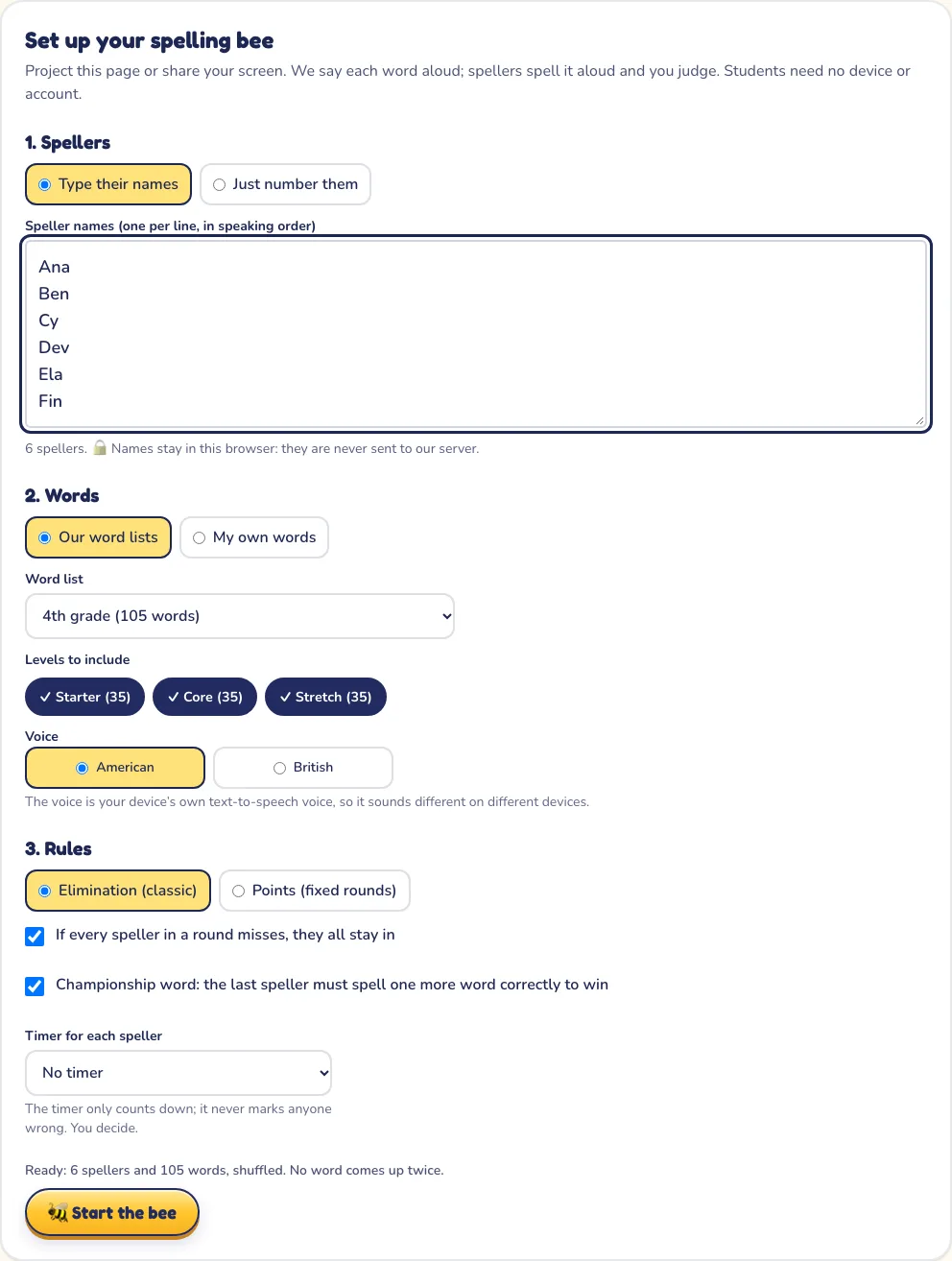
Settings you can choose: Speller names, or just a number of spellers; A word list by grade (1st–8th grade, plus harder and adult lists) or your own words; American or British device voice; Format: Elimination (classic) or Points (fixed rounds); optional answer timer.
1
Open the Spelling Bee Host
On the classroom computer, open the Spelling Bee Host page. Connect speakers or the board's sound.
What you should see: The setup form appears.
2
Add spellers and words
Type speller names (one per line) or choose Just number them. Under Words, pick a grade list or paste this week's words.
What you should see: The form says how many spellers and words are ready.
Setting up a bee: names, a word list and the format.
3
Start the bee
Press Start the bee. Explain the rules: listen, ask for the definition or a sentence if needed, then spell aloud.
What you should see: The first speller's name appears with the round number.
4
Run each turn
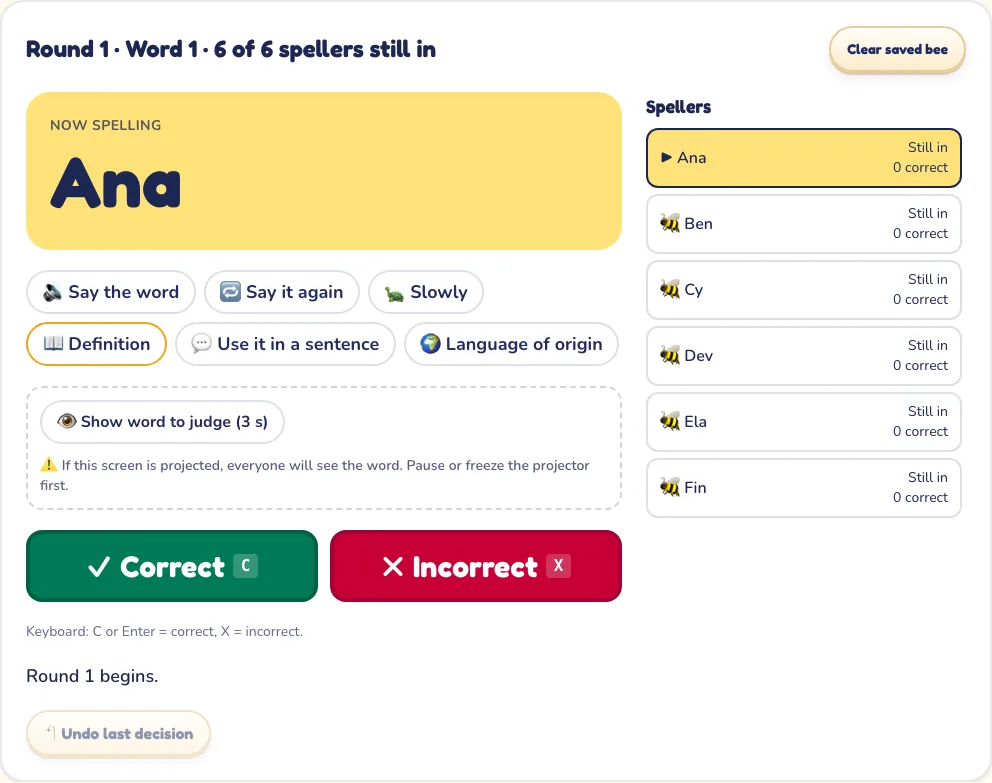
Press Say the word (and Definition, Use it in a sentence or Slowly when asked). Listen to the speller, then press Correct or Incorrect (keys C and X).
What you should see: The Host moves to the next speller and keeps track of who is still in.
A round in progress: the device says the word; you mark Correct or Incorrect.
5
Finish and review
When one speller is left (or after the points rounds), the Host shows the winner. Press Print results for the words used and missed.
What you should see: A printable results sheet to review difficult words with the class.
Good to know
Runs on one screen; students do not play on their own devices.
The voice is the device's text-to-speech: check unusual words first.
Names stay in your browser; nothing is saved by us.
If something goes wrong
No sound
Check the device volume and the board's audio; try another browser (voices differ by device).
A word sounds wrong
Use Say it again or Slowly, or read the word yourself; remove it from your list next time.
The projector shows the word
Freeze the projector before pressing Show word to judge.
Checked against Spelling Better 2.3.6 (73) and the live website on 28 November 2026. Screens marked “sample data” show example players and questions.
Free printable Grade 6 worksheets
Real worksheets made from this page's weekly lists, each with an answer key. Preview, print or save as PDF, or open one in its tool to change the words.
Prefix Words: Missing Letters and Scramble
Ask students to underline the prefix in every word after they finish the missing letters.
Two complete, printable plans built around this page's weekly lists.
Latin Roots: Look, Hear, Throw and Pull
50 minutes · Students discover four Latin roots, sort the Week 2 words by root and use roots to guess the meaning of new words.
Latin Roots: Look, Hear, Throw and Pull
Students discover four Latin roots, sort the Week 2 words by root and use roots to guess the meaning of new words.
Objectives
By the end of the lesson, students should be able to:
Identify the roots spect, aud, ject and tract inside longer words.
Spell at least ten of the Week 2 words correctly.
Use a root to make a sensible guess at an unfamiliar word's meaning.
Materials
Week 2 word list
Root sorting sheet with four columns
Mini whiteboards
Dictionaries or devices for checking
Exit slips
Target words
inspect
spectator
perspective
respectful
audience
audible
audition
auditorium
reject
projector
trajectory
attract
distract
subtract
Timing
Time
Stage
Minutes
0–5 min
What do these words share?
5
5–15 min
Meet the four roots
10
15–25 min
Sort the words together
10
25–37 min
Root guessing challenge
12
37–45 min
Write it right
8
45–48 min
Exit slip
3
48–50 min
Root of the day
2
Whole lesson
50
Lesson stages
1. What do these words share?5 min (0–5 min)
Spark curiosity about word parts.
Write audience, audible and audition on the board.
Ask pairs to find the shared letters and guess what they might mean.
Collect guesses without confirming yet.
2. Meet the four roots10 min (5–15 min)
Teach the meaning of each root with clear examples.
Reveal that aud means hear, then add spect (look), ject (throw) and tract (pull).
For each root, act out one word: cup a hand to your ear (audible), peer through your hands (inspect), mime throwing a ball in an arc (trajectory), pull an imaginary rope (attract).
Students copy the root and meaning into their notebooks.
Tip: Keep the four roots on the board for the whole lesson.
Students who have the Spelling Better app can keep practising spelling and vocabulary with its quizzes and word games at home. This is optional extra practice: the app uses its own word lists, not the words from this lesson.
Made with the free lesson plan generator at spellingbetter.com. A template-based starting point: change anything that does not suit your class.
Academic Words in Action, with a Spelling Bee Finish
55 minutes · Students learn the Week 4 academic words through question analysis and context clues, then review them in a short whole-class spelling bee.
Academic Words in Action, with a Spelling Bee Finish
Students learn the Week 4 academic words through question analysis and context clues, then review them in a short whole-class spelling bee.
Objectives
By the end of the lesson, students should be able to:
Explain what interpret, paraphrase and persuade ask a reader or writer to do.
Use at least three Week 4 words correctly in written sentences.
Spell the Week 4 words aloud in a spelling bee.
Materials
Week 4 word list
Sample test questions
Mini whiteboards
Teacher device with the free Spelling Bee Host
Projector or large screen
Target words
argument
source
factor
sequence
significant
category
approximately
interpret
relevant
accurate
consequence
chronological
paraphrase
persuade
objective
Timing
Time
Stage
Minutes
0–5 min
Question detectives
5
5–15 min
Words that give instructions
10
15–23 min
Context clue check
8
23–38 min
Spelling Bee Host review
15
38–50 min
Use them in writing
12
50–55 min
Three to remember
5
Whole lesson
55
Lesson stages
1. Question detectives5 min (0–5 min)
Show that these words appear in real questions.
Display three questions: 'Interpret the graph…', 'Paraphrase the second paragraph…', 'Put the events in chronological order…'
Ask: what is each question asking you to do?
2. Words that give instructions10 min (5–15 min)
Teach the meaning and spelling of the Week 4 words.
Go through the 15 words with their meanings, grouping them into 'words that tell you what to do' and 'words that describe information'.
Point out the -ence and -ant endings in sequence, consequence, significant and relevant.
Note the double p in approximately and the double c in accurate.
3. Context clue check8 min (15–23 min)
Practise working out meaning from sentences.
Show four sentences with a list word and a clear clue.
Students write the meaning on whiteboards and name the clue type.
Discuss any that were tricky.
4. Spelling Bee Host review15 min (23–38 min)
Review spelling aloud in a whole-class game.
Open the Spelling Bee Host, paste the 15 Week 4 words and enter five teams as the spellers (the Host needs one word per speller per round, so this covers three points rounds).
Run three points rounds: the Host reads each word; team members take turns as the speller, who may ask for the meaning or a sentence.
Students waiting their turn write every word on whiteboards and check against the speller.
Tip: Use points rather than elimination so everyone keeps spelling.
Students who have the Spelling Better app can keep practising spelling and vocabulary with its quizzes and word games at home. This is optional extra practice: the app uses its own word lists, not the words from this lesson.
Made with the free lesson plan generator at spellingbetter.com. A template-based starting point: change anything that does not suit your class.
With someone at home, look at food packaging, signs or a newspaper and find three words that contain a Latin or Greek root from this week (spect, aud, ject, tract, bio, graph, tele, micro, geo). Write each word and its root, and explain one to your helper.
Paste this week's words into the spelling test generator, listen to each word and type it. Write your score and the words you missed in your planner and bring the list to class.
Draw a four-panel comic in which a character misplaces something, disagrees with a friend and has to reconsider. Use at least five Week 1 words in the speech bubbles, spelled correctly.
Greek roots crossword
printable · about 15 min
Complete the Greek roots crossword printed in class. For every answer, write the root or roots it is made from beside the clue.
Choose one root from the weekly lists and make the longest list of real words you can that use it. Check every spelling in a dictionary. Bring your list on Monday for a class root wall.
Students who have the Spelling Better app can do extra practice with its spelling quizzes, vocabulary quizzes, flashcards and word games. The app uses its own word lists and does not report back to teachers.
A week of English practice for 6th grade
A five-day plan for any of the four lists. Each day takes about 15–25 minutes and builds from meeting the words to using them in writing and a Friday bee.
Monday20 min
Meet the word parts
Introduce the list, underline the prefix or root in every word and explain its meaning. Students start a word-part table in their notebooks.
Run a team bee in the free Spelling Bee Host with the week's list pasted in (enter 4–6 teams as spellers so the words cover two points rounds), with a bonus point for naming each word's root or prefix.
☐ I can name the prefix or root in every word this week.
☐ I can explain what each word part means.
☐ I can spell at least ten of the words from memory.
☐ I have written a sentence for each word that shows its meaning.
☐ I can work out a new word's meaning from its root.
☐ I practised the words I missed at least three times.
spellingbetter.com/for-teachers/grades/
Grade 6 teacher questions
What vocabulary should 6th graders be learning?
Sixth grade is a good time to move from single words to word parts. These pages focus on common prefixes, Latin roots such as spect and aud, Greek roots such as bio and graph, and the academic words students meet in questions and reports, like interpret and relevant. Every class is different, so use the easier or harder lists to suit your students.
Where can I find a longer 6th grade spelling list?
The 6th grade spelling bee words page (/6th-grade-spelling-bee-words/) has a longer list with meanings that you can print or use for practice. The four weekly lists on this page are shorter and grouped by spelling or vocabulary focus, so they are easier to teach one week at a time.
How do I teach Greek and Latin roots without it feeling like a list to memorize?
Start with words students already know, such as photograph or audience, and let them discover the shared part before you name it. Games like Root Museum Gallery Walk and Word Part Dominoes turn roots into puzzles, and the word roots page (/word-roots/) gives more roots and examples when students want to explore.
Can I run a spelling bee with my whole 6th grade class?
Yes. The free Spelling Bee Host runs in a browser on one teacher device: project it, choose the 6th grade list or paste your own words, and the device's voice reads each word while students spell aloud. With a short pasted list, enter teams as spellers, because the Host needs one word per speller per round. Students need no device or account.
Can sixth graders use the Spelling Better app in class?
Students who have the Spelling Better app can do extra practice with its spelling quizzes, vocabulary quizzes, flashcards and word games. For live play, the app's rooms hold 2–4 players, each on their own device with their own account, and rooms cost in-app coins, so they suit a small supervised group rather than the whole class. Check your school's rules on devices and accounts first.
Are the worksheets on this page free to print?
Yes. Each worksheet uses one of this grade's weekly lists and is made with a free tool on the site, such as the Crossword Maker or the Dictation Generator. You can use the same tool to make your own version with different words, and an answer key is included where the sheet needs one.
Continue practising with Spelling Better
Students can practise spelling and vocabulary at their own level in the app, on their own phone or tablet.
Spelling Better is free to download for iPhone, iPad and Android. Group rooms use in-app coins. Premium is free for everyone until 31 December 2026.