5th Grade Vocabulary Activities, Spelling Games and English Worksheets
Four weekly lists for fifth graders: -tion and -sion nouns, Latin roots, the academic words of science and the long words that trip up even confident writers. Each comes with games, worksheets, lesson plans, homework and a free whole-class spelling bee.
Children in 5th grade are usually 10–11 years old; in England and Wales this is often Year 6, the last year of primary school, and in many other countries it is called Primary 5 or Primary 6. Every class is different: use an easier or harder grade’s lists whenever they fit your students better.
What 5th grade students can practise
Word formation
Turn verbs into nouns with -tion and -sion (decide → decision, permit → permission) and spell the change in the base word.
Word roots
Recognize the Latin roots port, struct, rupt and dict and use them to work out the meaning of new words.
Academic vocabulary
Use words such as evidence, hypothesis and conclusion correctly when talking and writing about science and other subjects.
Tricky spellings
Spell long words with unstressed vowels and silent letters (separate, environment, Wednesday) using a memory trick for the hard part.
Dictionary skills
Check meanings, syllables and spellings in a dictionary and say where a word's root comes from when the dictionary shows it.
Speaking
Ask for a definition, sentence or language of origin in a spelling bee and spell long words aloud syllable by syllable.
Writing
Use new vocabulary accurately in short reports, summaries and explanations.
Spelling patterns and word study: -tion (invention) · -sion after d or de (decide → decision) · -ssion (permit → permission) · Latin roots port, struct, rupt, dict · Academic verbs (analyze, summarize) · Unstressed vowels (separate, vegetable) · Silent letters (Wednesday, environment).
These are suggested focus areas for this age, not an official curriculum. Adapt them to your own scheme of work.
Classroom games and activities for 5th grade
Teacher-led activities with full rules and an example round. None of them needs the app.
Root Roundup
15–20 min · team · Confident spellers; dictionaries support everyone
Objective: Teams list as many real words as they can that contain a given root, scoring extra for words no other team found.
You need
A sheet of paper per team
A timer
One dictionary per team for checking
Before you start
Pick three roots: port, struct and dict (rupt is harder and can be a final round).
Write the root and its meaning on the board before each round.
How to play
Show one root, for example port = carry.
Teams have three minutes to write every real word they can think of that contains the root.
When time is up, teams take turns reading one word at a time; any team with the same word crosses it off.
Words no other team has score 2 points; words another team also has score 1 point.
A word only counts if it is spelled correctly and the team can explain how the root fits its meaning.
Look-alikes do not count: portion and portrait only look like port words. If a team is unsure, check the word history in a dictionary.
Play three rounds with a different root each time.
Example round: Root: port. Team A writes transport, export, portable, report and porter. Team B writes import, export, transport and support. Export and transport are shared (1 point each). Team A explains that to report is to carry news back, and scores 2 for it.
Easier: Give each team two words to start with, and allow dictionaries during the three minutes. Harder: Add rupt (break) and spect (look), and ask teams to use their rarest word in a sentence.
Model two cards on the board: protect → protection, decide → decision.
How to play
Partner A draws a verb card and reads it aloud.
Partner B says the noun and spells it while Partner A writes it in the right column.
If the base word changes (decide drops de; permit changes t to ss), Partner B must explain the change to earn the point.
Swap roles after each card.
When all cards are used, check the columns together and look for patterns.
Finish by writing a rule in your own words, such as 'verbs ending in -de often change to -sion'.
Example round: Partner A reads 'permit'. Partner B says, 'Permission. P-E-R-M-I-S-S-I-O-N. The t changes to double s.' Next card: 'conclude'. Partner B: 'Conclusion. The de goes and you add -sion.' Both go in the right columns.
Easier: Use only verbs that keep their spelling (invent, collect, protect, express, discuss). Harder: Include verbs with less regular nouns, such as describe → description and receive → reception, and ask pairs to find more.
20–30 min · small-group, whole-class · Confident speakers; sentence frames help newer English learners
Objective: Small groups observe a simple object or picture, make a claim and back it with evidence using academic vocabulary.
You need
Mystery objects or photos (a feather, a rock with layers, a leaf with holes)
A group sheet with three boxes: Claim, Evidence, Conclusion
This week's academic words on the board
Before you start
Put one object or photo at each table.
Write sentence frames: 'We observe ___.' 'Our evidence is ___.' 'We can conclude that ___.'
How to play
Groups observe the object for two minutes without talking, then share what they noticed.
Together they write one claim about the object, such as what happened to it or where it came from.
They list at least two pieces of evidence that support the claim.
They write a conclusion using at least three list words (observe, evidence, hypothesis, identify, classify).
One member from each group presents; the class asks one question about the evidence.
Score: 1 point per list word used correctly and spelled correctly, checked by the teacher.
Example round: A group gets a leaf with holes. Claim: 'An insect ate this leaf.' Evidence: 'The holes have chewed, uneven edges, and there are tiny black dots on the leaf.' Conclusion: 'We observe chewed edges, and the black dots are more evidence, so we conclude that a caterpillar probably fed on it. We could investigate by checking the plant for caterpillars.'
Easier: Give groups a word bank of five words and the sentence frames to complete. Harder: Ask groups to name a variable they could test and how they would compare the results.
Memory Trick Makers
15–20 min · individual, whole-class · All levels; especially helpful for students who misspell the same words often
Objective: Students find the tricky part of a long word, invent a memory trick for it, and vote on the most useful tricks for the class wall.
You need
Index cards
Colored pens
Wall space for a 'Trick Wall'
Before you start
Write the tricky words list on the board with the hard part not marked.
Show two example tricks: a rat in separate; one collar and two sleeves in necessary.
How to play
Each student picks two words from the list.
On a card, they write the word large and color the tricky letters.
Below it, they write a memory trick: a hidden word, a silly sentence or a way of saying it (Wed-nes-day).
Students share their cards in groups of four and choose the best trick for each word.
The chosen cards go on the Trick Wall.
In the next week's check, students who misspell a word look up its trick on the wall and rewrite the word three times.
Example round: Lucas colors the r-u in February and writes: 'Feb-RU-ary: brrr, it's cold, so don't forget the r.' Nia colors the n in environment and writes: 'There is IRON in envIRONment.' Her group votes her trick onto the wall.
Easier: Let students choose from five ready-made tricks and illustrate the one they like best. Harder: Students make tricks for words from the longer 5th grade list and test them on a partner the next day.
20–30 min · whole-class, individual · All levels; good practice before a school bee
Objective: A whole-class bee in which every speller must ask the pronouncer at least one question before spelling, as in a real spelling bee.
You need
The free Spelling Bee Host on a classroom screen with a speaker
Printable spelling bee rules
Before you start
Open the Spelling Bee Host, choose Our word lists and the 5th grade list, and switch off the Intermediate and Advanced groups.
Choose Points (fixed rounds) and enter the spellers' names. The Host needs one word per speller per round: the 40 Beginner words give one round for up to 40 spellers, or two rounds for up to 20.
Teach the three questions spellers may ask: the definition, a sentence, and the language of origin.
How to play
The Host reads the word. The speller must ask at least one question before spelling.
Play the definition, sentence or language of origin on the Host when asked.
The speller says the word, spells it, and says the word again.
Mark the spelling on the Host. Spellers who asked a useful question score as normal; there is no extra point, but the habit counts.
Seated students write each word on paper and check it when it is revealed.
For a final, start a new bee with the Intermediate and Advanced groups switched back on.
Example round: The Host reads a word. Priya asks, 'May I have the definition, please?' and the Host reads it. She asks for the sentence too, then says the word, spells it slowly and says it again. The teacher marks it correct, and the class checks their written answers.
Easier: Let spellers write the word on a whiteboard before spelling it aloud. Harder: Switch to Elimination (classic) with a Championship word and use the Advanced words only.
15–25 min · team, whole-class · Confident readers and writers
Objective: Teams write three sentences using one vocabulary word, with one sentence using it wrongly, and other teams spot the fib.
You need
Paper strips or sticky notes
This week's list with meanings
Before you start
Put students in teams of three or four.
Give each team two words from the list (different words for each team).
How to play
Each team writes three sentences for its word: two use it correctly and one uses it wrongly.
The wrong sentence should be believable, not silly.
Teams read their three sentences aloud; the other teams vote on which one is the fib.
Teams that spot the fib score a point; the writing team scores a point for every team it fooled.
After each round, the class fixes the fib so it uses the word correctly.
Every word must be spelled correctly on the strip, or the writing team loses its point.
Example round: Word: contradict. 1. 'Mia likes to contradict her brother, so she always says the opposite.' 2. 'The scientist's new results contradict the old idea.' 3. 'I will contradict the cake by cutting it into slices.' Most teams spot sentence 3. The class fixes it: 'I will divide the cake by cutting it into slices.'
Easier: Give teams ready-made pairs of correct sentences so they only write the fib. Harder: Use academic words with close meanings (compare and contrast, estimate and predict) so the fib is harder to spot.
Play and practise online: Grade 5
A real read-aloud spelling test with this page's weekly lists: the device says each word and students type it. No sign-up.
Grade 5 weekly words
We read each word aloud. Type it, press Check, and keep going. Ask for the meaning, a sentence or the origin whenever you like.
The voice is your device’s own text-to-speech voice, not a recording, so it sounds different on different devices.
Read-aloud tests by grade; the device says each word.
Grade 5 spelling and vocabulary words, week by week
Four original weekly lists with meanings and example sentences. Copy or print a list, or turn it into a worksheet, flashcards or a read-aloud spelling test in one click.
Week 1 · -tion, -sion and -ssion
Nouns Ending in -tion and -sion
Objective: Students turn verbs into nouns with -tion, -sion and -ssion and use the sound and the base word to choose the right ending.
Nouns Ending in -tion and -sion: words, meanings and example sentences
Word
Meaning
Example
Listen
inventionnoun · invent + ion
Something new that a person designs or makes for the first time.
The printing press was an important invention.
directionnoun · direct + ion
The way something is facing or moving.
Which direction is the library from here?
collectionnoun · collect + ion
A group of things gathered together because they are alike or special.
My aunt has a collection of old coins from around the world.
protectionnoun · protect + ion
Something that keeps a person or thing safe from harm.
Sunscreen gives your skin protection from the sun.
attentionnoun · -tion
Careful listening, watching or thinking.
Please give the speaker your full attention.
decisionnoun · decide → -sion
A choice you make after thinking about it.
Choosing a science project was a hard decision.
divisionnoun · divide → -sion
Splitting a number or a thing into equal parts.
We practiced long division in math today.
explosionnoun · explode → -sion
A sudden, loud burst that pushes things outward.
Our volcano model made a foamy explosion of bubbles.
televisionnoun · -sion
A machine that shows moving pictures with sound.
We watched a nature show on television.
expressionnoun · express + ion
The look on a face that shows a feeling; also a way of saying something.
Her expression showed that she was surprised.
discussionnoun · discuss + ion
A talk where people share their ideas about a topic.
Our class had a discussion about recycling.
permissionnoun · permit → -ssion
Being told that you are allowed to do something.
Ask permission before you borrow the scissors.
Practice ideas
Write the verb next to each noun (invent → invention, decide → decision) and circle the letters that changed.
Say each word slowly and listen to the end: 'shun' after a t-verb is usually -tion; 'zhun' as in decision is -sion.
Sort the words into three columns: -tion, -sion and -ssion, and add one new word to each column.
Write a short advert for a new invention using five list words.
Week 2 · Latin roots
Latin Roots: port, struct, rupt and dict
Objective: Students learn four Latin roots and use them to spell and work out the meaning of twelve words.
Latin Roots: port, struct, rupt and dict: words, meanings and example sentences
Word
Meaning
Example
Listen
importverb · port = carry (im = in)
To bring in goods from another country to sell.
Our town stores import bananas because they don't grow here.
reportverb · port = carry (re = back)
To tell people about something that happened or something you found out.
Each group will report its results to the class.
supportverb · port = carry (sup = from below)
To hold something up so that it does not fall.
Four strong posts support the tree house.
constructionnoun · struct = build
The work of building something, such as a house, a road or a bridge.
The construction of the new library took a whole year.
structurenoun · struct = build
Something that has been built, or the way the parts of something are arranged.
The tallest structure in our town is the clock tower.
destructionnoun · struct = build (de = undo)
Damage so great that something is ruined or cannot be used.
The flood caused destruction along the riverbank.
obstructverb · struct = build (ob = against)
To block a path or get in the way of something.
Please don't obstruct the fire exit with your bags.
eruptverb · rupt = break
To burst out suddenly, like lava from a volcano.
Scientists watched the volcano erupt from a safe distance.
interruptverb · rupt = break
To stop someone while they are speaking or doing something.
Please don't interrupt while someone is reading aloud.
dictateverb · dict = say
To say words aloud so that someone else can write them down.
Our teacher will dictate five sentences for us to write.
dictionarynoun · dict = say
A book or website that lists words in ABC order and tells what they mean.
Look up the new word in a dictionary.
contradictverb · dict = say (contra = against)
To say the opposite of what someone else has said.
My little brother likes to contradict everything I say.
Practice ideas
Draw a box around the root in each word and write its meaning above it (port = carry).
Explain each word using its root: interrupt means to break into someone's talk.
Make a root web: put one root in the middle and add every word you can find with it, from this list and beyond.
Notice the double r in interrupt: inter + rupt. Spell it in two parts, then as one word.
Week 3 · Academic vocabulary
Academic Words: Thinking Like a Scientist
Objective: Students learn fourteen academic words used across subjects and use them to plan, carry out and explain a simple investigation.
Academic Words: Thinking Like a Scientist: words, meanings and example sentences
Word
Meaning
Example
Listen
observeverb · -ve
To watch something carefully to learn about it.
We will observe the caterpillar every morning.
evidencenoun · -ence
Facts or clues that show something is true.
Muddy paw prints were evidence that the dog had come inside.
analyzeUK: analyseverb · -yze (y says long i)
To study something closely, part by part, to understand it.
Let's analyze the results of our plant test.
compareverb · -are
To look at two or more things to see how they are alike and different.
Compare the two maps and find what has changed.
contrastverb · con-
To show how two things are different from each other.
Contrast life in the desert with life in the rainforest.
conclusionnoun · conclude → -sion
What you decide is true after looking at all the facts.
Our conclusion was that the plants needed light to grow.
estimateverb · -ate
To make a careful guess about an amount or size.
Estimate how many beans are in the jar.
hypothesisnoun · y says long i; th in the middle
An idea you can test to find out if it is true.
My hypothesis is that warm water melts ice faster than cold water.
summarizeUK: summariseverb · double m; -ize
To tell the most important points in a short way.
Summarize the chapter in three sentences.
identifyverb · -ify
To recognize something and say what it is.
Can you identify the bird by its song?
investigateverb · -ate
To look into something carefully to find out the facts.
The class will investigate why the pond is turning green.
classifyverb · -ify
To sort things into groups by what they have in common.
Scientists classify animals as mammals, birds, fish and more.
variablenoun · -able
Something in an experiment that can change or be changed.
The amount of water was the only variable we changed.
organizeUK: organiseverb · -ize
To arrange things in a neat and useful order.
Organize your notes under clear headings.
Practice ideas
Put the words in the order a scientist might use them: observe, identify, hypothesis, investigate, variable, evidence, analyze, conclusion.
Run a tiny investigation (which paper towel soaks up the most water?) and write it up using six list words.
Explain the difference between compare and contrast to a partner, with an example from your own life.
Spot the -ize, -ify and -ate endings and say each word in syllables (hy-poth-e-sis, in-ves-ti-gate).
Week 4 · Unstressed vowels and silent letters
Tricky Multi-Syllable Words
Objective: Students spell long words with unstressed vowels and silent letters by finding the hard part and making a memory trick for it.
Tricky Multi-Syllable Words: words, meanings and example sentences
Word
Meaning
Example
Listen
separateadjective · there's a rat in sep-a-rat-e
Kept apart; not joined together.
Keep the wet towels separate from the dry ones.
necessaryadjective · one c, double s
Needed; it must be done or had.
Is it necessary to bring a coat today?
definitelyadverb · finite inside
Certainly; with no doubt at all.
I will definitely finish my project tonight.
environmentnoun · n before m (iron inside)
The land, water, air and living things around us.
We help the environment when we recycle.
governmentnoun · n before m (govern + ment)
The group of people who run a country, state or town.
The government built a new bridge across the river.
temperaturenoun · tem-per-a-ture
How hot or cold something is.
The temperature dropped below freezing last night.
vegetablenoun · veg-e-ta-ble
A plant or part of a plant that people eat, such as a carrot or a pea.
Broccoli is a green vegetable that looks like a tiny tree.
interestingadjective · in-ter-est-ing
Making you want to know more.
The book about sharks was really interesting.
librarynoun · the first r
A place with books and other materials that people can borrow.
I borrowed three books from the library.
Februarynoun · the first r (Feb-ru-ar-y)
The second month of the year.
My cousin's birthday is in February.
Wednesdaynoun · silent d (Wed-nes-day)
The day after Tuesday and before Thursday.
We have art class every Wednesday.
probablyadverb · prob-ab-ly
Very likely to happen or be true.
It will probably rain this afternoon.
differentadjective · dif-fer-ent
Not the same as something else.
Every snowflake has a different shape.
favoriteUK: favouriteadjective · fa-vor-ite
Liked more than all the others.
Blue is my favorite color.
Practice ideas
Say each word in 'spelling voice', pronouncing every letter: Wed-nes-day, Feb-ru-ar-y, gov-ern-ment.
Find the hard part of each word and highlight it, then make a memory trick (one collar and two sleeves for the c and s's in necessary).
Look for smaller words hiding inside: finite in definitely, iron in environment, rat in separate, govern in government.
Write each word three times without looking: first slowly in syllables, then at normal speed, then from memory a day later.
Your browser has no speech voice, so the listen buttons are hidden.
Need a longer list? See the full 5th grade spelling words, with a read-aloud test for every level.
Turn these words into a classroom game: paste a week’s list into the free Spelling Bee Host and run a spoken bee on the board, or see how to host a live game below.
How to host live word games for Grade 5 students
Suggested game session for 5th grade
Fifth graders are ready for a spelling bee that feels like the real thing. The free Spelling Bee Host lets the whole class play on one screen, and words from its built-in lists come with a definition and usually a sentence and language of origin to ask for.
Game
Spelling Bee Host (in your browser)
Settings to try
Our word lists → the 5th grade list (Beginner, Intermediate or Advanced), or My own words → this week's list for teams or a small group (one word per speller per round). Points for practice; Elimination for a class final.
Vocabulary focus
-tion and -sion nouns, Latin roots, academic words or tricky multi-syllable words. Spellers ask for the definition or origin before spelling.
Warm-up
Clap the syllables of three long words together (hy-poth-e-sis, en-vi-ron-ment, tem-per-a-ture) before the first round.
Session length
20–30 minutes
Format
Whole class on one screen. Spellers stand one at a time while seated students write each word, so everyone practices every turn.
Supervision
The teacher runs the Host and marks each spelling. No student device or account is needed.
Afterwards
Collect the words that eliminated spellers and add them to a 'comeback list' for the next practice bee.
Independent practice
At home, students can take the read-aloud online spelling test with the 5th grade list, or play Spell It! with a grown-up.
For a small group of 2–4 students who each have the Spelling Better app and their own account, an adult can supervise a Group Battle or an Audio Quiz room (try A2, then move up or down as needed). Rooms cost in-app coins.
Session length and grouping are teaching suggestions, not app settings. The app has no grade setting.
Step by step: Spelling Bee Host (in your browser)
Best for: A whole class on one screen, from kindergarten up. Free, no accounts, no student devices.
Players: 2–60 spellers on one screen
Devices: Any computer, laptop or interactive whiteboard with a modern browser and speakers
Cost: Free. No sign-up.
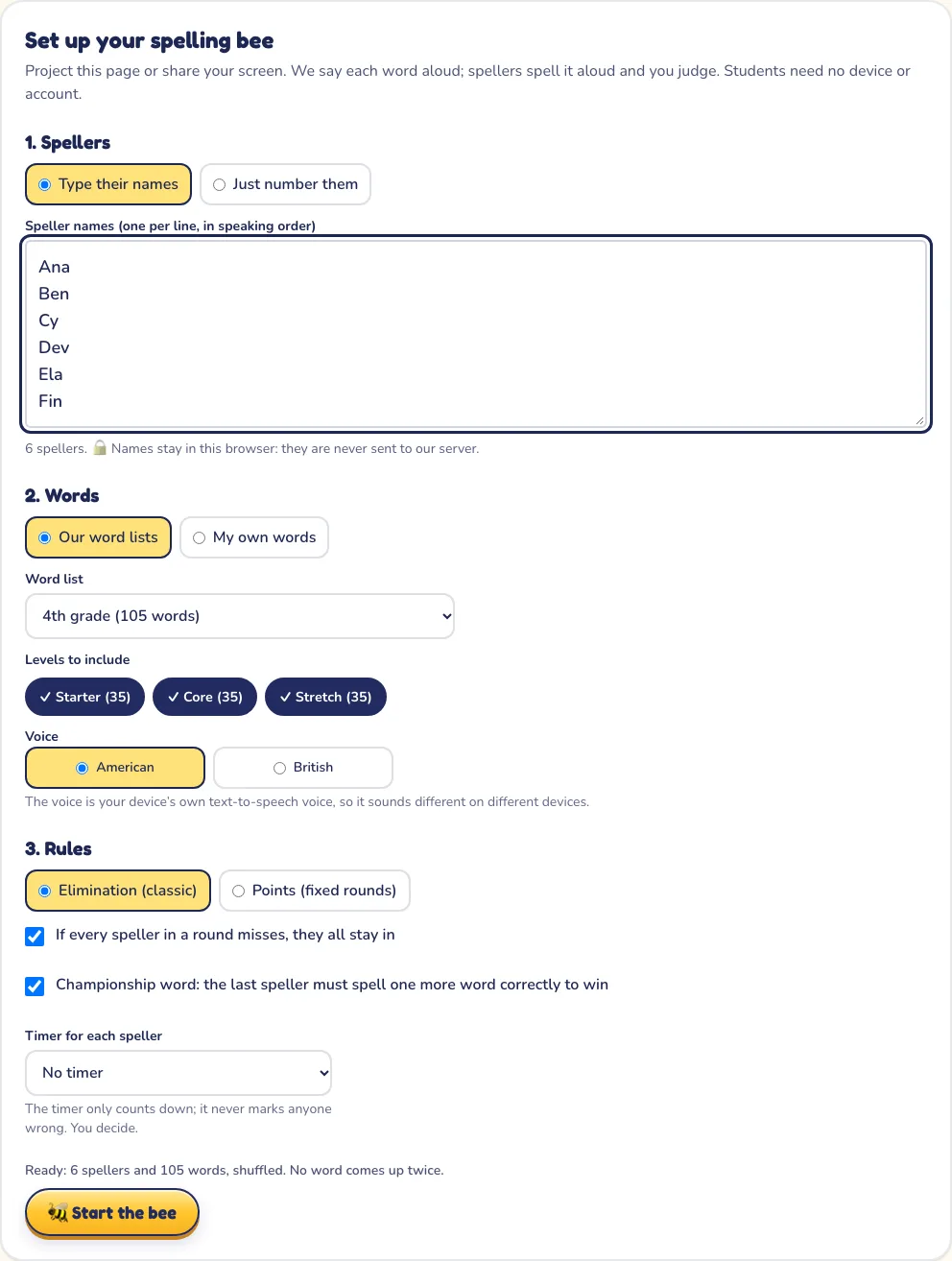
Settings you can choose: Speller names, or just a number of spellers; A word list by grade (1st–8th grade, plus harder and adult lists) or your own words; American or British device voice; Format: Elimination (classic) or Points (fixed rounds); optional answer timer.
1
Open the Spelling Bee Host
On the classroom computer, open the Spelling Bee Host page. Connect speakers or the board's sound.
What you should see: The setup form appears.
2
Add spellers and words
Type speller names (one per line) or choose Just number them. Under Words, pick a grade list or paste this week's words.
What you should see: The form says how many spellers and words are ready.
Setting up a bee: names, a word list and the format.
3
Start the bee
Press Start the bee. Explain the rules: listen, ask for the definition or a sentence if needed, then spell aloud.
What you should see: The first speller's name appears with the round number.
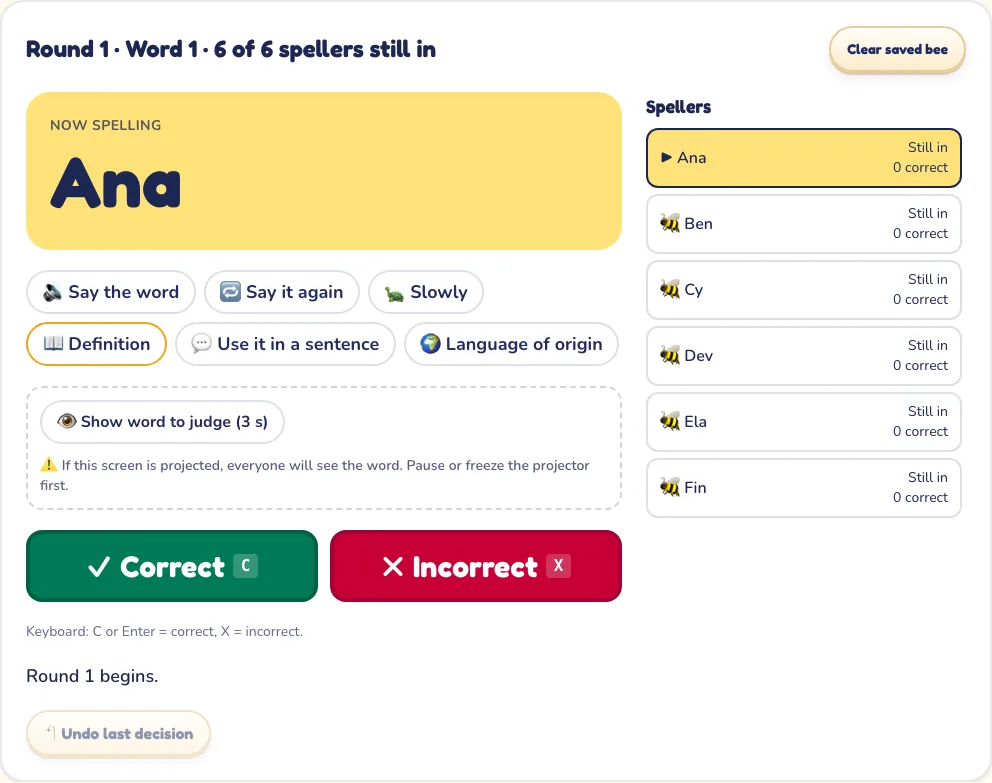
4
Run each turn
Press Say the word (and Definition, Use it in a sentence or Slowly when asked). Listen to the speller, then press Correct or Incorrect (keys C and X).
What you should see: The Host moves to the next speller and keeps track of who is still in.
A round in progress: the device says the word; you mark Correct or Incorrect.
5
Finish and review
When one speller is left (or after the points rounds), the Host shows the winner. Press Print results for the words used and missed.
What you should see: A printable results sheet to review difficult words with the class.
Good to know
Runs on one screen; students do not play on their own devices.
The voice is the device's text-to-speech: check unusual words first.
Names stay in your browser; nothing is saved by us.
If something goes wrong
No sound
Check the device volume and the board's audio; try another browser (voices differ by device).
A word sounds wrong
Use Say it again or Slowly, or read the word yourself; remove it from your list next time.
The projector shows the word
Freeze the projector before pressing Show word to judge.
Checked against Spelling Better 2.3.6 (73) and the live website on 28 November 2026. Screens marked “sample data” show example players and questions.
Free printable Grade 5 worksheets
Real worksheets made from this page's weekly lists, each with an answer key. Preview, print or save as PDF, or open one in its tool to change the words.
-tion and -sion: Missing Letters
Every consonant is missing and the meaning is the hint, so students rebuild each word, including t, s or double s in the ending. A real challenge: allow the list for support.
Students who have the Spelling Better app can keep practising spelling and vocabulary with its quizzes and word games at home. This is optional extra practice: the app uses its own word lists, not the words from this lesson.
Made with the free lesson plan generator at spellingbetter.com. A template-based starting point: change anything that does not suit your class.
Tricky Words and an Ask the Pronouncer Bee
45 minutes · Students find the hard part of long words, make memory tricks, and practice asking questions in a whole-class spelling bee.
Tricky Words and an Ask the Pronouncer Bee
Students find the hard part of long words, make memory tricks, and practice asking questions in a whole-class spelling bee.
Objectives
By the end of the lesson, students should be able to:
Spell fourteen multi-syllable words with unstressed vowels or silent letters.
Create a memory trick for at least two words.
Ask for a definition, sentence or origin before spelling in a bee.
Materials
This week's list
Index cards and colored pens
A computer with the free Spelling Bee Host and a speaker
Paper for seated spellers
Target words
separate
necessary
definitely
environment
government
temperature
vegetable
interesting
library
February
Wednesday
probably
different
favorite
Timing
Time
Stage
Minutes
0–5 min
Spelling voice
5
5–13 min
Find the hard part
8
13–20 min
Memory Trick Makers
7
20–35 min
Ask the Pronouncer Bee
15
35–41 min
Written check
6
41–45 min
My trickiest word
4
Whole lesson
45
Lesson stages
1. Spelling voice5 min (0–5 min)
Hear the letters that we usually swallow.
Say Wednesday normally, then in 'spelling voice': Wed-nes-day.
Students try February, library and different in spelling voice.
2. Find the hard part8 min (5–13 min)
Show where the tricky letters are.
Show each word and ask: which letters would most people get wrong?
Highlight them: the a in separate, the n in government, the first r in February.
Share two memory tricks: a rat in separate, iron in environment.
3. Memory Trick Makers7 min (13–20 min)
Make personal memory tricks.
Each student makes cards for two words, with the tricky letters colored and a trick written below.
Groups of four choose their best tricks for the Trick Wall.
4. Ask the Pronouncer Bee15 min (20–35 min)
Practice real spelling bee habits with long words.
Open the Spelling Bee Host, choose My own words, paste this week's list with the academic words list (28 words) and select Add meanings. For any word without a meaning, read it from this page.
Choose Points with 1 round (the Host needs one word per speller per round). Every speller must ask at least one question before spelling.
Seated students write each word and check it when the answer is shown.
Students who have the Spelling Better app can keep practising spelling and vocabulary with its quizzes and word games at home. This is optional extra practice: the app uses its own word lists, not the words from this lesson.
Made with the free lesson plan generator at spellingbetter.com. A template-based starting point: change anything that does not suit your class.
Visit the word roots page and find the roots port, struct, rupt and dict. For each root, write two words that use it and one sentence explaining what one of the words means.
Ask a family member about an invention that changed their life. Write four sentences about it using at least three -tion or -sion words, such as invention, decision or television.
Mini lab report
writing · about 25 min
Test something simple at home, such as which cup keeps water warm longest. Write a short report with these headings: Hypothesis, Variable, Evidence, Conclusion. Use at least six list words.
Weekend spelling test
weekend · about 10 min
With a grown-up's help, take the read-aloud online spelling test with the 5th grade list. Note the words you missed and make a memory trick for one of them.
Students who have the Spelling Better app can do extra practice with its spelling quizzes, vocabulary quizzes, flashcards and word games. The app uses its own word lists and does not report back to teachers.
A week of English practice for 5th grade
A sample week for fifth graders built around one list. Tuesday and Thursday focus on meaning, so new words get used as well as spelled.
Monday15 min
Pretest and hard parts
Give a pretest of the full list. Students check their own and highlight the hard part of every word they missed.
Tuesday20 min
Meaning and roots
Explain each word through its root, its base word or its use in science. Students write five sentences that show the meaning clearly.
Wednesday20 min
Worksheet
Students complete one worksheet, such as missing letters, the roots matching sheet or the science crossword.
☐ Highlight the hard part of each word I missed on Monday
☐ Explain five words using their root or base word
☐ Finish one worksheet
☐ Use three list words correctly in my own writing
☐ Make a memory trick for my trickiest word
☐ Spell in the Friday bee and take the written check
spellingbetter.com/for-teachers/grades/
Grade 5 teacher questions
How hard should 5th grade spelling words be?
Most fifth graders are ready for words of three or more syllables, words built from roots and suffixes, and the academic words they meet in science and social studies. That said, some students need shorter lists and some want much harder ones. Use the four lists here as a middle point and adjust up or down for each group.
Which word roots are good to teach in 5th grade?
Roots that appear in many everyday words give the best value: port (carry), struct (build), rupt (break) and dict (say), which are in this page's second list, and later spect (look), scrib (write) and graph (write). The word roots page (/word-roots/) lists many more with examples.
Where can I find more 5th grade spelling bee words?
Our 5th grade spelling bee words page (/5th-grade-spelling-bee-words/) has a longer list in Beginner, Intermediate and Advanced groups, with meanings. It is also built into the free Spelling Bee Host, so you can run a practice bee straight from it.
How do I prepare 5th graders for a school spelling bee?
Practice the habits as well as the words: asking for the definition, sentence and language of origin, saying the word before and after spelling it, and spelling long words syllable by syllable. Run short practice bees on the free Spelling Bee Host, print the spelling bee rules, and see the school spelling bee guide (/for-teachers/school-spelling-bee/) for planning the event.
How do I teach academic vocabulary to 5th graders?
Teach the words while students use them. Run a small investigation and ask students to observe, make a hypothesis, collect evidence and write a conclusion, as in the Claim, Evidence, Conclusion activity on this page. Words like compare, contrast, summarize and identify work across subjects, so keep using them in other lessons too.
Can 5th graders play live games in the Spelling Better app?
Small groups can, with an adult supervising. Group Battle and Audio Quiz rooms take 2–4 players, each on their own phone or tablet with the app and their own account, and joined with a 6-digit code. Rooms cost in-app coins, the app has no grade setting, and it cannot use your word list. For whole-class games, use the browser Spelling Bee Host.
Continue practising with Spelling Better
Students can practise spelling and vocabulary at their own level in the app, on their own phone or tablet.
Spelling Better is free to download for iPhone, iPad and Android. Group rooms use in-app coins. Premium is free for everyone until 31 December 2026.