4th Grade Spelling Games, Vocabulary Activities and English Worksheets
Four weekly lists for fourth graders that build word choice as well as spelling: strong verbs for dialogue, opposites, tricky homophones and word families. Each list has games, printable worksheets, lesson plans, homework and a free whole-class spelling bee.
Children in 4th grade are usually 9–10 years old; in England and Wales this is often Year 5, and in many other countries it is called Primary 4 or Primary 5. Every class is different: use an easier or harder grade’s lists whenever they fit your students better.
What 4th grade students can practise
Synonyms
Choose a precise verb instead of said (whisper, mumble, announce) and explain how it changes the way a line of dialogue sounds.
Antonyms
Name and spell the opposite of a word, such as arrive and depart or increase and decrease, and use both in one sentence.
Homophones
Pick the right spelling of harder homophones such as weather and whether, threw and through, using the meaning of the sentence.
Word families
Build new words from a base word with -ment, -able and -ation, and notice spelling changes such as imagine to imagination.
Context clues
Work out the meaning of an unfamiliar word from the words and sentences around it, then check with a dictionary.
Writing
Use new words correctly in their own dialogue, descriptions and short reports.
Spelling patterns and word study: Dialogue verbs (synonyms for said) · Antonym pairs · Homophones (threw/through) · Suffix -ment · Suffix -able (drop e, y to i) · Suffix -ation (imagine → imagination) · Double letters (suggest, announce) · Final -le (giggle, mumble).
These are suggested focus areas for this age, not an official curriculum. Adapt them to your own scheme of work.
Classroom games and activities for 4th grade
Teacher-led activities with full rules and an example round. None of them needs the app.
Said Is Tired
10–15 min · pair · Developing to confident readers
Objective: Students replace said with a precise verb and perform the line so a partner can guess which verb they chose.
You need
Strips of paper with plain dialogue lines such as 'I found it,' said Sam.
This week's dialogue verbs on the board
Before you start
Write eight to ten short dialogue lines that use said.
Put one set of strips in an envelope for each pair.
How to play
Partner A draws a dialogue strip and secretly chooses a list verb to replace said.
Partner A reads the line aloud in the way that verb sounds: whispering, mumbling, exclaiming and so on.
Partner B guesses the verb and spells it aloud. A right guess with a right spelling scores 2 points.
If the guess is a different verb that also fits, both partners score 1 point.
Partner A writes the new line with the chosen verb, then the partners swap roles.
After ten minutes, each pair shares its funniest or best-fitting line with the class.
Example round: Partner A draws 'I lost my homework,' said Leo. She chooses mumble and reads the line quietly and unclearly. Partner B guesses: 'Mumbled! M-U-M-B-L-E.' That scores 2. Partner A writes: 'I lost my homework,' Leo mumbled.
Easier: Use four verbs that sound very different (whisper, shout, giggle, mumble) and let partners point to the board. Harder: Add an adverb rule: the partner must also guess how, such as 'whispered nervously', and spell both words.
10–15 min · team, whole-class · All levels in grade 4
Objective: Teams race to write and spell the opposite of a word, pulling a paper marker toward their side of the board.
You need
A long line drawn on the board with a middle mark
A magnet or sticky note as the 'rope' marker
Two mini whiteboards
Before you start
Split the class into two teams and seat them on opposite sides.
Prepare a list of the fourteen words in random order.
How to play
One player from each team comes to the front with a whiteboard.
Say a word from the list, for example ancient.
Both players write its opposite. The first correct spelling held up moves the marker one step toward their team.
A misspelled opposite does not count; the other player may still win the point.
New players come up every round, so everyone gets a turn.
When the marker reaches either end, or after twelve rounds, the team it is closest to wins.
Example round: Teacher: 'Increase.' Both players write. Ravi holds up DECREASE first and it is spelled correctly, so the marker moves one step toward his team. Teacher: 'Shallow.' Lily writes DEEP in two seconds and pulls the marker back.
Easier: Show both words of every pair on the board and let students copy the opposite instead of writing from memory. Harder: Say a word that is not on the list (polite, ordinary, include) so students must think of an opposite and spell it.
15–20 min · small-group · Confident readers; good for review
Objective: Small groups act as judges, find the homophone mistake in each sentence, correct it and explain their ruling.
You need
Case cards: one sentence each, some with a homophone mistake
A paper gavel or a bell for each group (optional)
Ruling sheets
Before you start
Write ten case cards, about seven with a mistake (The whether was sunny) and three that are correct.
Make one ruling sheet per group with columns: Case, Guilty or Not guilty, Correct spelling, Reason.
How to play
Each group of three or four is a court with a judge, a reader and a writer; swap roles every case.
The reader reads the case card aloud.
The court decides: guilty (a homophone is wrong) or not guilty (the sentence is correct).
For guilty cases, the writer spells the right homophone on the ruling sheet and the judge gives the reason in one sentence.
Groups get a point for each correct ruling and a bonus point for a clear reason.
Review the trickiest case together at the end.
Example round: Case 4: 'The ball flew threw the window.' The court rules guilty. The writer spells THROUGH and the judge explains: 'Threw is what you do with a ball. Through means in one side and out the other.' Case 7: 'We read the poem aloud.' Not guilty.
Easier: Underline the word to check on each case card so groups only decide which spelling is right. Harder: Hide two mistakes in some cases and add review pairs from 3rd grade, such as hear/here.
15–20 min · pair, individual · Developing to confident readers
Objective: Students work out the meaning of a new word from the sentences around it, then check with a dictionary.
You need
Case file cards: a short passage with one unfamiliar word in bold
Student dictionaries or a classroom dictionary
A case file sheet: Word, My clue, My guess, Dictionary meaning
Before you start
Write six short passages, each with a word students have not met yet (for example fragile, enormous, timid).
Make sure each passage has a clue: a definition, an example, an opposite or a synonym nearby.
How to play
Pairs read the passage twice and underline every word that could be a clue.
They write the clue type: definition, example, opposite or synonym.
They write their guess at the meaning in their own words before looking anything up.
Then they check the dictionary and give themselves a star if the guess was close.
Each pair spells the new word from memory on the back of the card.
Share one case with the class and explain which clue cracked it.
Example round: Passage: 'The vase was fragile. Unlike the sturdy plastic cups, it could shatter if you touched it too hard.' The pair underlines 'unlike the sturdy plastic cups' (an opposite clue) and 'could shatter'. Guess: 'easy to break'. The dictionary agrees, and they connect it to the list word breakable.
Easier: Use passages where the clue is a definition right after the word, such as 'timid, or shy'. Harder: Use passages with only an example clue, and ask students to write a new sentence with a clue of their own.
15–20 min · team · Developing; works with mixed-ability teams
Objective: Teams grow a word family from one base word, spelling each new form correctly, including any dropped or changed letters.
You need
Large paper with a tree trunk drawn on it for each team
Markers
A dictionary for each team
Before you start
Choose base words from the list: enjoy, measure, value, imagine, explore, observe, inform.
Write one base word on each tree trunk.
How to play
Each team gets a tree with a base word on the trunk.
In eight minutes, the team adds as many real words from the same family as it can, one word per branch.
Each word must use the base word plus a prefix or suffix (explore → explorer, exploring, exploration).
Circle any letter that was dropped or changed.
Trees rotate to the next team, who check spelling with a dictionary and cross out any word that is not real.
Score one point per correct branch and a bonus point for each correctly circled spelling change.
Example round: Team 2 gets imagine. They add imagined, imagining, imagination, imaginary and unimaginable, and circle the missing e in imagination. The checking team finds that 'imaginate' is not a word and crosses it out, so Team 2 scores 5 plus 1 bonus.
Easier: Give each team a word bank of possible endings (-ed, -ing, -er, -ment, -able, -ation) to try. Harder: Ask teams to write a sentence that uses three words from their tree.
20–30 min · whole-class, individual · All levels; the bonus stretches strong spellers
Objective: A whole-class spelling bee where spellers can earn a bonus by giving a synonym or antonym for their word.
You need
The free Spelling Bee Host on one screen with a speaker
A printed spelling bee score sheet for the bonus tally
Before you start
Open the Spelling Bee Host and choose My own words. Paste the dialogue-verb and antonym lists together (26 words).
Choose Points (fixed rounds) and enter the spellers' names. The Host needs one word per speller per round, so 26 words give one round for up to 26 spellers; for more rounds, choose the 4th grade list.
Keep this page open so you can read the meaning or sentence for any word that has none in the Host.
How to play
The Host reads the word. The speller may ask for the meaning or a sentence.
The speller spells the word aloud. Mark it on the Host.
If the spelling is correct, the speller may try a bonus: a synonym (for dialogue verbs) or the opposite (for the antonym list).
A sensible bonus word earns one tally mark on the score sheet; spelling the bonus word correctly earns a second.
At the end, add the Host points and the bonus tallies together.
Nobody loses points for a wrong bonus, so everyone can have a go.
Example round: The Host reads 'generous'. Aisha spells G-E-N-E-R-O-U-S and the teacher marks it correct. Bonus: 'The opposite is selfish, S-E-L-F-I-S-H.' She earns two tally marks. Next, Jonah spells WHISPER and gives the bonus synonym 'murmur', which earns one tally mark.
Easier: Allow spellers to choose the bonus word from a list on the board. Harder: Switch to Elimination (classic) with a Championship word, and ask for both a synonym and an antonym where one exists.
Read-aloud tests by grade; the device says each word.
Grade 4 spelling and vocabulary words, week by week
Four original weekly lists with meanings and example sentences. Copy or print a list, or turn it into a worksheet, flashcards or a read-aloud spelling test in one click.
Week 1 · Synonyms for said
Strong Verbs for Dialogue
Objective: Students spell twelve verbs that can replace said and choose the one that best shows how a character speaks.
Strong Verbs for Dialogue: words, meanings and example sentences
Word
Meaning
Example
Listen
whisperverb · wh-
To speak very softly, using your breath more than your voice.
Please whisper so you don't wake the baby.
shoutverb · ou
To call out in a very loud voice.
We had to shout across the windy field.
replyverb · final y
To answer someone who has spoken or written to you.
Remember to reply when a friend asks you a question.
explainverb · ai
To make something clear so that another person understands it.
Can you explain how you solved the puzzle?
mumbleverb · final -le
To speak quietly and unclearly, so your words are hard to understand.
Please don't mumble; say your answer clearly.
giggleverb · double g, final -le
To laugh in a light, silly way.
The twins giggle whenever the puppy sneezes.
complainverb · ai
To say that you are unhappy or annoyed about something.
My brother likes to complain about bedtime.
announceverb · double n
To tell a lot of people something important, often in a formal way.
The principal will announce the spelling bee winner at lunch.
suggestverb · double g
To offer an idea for someone else to think about.
I suggest we read the next chapter together.
wonderverb · o says short u
To feel curious and ask yourself about something.
I wonder why the sky turns orange at sunset.
argueverb · final -ue
To disagree with someone, often in an angry or noisy way.
The two characters argue about who ate the last cookie.
exclaimverb · ai
To say something suddenly and with strong feeling.
'Look, a rainbow!' Maya exclaimed.
Practice ideas
Line the words up from quietest to loudest (whisper, mumble, reply ... shout, exclaim) and explain your order.
Rewrite three lines of dialogue from a class book, swapping said for a list word that fits the character's feelings.
Read a line such as 'I lost my homework' in the voice of each verb while a partner guesses which one you chose.
Circle the tricky part of each word: the wh in whisper, the double g in suggest, the ue in argue.
Week 2 · Antonyms (opposites)
Antonym Pairs: Opposites
Objective: Students spell seven pairs of opposites and use each pair in a sentence that shows the contrast.
Antonym Pairs: Opposites: words, meanings and example sentences
Word
Meaning
Example
Listen
arriveverb · opposite: depart
To reach a place at the end of a trip.
The bus will arrive at the zoo at ten o'clock.
departverb · opposite: arrive
To leave a place, especially at the start of a trip.
Our train will depart from platform two.
ancientadjective · opposite: modern
Very, very old; from a long time ago.
We visited the ruins of an ancient city.
modernadjective · opposite: ancient
New, or belonging to the present time.
The museum has a modern glass roof.
shallowadjective · opposite: deep
Not deep; the bottom is close to the top.
Little kids can splash in the shallow end of the pool.
deepadjective · opposite: shallow
Going a long way down from the top.
The lake is too deep to stand up in.
smoothadjective · opposite: rough
Flat and even, with no bumps or scratchy spots.
The pebble felt smooth in my hand.
roughadjective · opposite: smooth
Bumpy, scratchy or uneven to touch.
The bark of the old tree was rough.
increaseverb · opposite: decrease
To become bigger in number or amount.
The number of birds will increase in spring.
decreaseverb · opposite: increase
To become smaller in number or amount.
The noise began to decrease as the parade moved away.
generousadjective · opposite: selfish
Happy to share and give to others.
Our generous neighbor gave us a bag of fresh tomatoes.
selfishadjective · opposite: generous
Caring only about yourself and not about other people.
It felt selfish to keep all the markers for myself.
victorynoun · opposite: defeat
A win in a game, contest or battle.
The team celebrated their victory with a loud cheer.
defeatnoun · opposite: victory
A loss in a game, contest or battle.
After the defeat, the coach said everyone had played hard.
Practice ideas
Write each pair on one card, one word on each side; flip the card and spell the opposite from memory.
Write one sentence for each pair that uses both words, such as: The ancient castle stood next to a modern hotel.
Play 'opposite echo': a partner says a word and you say and spell its opposite.
Find the word part that flips the meaning in increase and decrease, and talk about why the rest stays the same.
Week 3 · Homophones
Tricky Homophones
Objective: Students choose between harder homophones by checking the meaning of the sentence, and use a memory trick for each pair.
Tricky Homophones: words, meanings and example sentences
Word
Meaning
Example
Listen
weathernoun · sounds like whether
What it is like outside: sunny, rainy, windy or snowy.
The weather was perfect for a bike ride.
whetherconjunction · sounds like weather
A word used when there is a choice between two possibilities, like 'if'.
I can't decide whether to wear boots or sneakers.
piecenoun · sounds like peace
One part of something bigger.
Can I have a piece of your orange?
peacenoun · sounds like piece
A calm time with no fighting or noise.
We enjoyed the peace of the quiet library.
threwverb · sounds like through
Sent something through the air with your hand, in the past.
Mia threw the ball and her dog raced after it.
throughpreposition · sounds like threw
In one side and out the other.
The train went through a long, dark tunnel.
aloudadverb · sounds like allowed
In a voice that other people can hear.
Our teacher read the poem aloud.
allowedadjective · sounds like aloud
Given permission; it is okay to do it.
Dogs are not allowed inside the bakery.
boardnoun · sounds like bored
A flat piece of wood, or the surface your teacher writes on.
Write the date at the top of the board.
boredadjective · sounds like board
Tired and restless because nothing interesting is happening.
I was bored waiting for the rain to stop.
stairnoun · sounds like stare
One step in a set of steps.
I tripped on the bottom stair.
stareverb · sounds like stair
To look at something for a long time without looking away.
The cat likes to stare at the fish tank.
stealverb · sounds like steel
To take something that does not belong to you.
The crow tried to steal a shiny spoon.
steelnoun · sounds like steal
A very strong metal made mostly from iron.
The bridge is held up by thick steel cables.
Practice ideas
Make a memory trick for each pair: a piece of pie, the air goes up the stair, you read aloud out loud.
Write a short weather report that uses both weather and whether correctly.
Partner check: one partner writes a sentence with a blank, the other fills in the right homophone.
Highlight the letters that are different in each pair (ea and ee in steal and steel) and say what each word means.
Week 4 · Suffixes -ment, -able, -ation
Word Families with -ment, -able and -ation
Objective: Students build nouns and adjectives from base words with -ment, -able and -ation and spell the changes (drop the e, y to i).
Word Families with -ment, -able and -ation: words, meanings and example sentences
Word
Meaning
Example
Listen
enjoymentnoun · enjoy + ment
The good feeling you get from doing something you like.
Reading comics gives me lots of enjoyment.
agreementnoun · agree + ment
When people decide they think the same thing or will do the same thing.
The class came to an agreement about the rules.
measurementnoun · measure + ment
A number that tells how long, heavy or big something is.
Write each measurement in centimeters.
equipmentnoun · equip + ment
The tools and things you need for a job or activity.
Put the science equipment back in the box.
comfortableadjective · comfort + able
Feeling relaxed, with nothing that hurts or bothers you.
This beanbag chair is very comfortable.
breakableadjective · break + able
Easy to break, so you must handle it with care.
Glass jars are breakable, so carry them slowly.
valuableadjective · value: drop the e + able
Worth a lot of money, or very useful and important.
Clean water is valuable to every living thing.
reliableadjective · rely: y to i + able
Able to be trusted to work well or to help every time.
Our old flashlight is reliable even in the rain.
imaginationnoun · imagine: drop the e + ation
The ability to make pictures and ideas in your mind.
Use your imagination to design a new robot.
invitationnoun · invite: drop the e + ation
A message asking someone to come to an event.
We sent an invitation to every family for the science fair.
explorationnoun · explore: drop the e + ation
Traveling through a place or studying it to learn about it.
Space exploration helps us learn about other planets.
observationnoun · observe: drop the e + ation
Something you notice by watching carefully.
Write one observation about your plant each day.
informationnoun · inform + ation
Facts or details about something.
The poster gives information about the moon.
Practice ideas
Write each base word, then the new word beside it, and circle any letter that was dropped or changed (imagine → imagination).
Build a word family tree: put a base word such as explore on the trunk and add explorer, exploring and exploration on branches.
Plan a pretend science fair poster that uses five list words.
Sort the words into -ment, -able and -ation, then add one more word of your own to each group.
Your browser has no speech voice, so the listen buttons are hidden.
Need a longer list? See the full 4th grade spelling words, with a read-aloud test for every level.
Turn these words into a classroom game: paste a week’s list into the free Spelling Bee Host and run a spoken bee on the board, or see how to host a live game below.
How to host live word games for Grade 4 students
Suggested game session for 4th grade
Fourth graders can handle a real spelling bee with longer words, and the free Spelling Bee Host runs it on one screen for the whole class. The device voice reads each word, so you can watch and coach instead of reading out lists.
Game
Spelling Bee Host (in your browser)
Settings to try
Our word lists → the 4th grade list (Starter, Core or Stretch), or My own words → this week's list for teams or a small group (one word per speller per round). Points for practice; Elimination with a Championship word for a final.
Vocabulary focus
Dialogue verbs, antonym pairs, homophones or -ment/-able/-ation words. Encourage spellers to ask for a sentence before spelling any homophone.
Warm-up
Show the week's pairs (weather/whether, piece/peace) and ask students to explain one difference before the first round.
Session length
20–30 minutes
Format
Whole class on one screen. Spellers stand one at a time; seated students write each word on a whiteboard so everyone keeps practicing.
Supervision
The teacher runs the Host and marks each spelling. No student device or account is needed.
Afterwards
Students copy the three words that caught most spellers into their notebooks and write a memory trick for each.
Independent practice
At home, students can take the read-aloud online spelling test and choose the 4th grade list.
For a small group of 2–4 students who each have the Spelling Better app and their own account, an adult can supervise a Group Battle or an Audio Quiz room (start with A1 or A2 and move up if it is too easy). Rooms cost in-app coins.
Session length and grouping are teaching suggestions, not app settings. The app has no grade setting.
Step by step: Spelling Bee Host (in your browser)
Best for: A whole class on one screen, from kindergarten up. Free, no accounts, no student devices.
Players: 2–60 spellers on one screen
Devices: Any computer, laptop or interactive whiteboard with a modern browser and speakers
Cost: Free. No sign-up.
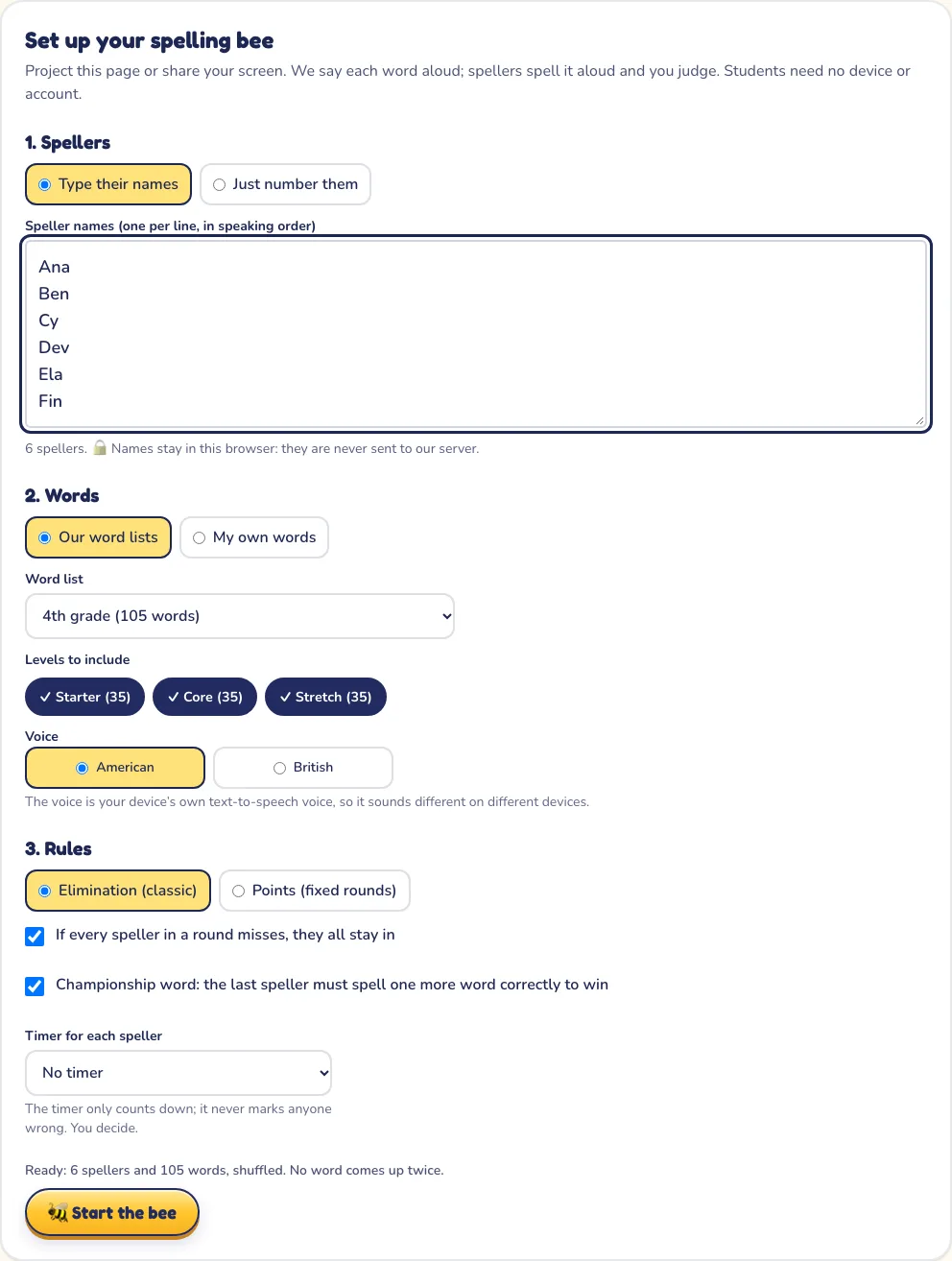
Settings you can choose: Speller names, or just a number of spellers; A word list by grade (1st–8th grade, plus harder and adult lists) or your own words; American or British device voice; Format: Elimination (classic) or Points (fixed rounds); optional answer timer.
1
Open the Spelling Bee Host
On the classroom computer, open the Spelling Bee Host page. Connect speakers or the board's sound.
What you should see: The setup form appears.
2
Add spellers and words
Type speller names (one per line) or choose Just number them. Under Words, pick a grade list or paste this week's words.
What you should see: The form says how many spellers and words are ready.
Setting up a bee: names, a word list and the format.
3
Start the bee
Press Start the bee. Explain the rules: listen, ask for the definition or a sentence if needed, then spell aloud.
What you should see: The first speller's name appears with the round number.
4
Run each turn
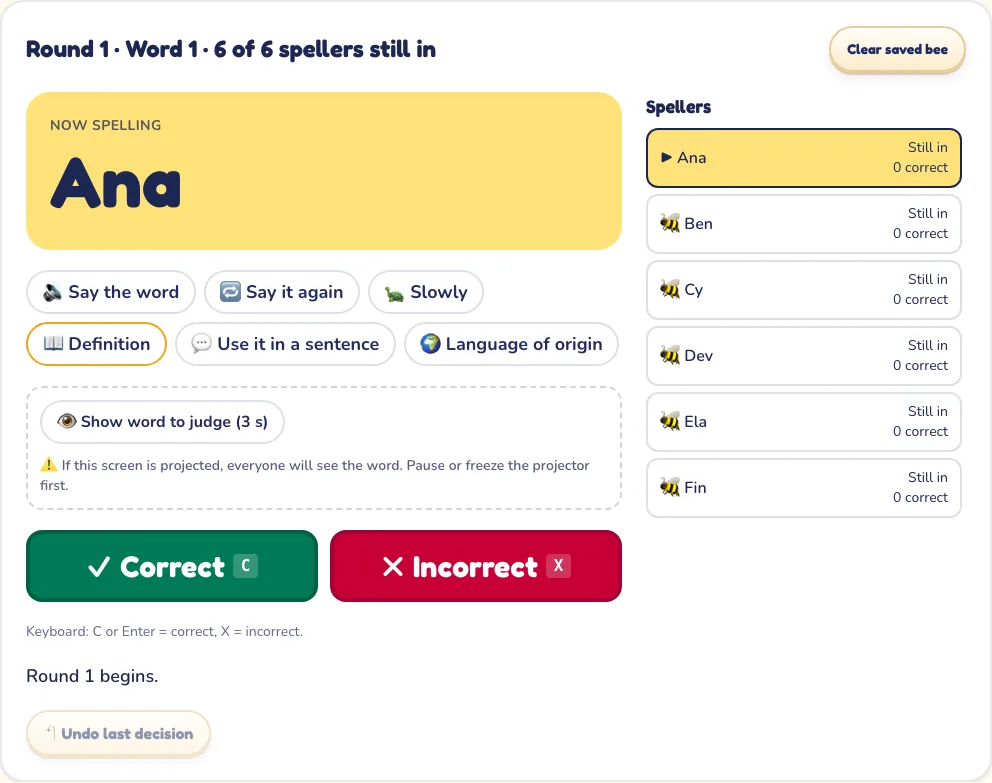
Press Say the word (and Definition, Use it in a sentence or Slowly when asked). Listen to the speller, then press Correct or Incorrect (keys C and X).
What you should see: The Host moves to the next speller and keeps track of who is still in.
A round in progress: the device says the word; you mark Correct or Incorrect.
5
Finish and review
When one speller is left (or after the points rounds), the Host shows the winner. Press Print results for the words used and missed.
What you should see: A printable results sheet to review difficult words with the class.
Good to know
Runs on one screen; students do not play on their own devices.
The voice is the device's text-to-speech: check unusual words first.
Names stay in your browser; nothing is saved by us.
If something goes wrong
No sound
Check the device volume and the board's audio; try another browser (voices differ by device).
A word sounds wrong
Use Say it again or Slowly, or read the word yourself; remove it from your list next time.
The projector shows the word
Freeze the projector before pressing Show word to judge.
Checked against Spelling Better 2.3.6 (73) and the live website on 28 November 2026. Screens marked “sample data” show example players and questions.
Free printable Grade 4 worksheets
Real worksheets made from this page's weekly lists, each with an answer key. Preview, print or save as PDF, or open one in its tool to change the words.
Dialogue Verbs Word Search and Sentences
Words run across, down and diagonally. On the back, students write four lines of dialogue that use list verbs instead of said.
Students who have the Spelling Better app can keep practising spelling and vocabulary with its quizzes and word games at home. This is optional extra practice: the app uses its own word lists, not the words from this lesson.
Made with the free lesson plan generator at spellingbetter.com. A template-based starting point: change anything that does not suit your class.
Word Families: From Base Word to New Word
45 minutes · Students add -ment, -able and -ation to base words, spell the spelling changes and finish with a short spelling bee.
Word Families: From Base Word to New Word
Students add -ment, -able and -ation to base words, spell the spelling changes and finish with a short spelling bee.
Objectives
By the end of the lesson, students should be able to:
Spell thirteen words built with -ment, -able and -ation.
Explain when a final e is dropped or a y changes to i.
Use context clues to choose the right word form in a sentence.
Materials
This week's list
Tree trunk posters for Word Family Trees
A computer with the free Spelling Bee Host and a speaker
Mini whiteboards
Target words
enjoyment
agreement
measurement
equipment
comfortable
breakable
valuable
reliable
imagination
invitation
exploration
observation
information
Timing
Time
Stage
Minutes
0–5 min
One word, many forms
5
5–15 min
Three suffixes, three rules
10
15–23 min
Which form fits?
8
23–35 min
Bee round
12
35–41 min
Quick dictation
6
41–45 min
Rule reminder
4
Whole lesson
45
Lesson stages
1. One word, many forms5 min (0–5 min)
Show that one base word can grow into many words.
Write play on the board. Students call out other words in its family (player, playful, replay, playground).
Circle the base word in each one.
2. Three suffixes, three rules10 min (5–15 min)
Teach the suffixes and spelling changes.
Show the pairs base → new word: enjoy → enjoyment, comfort → comfortable, imagine → imagination.
Rule 1: most base words just add the suffix (agree + ment).
Rule 2: a final e usually drops before -able or -ation (value → valuable, invite → invitation). Rule 3: y after a consonant changes to i (rely → reliable).
Tip: Measurement keeps its e because -ment starts with a consonant. Ask students to spot that difference.
3. Which form fits?8 min (15–23 min)
Use context clues to pick a word form.
Read sentences with a blank: 'Space ___ helps us learn about other planets.' Students choose between explore and exploration.
Ask what in the sentence told them a noun was needed.
4. Bee round12 min (23–35 min)
Spell the new words aloud under light pressure.
Open the Spelling Bee Host, choose My own words and paste this week's list. Enter pairs or small teams as the spellers and choose Points with 1 round: the Host needs one word per speller per round, and the list has 13 words.
Before spelling, each speller says the base word. Then they spell the full word aloud.
Mark each spelling on the Host and note words that caught several spellers.
Students tell a partner one of the three rules with an example word.
Add new family words they think of to the word wall.
Differentiation
Support: Start with the six words that simply add the suffix (enjoyment, agreement, equipment, comfortable, breakable, information).
Stretch: Students build a whole family for one base word, such as observe, observer, observant, observation and unobserved.
Assessment
Use the dictation and the bee: can students spell each word and explain any dropped or changed letter?
Homework
Choose three base words from the list and make a word family tree for each with at least four branches.
After class (optional)
Students who have the Spelling Better app can keep practising spelling and vocabulary with its quizzes and word games at home. This is optional extra practice: the app uses its own word lists, not the words from this lesson.
Made with the free lesson plan generator at spellingbetter.com. A template-based starting point: change anything that does not suit your class.
With a grown-up's help, open the read-aloud online spelling test and choose the 4th grade list. Listen, type each word, and write any word you missed three times in your notebook.
During a family meal or car ride, listen for how people speak. Did anyone whisper, giggle, complain or explain? Write three sentences about what you heard using list verbs (no names needed).
Comic strip without said
writing · about 25 min
Draw a four-panel comic strip with speech captions underneath. Use at least five verbs from the dialogue list instead of said, and spell each one carefully.
Word ladder puzzles
weekend · about 15 min
With a grown-up, try a few Honey Ladder puzzles in the browser, changing one letter at a time to turn one word into another. Write down two new words you made along the way.
Students who have the Spelling Better app can do extra practice with its spelling quizzes, vocabulary quizzes, flashcards and word games. The app uses its own word lists and does not report back to teachers.
A week of English practice for 4th grade
A five-day plan for one weekly list. Short daily sessions leave room for reading, and Friday ends with a bee and a written check.
Monday15 min
Pretest and predict
Give a quick pretest of eight words. Students mark which ones they knew and predict which will be hardest this week.
Tuesday20 min
Meaning day
Talk about the meanings: line up the dialogue verbs by volume, match the antonym pairs or sort the homophones. Students write one sentence per word for five words.
Wednesday20 min
Worksheet
Students complete one worksheet for the list, such as the word search, matching sheet or crossword.
☐ Take the Monday pretest and star my hardest words
☐ Write a sentence for five list words
☐ Finish one worksheet
☐ Play one word game in class
☐ Practice my starred words at home
☐ Spell in the Friday bee and take the written check
spellingbetter.com/for-teachers/grades/
Grade 4 teacher questions
How many spelling words should 4th graders practice each week?
Twelve to fifteen is a good starting point for many fourth graders, and each list here has twelve to fourteen words. Some students do better with eight words they really learn; others are ready for extra stretch words. Adjust the list to the class you have rather than the grade number.
What should 4th grade spelling and vocabulary focus on?
Fourth grade is a good time to move from spelling patterns toward word choice: synonyms (better verbs than said), antonyms, harder homophones such as through and threw, and word families built with suffixes like -ment, -able and -ation. Reading words in context and guessing meanings from clues is a big part of it too.
Where can I find a longer 4th grade spelling word list?
Our 4th grade spelling bee words page (/4th-grade-spelling-bee-words/) has a longer list in Starter, Core and Stretch groups, with meanings. It is also built into the free Spelling Bee Host, so you can run a bee from it without typing anything.
How do I teach context clues to 4th graders?
Show students four kinds of clue: a definition right after the word, an example, an opposite (words like unlike or but), and a synonym nearby. Then let them guess a meaning before checking a dictionary, as in the Context Clue Case Files game on this page. Praise good reasoning even when the guess is not quite right.
How can I run a spelling bee with my whole 4th grade class?
Open the free Spelling Bee Host on a classroom screen, choose the 4th grade list or paste your own, and pick Points for practice or Elimination for a final. The device voice reads each word, and no student needs a device or account. Ask seated students to write each word too, so the whole class practices during every turn.
Can 4th graders play group games in the Spelling Better app?
Yes, as a supervised small-group option. Group Battle and Audio Quiz rooms take 2–4 players, each with the app on their own phone or tablet and their own account, and rooms cost in-app coins. An adult should set up the accounts and stay with the group. The app has no grade setting and cannot load your word list, so use the browser Spelling Bee Host for whole-class games.
Continue practising with Spelling Better
Students can practise spelling and vocabulary at their own level in the app, on their own phone or tablet.
Spelling Better is free to download for iPhone, iPad and Android. Group rooms use in-app coins. Premium is free for everyone until 31 December 2026.