3rd Grade Spelling Games, Vocabulary Activities and English Worksheets
Four ready-made weekly lists for third graders, from two-syllable words to homophones and describing words with suffixes. Each comes with games you can run tomorrow, printable worksheets, two full lesson plans and a free whole-class spelling bee.
Children in 3rd grade are usually 8–9 years old; in England and Wales this is often Year 4, and in many other countries it is called Primary 3 or Primary 4. Every class is different: use an easier or harder grade’s lists whenever they fit your students better.
What 3rd grade students can practise
Syllables
Split two-syllable words between the middle consonants (pic-nic, hel-met) and spell one syllable at a time.
Prefixes
Add un-, re- and pre- to familiar base words and explain the new meaning: not or undo, again, before.
Homophones
Choose between words that sound the same, such as hear and here or knight and night, by thinking about the meaning in a sentence.
Suffixes
Build describing words with -ful, -less, -ness and -ly, including the y-to-i change in happiness and beautiful.
Vocabulary
Explain what each list word means in their own words and use it in a sentence of their own.
Speaking and listening
Listen to a word, ask for a meaning or sentence when needed, and spell it aloud clearly in a class spelling bee.
Spelling patterns and word study: VC/CV syllable split (pic-nic) · Double middle consonants (rabbit, kitten) · Prefixes un-, re-, pre- · Homophone pairs (hear/here) · Silent k in knight · Suffixes -ful, -less, -ness, -ly · Changing y to i (happy → happiness).
These are suggested focus areas for this age, not an official curriculum. Adapt them to your own scheme of work.
Classroom games and activities for 3rd grade
Teacher-led activities with full rules and an example round. None of them needs the app.
Syllable Memory Match
10–15 min · pair, small-group · Developing spellers; works well with mixed abilities
Objective: Pairs turn over syllable cards two at a time, keep any two that join into a list word, and spell the whole word aloud.
You need
Index cards cut in half, with one syllable on each half (one set per pair)
Scrap paper for keeping score
Before you start
Write each word from the picnic list on a card and cut it between the syllables (pic | nic, hel | met).
Shuffle each set and lay the half-cards face down in rows on the desk.
How to play
Players take turns turning over any two half-cards and reading them aloud.
If the two halves make a list word in the right order, the player claps the syllables, spells the whole word aloud and keeps both cards.
If they do not make a word, or the spelling is wrong, both cards go face down again in the same places.
When one half fits two words (PIC + NIC or PIC + TURE), either counts, as long as the other PIC card can still make a real word.
When all cards are gone, the player with more words wins.
Both partners then write five of the words from memory and check them against the list.
Example round: Ana turns over MUF and KET: 'Muf-ket? Not a word.' She turns them back. Ben turns over BAS, remembers where KET was and makes bas-ket: 'B-A-S-K-E-T.' He keeps the pair. Next, Ana turns over PIC and TURE: 'Pic-ture, P-I-C-T-U-R-E,' and keeps them, leaving the other PIC for nic.
Easier: Use only eight half-cards (four words) and turn them face up for the first round, so players only match and spell. Harder: Add three-syllable words such as won-der-ful and hap-pi-ness: a player who turns over a first syllable may turn over a third card to finish it.
10–20 min · pair, small-group · Developing; best once students can read the base words
Objective: Students attach un-, re- or pre- to a base word, decide whether it makes a real word, and explain the new meaning.
You need
Prefix cards: un-, re- and pre- (four of each)
Base word cards: lock, pack, kind, tie, read, tell, write, fill, heat, view, play, safe
Scrap paper for scores
Before you start
Write the prefix and base word cards and put one set in an envelope for each pair.
Model one turn on the board before pairs start.
How to play
Shuffle both piles and place them face down.
Player 1 turns over one prefix card and one base word card.
If the parts make a real word (re + fill = refill), the player spells it aloud and gives its meaning in their own words for 2 points.
If they do not make a real word (pre + kind), the player says 'No match' and earns 1 point for spotting it.
The partner checks the spelling against this week's list; a misspelled word scores 0. A real word that is not on the list (review, reheat, repack) still counts: check it with the teacher.
Play for ten minutes. Then both partners write their three favorite words from the game.
Example round: Ana turns over RE- and TELL. She says, 'Retell, R-E-T-E-L-L. It means to tell the story again,' and scores 2. Ben turns over PRE- and KIND and says, 'No match. Prekind is not a word,' and scores 1. On his next turn he gets UN- and TIE: 'Untie, U-N-T-I-E, to loosen a knot.'
Easier: Use only un- and re- with six base words, and keep this week's list where everyone can see it. Harder: Add dis- and mis- cards with base words such as agree and spell, and ask for a sentence with every real word.
5–15 min · whole-class, individual · All levels in grade 3
Objective: Students listen to a sentence and hold up the spelling of the homophone that matches its meaning.
You need
Two blank cards or a mini whiteboard for each student
This week's homophone pairs and sentences
Before you start
Choose four pairs to start with, such as hear/here, week/weak, knight/night and pair/pear.
Have two sentences ready for each word (the ones in the list above work well).
How to play
Students write both words of the first pair on two cards, one word on each card.
Read a sentence aloud with one of the homophones in it. Read it twice.
On 'Hold up!', everyone shows the card they think fits.
Ask one student to name the clue that helped, for example 'seven days' points to week.
Move to the next pair after three or four sentences.
Nobody is out. Students keep a tally of their own correct hold-ups and try to beat it next time.
Example round: Teacher: 'The knight wore shiny armor. The knight wore shiny armor.' Most students hold up KNIGHT. Teacher: 'How did you know?' Student: 'Armor is something a soldier wears, so it is the knight with a k.' Next sentence: 'I could not sleep last night.' Everyone switches to NIGHT.
Easier: Use two pairs only and add a small picture to each card (a pear, a pair of socks). Harder: Read sentences that use both words, such as 'Do you hear the music over here?', and ask students to write both words in order.
20–30 min · individual, whole-class · Developing writers; sentence starters help
Objective: Students use -ful, -less, -ness and -ly words to describe a story character and back up each word with a reason.
You need
Sticky notes or paper strips
Pictures of three or four characters from books the class knows
This week's describing words on the board
Before you start
Put the character pictures in different spots around the room.
Write two sentence starters on the board: 'The character is ___ because ___.' and 'The character acted ___ when ___.'
How to play
Each student picks one character and writes two notes, each with a different list word.
Every note needs a reason, using 'because' or 'when'.
Students stick their notes beside the picture, then walk to the next character.
At each picture they read the notes and add a tick if they agree, or a question mark if a word does not fit.
Back together, the class reads the notes with question marks and chooses a better word.
Check spelling together; writers fix any misspelled list word on their own note.
Example round: Beside a picture of a mouse freeing a lion from a net, Zara writes: 'The mouse acted bravely when it chewed the rope.' Omar writes: 'The lion is thankful because the mouse saved him.' Someone has written 'The lion is careless' and another student adds a question mark. The class talks it over and changes it to 'The lion is powerful because he is so strong.'
Easier: Give each student a word bank of six words and one sentence starter to copy. Harder: Students must use one word from each suffix group, including a word with a spelling change (beautiful or happiness).
Suffix Four Corners
10–15 min · whole-class, team · Developing; a good movement break
Objective: Students decide which suffix (-ful, -less, -ness or -ly) turns a base word into the word a sentence needs, then spell it.
You need
Four signs: -ful, -less, -ness, -ly
Ten sentences, each with a base word to change
A mini whiteboard for each corner
Before you start
Tape one sign in each corner of the room.
Write ten sentences with the ending missing from one word, such as 'We walked (quiet) past the library.'
How to play
Read a sentence aloud with the base word, for example 'We walked (quiet) past the library.'
Students have five seconds to walk to the corner with the suffix that fits.
Each corner group agrees on the spelling, and one member writes it on the whiteboard.
Right corner and right spelling: everyone in that corner scores a point.
If the base word changes its spelling (happy to happiness), the group earns a bonus point for explaining the change.
Play eight to ten rounds; students keep their own score.
Example round: Teacher: 'The cave was full of (dark).' Students hurry to the -NESS corner and write DARKNESS. Next: 'The (fear) superhero jumped straight in.' Most go to -LESS and write FEARLESS. A few go to -FUL, and the class talks about why fearful would mean the opposite.
Easier: Use only two corners (-ful and -less) and say the meaning of each suffix before every sentence. Harder: Choose base words that change (beauty, happy, gentle) and ask each corner to spell its word aloud together.
15–25 min · pair, whole-class · All levels; a gentle first spelling bee
Objective: Pairs practice for a class spelling bee: one partner spells, the other coaches, while the free Spelling Bee Host reads the words.
You need
A computer or tablet with a speaker or projector
The free Spelling Bee Host
One mini whiteboard for each pair
Before you start
Open the Spelling Bee Host, choose My own words and paste this week's list.
Add each pair as one speller, using both names (for example 'Ana and Ben').
Choose Points (fixed rounds) with 2 rounds so both partners spell and no pair is knocked out. The Host needs one word per pair per round, so with more than six or seven pairs, paste last week's list too or choose the 3rd grade list.
How to play
Pairs take turns at the front: one partner is the speller, the other is the coach.
The Host says the word. The speller may ask for the meaning or a sentence; read them from this week's list on this page.
The pair gets ten seconds to write the word together on their whiteboard.
The speller turns away from the board and spells the word aloud; you mark it on the Host.
Partners swap roles every round.
At the end, every pair names one word they now spell better, whatever their score.
Example round: The Host reads 'knight'. Ben asks for a sentence and the teacher reads it from the list: 'The knight rode his horse up to the castle.' Ana whispers, 'Remember the silent k.' They write KNIGHT, Ben turns around and spells K-N-I-G-H-T, and the teacher marks it Correct.
Easier: Let the speller look at the whiteboard while spelling, and start with the Starter words on the 3rd grade list. Harder: Drop the whiteboard step and switch to Elimination (classic) for the final rounds.
Read-aloud tests by grade; the device says each word.
Grade 3 spelling and vocabulary words, week by week
Four original weekly lists with meanings and example sentences. Copy or print a list, or turn it into a worksheet, flashcards or a read-aloud spelling test in one click.
Week 1 · Two-syllable VC/CV words
Two-Syllable Words: Split the Middle
Objective: Students split two-syllable words between the middle consonants (pic-nic) and spell the word one syllable at a time.
Two-Syllable Words: Split the Middle: words, meanings and example sentences
Word
Meaning
Example
Listen
picnicnoun · pic-nic
A meal you pack and eat outdoors, often sitting on a blanket.
We had a picnic under the big oak tree.
basketnoun · bas-ket
A container woven from thin strips, with a handle for carrying things.
Grandma packed six apples in a basket.
napkinnoun · nap-kin
A small square of cloth or paper for wiping your mouth and hands.
Please put a napkin next to each plate.
muffinnoun · muf-fin
A small round baked treat, a bit like a little cake.
I chose a blueberry muffin for my snack.
blanketnoun · blan-ket
A large soft cover that keeps you warm or that you can sit on.
We spread a striped blanket on the grass.
gardennoun · gar-den
A piece of land where people grow flowers, fruit or vegetables.
Tomatoes are growing in our garden.
insectnoun · in-sect
A tiny animal with six legs, such as an ant or a bee.
An insect crawled across the picnic plate.
rabbitnoun · rab-bit
A small furry animal with long ears that hops.
A rabbit hopped behind the bushes.
helmetnoun · hel-met
A hard hat that protects your head.
Always wear a helmet when you ride your bike.
tennisnoun · ten-nis
A game where players use rackets to hit a ball over a net.
My cousin plays tennis every Saturday morning.
kittennoun · kit-ten
A young cat.
The kitten chased a leaf across the path.
picturenoun · pic-ture
A drawing, painting or photo of something.
Dad took a picture of the ducks on the pond.
Practice ideas
Clap each word and draw a line between the two middle consonants: pic|nic, bas|ket, hel|met.
Spell one syllable at a time aloud, then write the whole word without looking.
Sort the words into two groups: double middle letters (rabbit, muffin, tennis, kitten) and two different letters (basket, garden, helmet).
Pack an imaginary picnic: write one sentence that uses three list words.
Week 2 · Prefixes un-, re-, pre-
Prefixes un-, re- and pre-
Objective: Students add un-, re- and pre- to base words they know and explain how each prefix changes the meaning.
Prefixes un-, re- and pre-: words, meanings and example sentences
Word
Meaning
Example
Listen
unlockverb · un-
To open something that was shut with a key or a code.
Mr. Ortiz will unlock the classroom door at eight.
unpackverb · un-
To take things out of a bag, box or suitcase.
We unpack our backpacks and hang up our coats.
unkindadjective · un-
Not nice or caring toward other people.
It is unkind to laugh when someone trips.
unsafeadjective · un-
Likely to lead to someone getting hurt.
Running beside the pool is unsafe.
untieverb · un-
To loosen a knot or a bow.
Can you help me untie this knot in my shoelace?
rereadverb · re-
To read something one more time.
Reread the question before you answer it.
retellverb · re-
To tell a story again in your own words.
Please retell the story to your partner.
rewriteverb · re-
To write something again, usually to make it better or neater.
I will rewrite my sentence so it is easier to read.
refillverb · re-
To fill something up again.
You can refill your water bottle at the fountain.
replayverb · re-
To play something again, such as a song, a game or a video.
Let's replay the song and practice the dance.
preheatverb · pre-
To warm an oven before you start cooking in it.
Preheat the oven before you bake the bread.
previewnoun · pre-
A short look at something before it begins or comes out.
Our teacher gave us a preview of the next chapter.
Practice ideas
Fold a word card so the prefix is hidden: read the base word, then unfold it and read the new word.
Make a three-column chart (un-, re-, pre-) and add one more word of your own to each column.
Say a quick meaning for each prefix before spelling: un- means not or undo, re- means again, pre- means before.
Act out untie, unpack and refill while a partner guesses the word and spells it.
Week 3 · Homophone pairs
Homophones: Same Sound, Different Spelling
Objective: Students choose the right spelling of common homophone pairs by thinking about what the word means in the sentence.
Homophones: Same Sound, Different Spelling: words, meanings and example sentences
Word
Meaning
Example
Listen
hearverb · sounds like here
To take in sounds with your ears.
I can hear rain tapping on the roof.
hereadverb · sounds like hear
In this place.
Please put your books here on the table.
weeknoun · sounds like weak
Seven days in a row.
Our class trip is next week.
weakadjective · sounds like week
Not strong.
The baby bird was too weak to fly.
knightnoun · silent k; sounds like night
A soldier from long ago who wore armor and served a king or queen.
The knight rode his horse up to the castle.
nightnoun · sounds like knight
The dark time between evening and morning.
Owls hunt for food at night.
writeverb · silent w; sounds like right
To put letters and words on paper or a screen.
Write your name at the top of the page.
rightadjective · sounds like write
Correct; it can also mean the side opposite to left.
You got every answer right!
flournoun · sounds like flower
A soft powder made from grain, used to bake bread and cakes.
We need two cups of flour for the pancakes.
flowernoun · sounds like flour
The colorful part of a plant that opens up and blooms.
A yellow flower grew beside the gate.
pairnoun · sounds like pear
Two things that go together.
I got a new pair of socks.
pearnoun · sounds like pair
A sweet fruit that is wide at the bottom and narrow at the top.
She packed a juicy pear in her lunch box.
wholeadjective · silent w; sounds like hole
All of something, with nothing missing.
Our dog ate the whole sandwich!
holenoun · sounds like whole
An empty space or opening in something.
The rabbit dug a hole under the fence.
Practice ideas
Draw a tiny picture clue beside each word (a pear, a knight's helmet, a flower) to remember which spelling is which.
Write each pair in one sentence, such as: At night the knight slept in the castle.
Partner quiz: one partner says a sentence aloud, the other writes the homophone that fits it.
Spot the word inside the word: here is a place word, so it looks like there and where.
Week 4 · Suffixes -ful, -less, -ness, -ly
Describing Words with -ful, -less, -ness and -ly
Objective: Students add suffixes to build describing words, including the y-to-i change (happy to happiness), and use them to describe a character.
Describing Words with -ful, -less, -ness and -ly: words, meanings and example sentences
Word
Meaning
Example
Listen
wonderfuladjective · -ful
Very good; amazing.
We had a wonderful time at the fair.
beautifuladjective · -ful (y changes to i)
Very pretty or lovely to look at or listen to.
The sky turned a beautiful shade of pink.
colorfulUK: colourfuladjective · -ful
Full of many bright shades.
The parrot had colorful feathers.
powerfuladjective · -ful
Very strong, or able to make big things happen.
The powerful wind bent the tall trees.
fearlessadjective · -less
Not afraid at all; very brave.
The fearless climber reached the top of the rope.
carelessadjective · -less
Not paying enough attention, so mistakes happen.
One careless slip made me miss the last word.
endlessadjective · -less
Seeming to go on and on forever.
The car ride to the beach felt endless.
kindnessnoun · -ness
Being friendly, gentle and helpful to others.
Her kindness made the new boy feel welcome.
darknessnoun · -ness
A time or place with no light.
The cat's eyes shone in the darkness.
happinessnoun · -ness (y changes to i)
The feeling of being glad and cheerful.
You could see the happiness on his face.
quietlyadverb · -ly
Without making much noise.
The mouse crept quietly past the sleeping cat.
gentlyadverb · -ly (gentle drops the e)
In a soft and careful way.
Hold the baby chick gently in your hands.
bravelyadverb · -ly
In a way that shows courage.
The knight bravely faced the dragon.
suddenlyadverb · -ly
Quickly and without any warning.
Suddenly, all the lights went out.
Practice ideas
Underline the base word in each one and circle the suffix: wonder + ful, dark + ness, quiet + ly.
Spot the spelling changes: happy becomes happiness, beauty becomes beautiful and gentle becomes gently.
Choose a story character and describe them in four sentences, using a different list word in each.
Sort the words: describing a person or thing (-ful, -less), naming a feeling or idea (-ness), or telling how something is done (-ly).
Your browser has no speech voice, so the listen buttons are hidden.
Need a longer list? See the full 3rd grade spelling words, with a read-aloud test for every level.
Turn these words into a classroom game: paste a week’s list into the free Spelling Bee Host and run a spoken bee on the board, or see how to host a live game below.
How to host live word games for Grade 3 students
Suggested game session for 3rd grade
Third graders enjoy spelling aloud, and the free Spelling Bee Host lets the whole class play on one screen. The device voice reads each word, and for words on our lists it can also read a meaning and a sentence. Students need no device or account.
Game
Spelling Bee Host (in your browser)
Settings to try
Our word lists → the 3rd grade list for one speller per child, or My own words → this week's list with pairs or teams as spellers (one word per speller per round). Points for practice; Elimination (classic) for a final.
Vocabulary focus
This week's list: two-syllable words, prefixes, homophones or describing words. For homophones, always read the sentence from this page.
Warm-up
Spell two practice words together on whiteboards before the first scored round, so every child starts with a success.
Session length
15–25 minutes
Format
Whole class on one screen. Spellers come to the front one at a time from the 3rd grade list, or pairs play as one speller with this week's list in Points mode.
Supervision
The teacher runs the Host and marks each spelling. No student device or account is needed.
Afterwards
List the words most spellers missed on the board and add them to next week's warm-up.
Independent practice
At home, students can try the read-aloud online spelling test or a few rounds of Spell It! on a family device with a grown-up.
For a small group of 2–4 students who each have the Spelling Better app and their own account, an adult can supervise an Audio Quiz room (start with A1 and move up if it is too easy). Rooms cost in-app coins.
Session length and grouping are teaching suggestions, not app settings. The app has no grade setting.
Step by step: Spelling Bee Host (in your browser)
Best for: A whole class on one screen, from kindergarten up. Free, no accounts, no student devices.
Players: 2–60 spellers on one screen
Devices: Any computer, laptop or interactive whiteboard with a modern browser and speakers
Cost: Free. No sign-up.
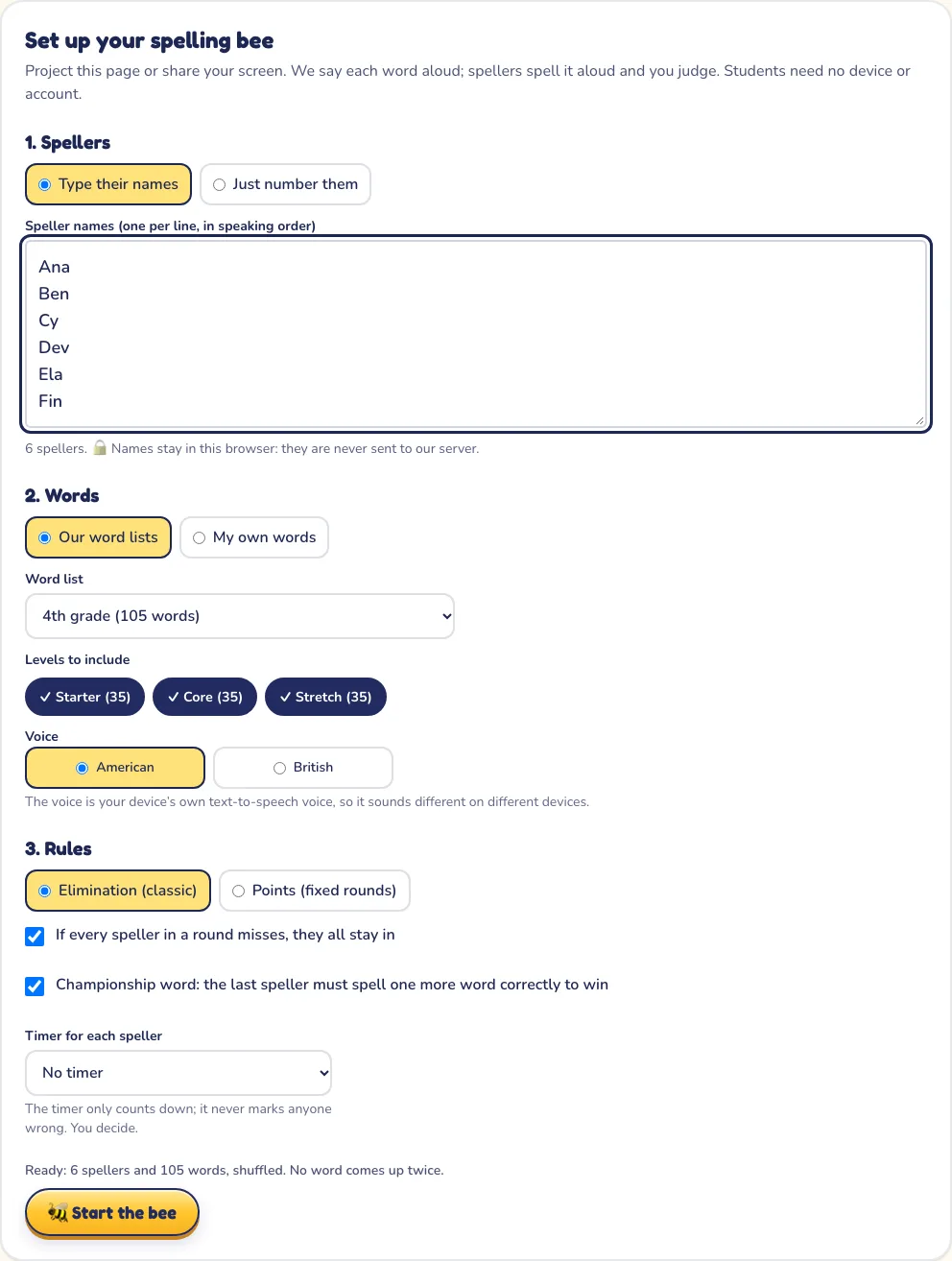
Settings you can choose: Speller names, or just a number of spellers; A word list by grade (1st–8th grade, plus harder and adult lists) or your own words; American or British device voice; Format: Elimination (classic) or Points (fixed rounds); optional answer timer.
1
Open the Spelling Bee Host
On the classroom computer, open the Spelling Bee Host page. Connect speakers or the board's sound.
What you should see: The setup form appears.
2
Add spellers and words
Type speller names (one per line) or choose Just number them. Under Words, pick a grade list or paste this week's words.
What you should see: The form says how many spellers and words are ready.
Setting up a bee: names, a word list and the format.
3
Start the bee
Press Start the bee. Explain the rules: listen, ask for the definition or a sentence if needed, then spell aloud.
What you should see: The first speller's name appears with the round number.
4
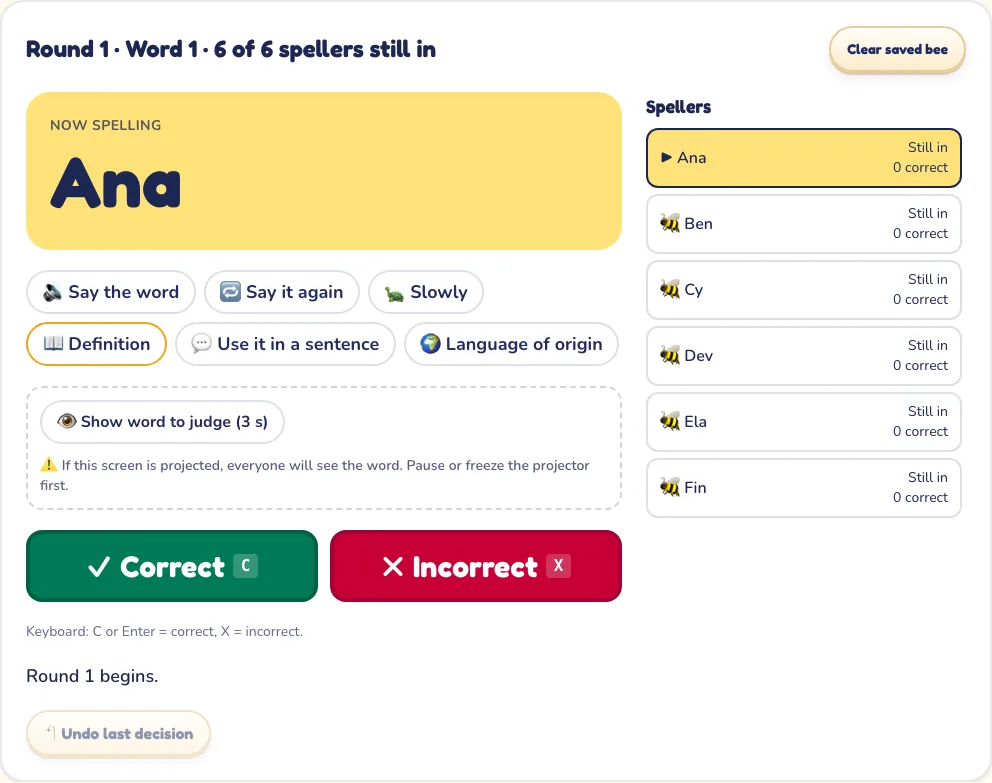
Run each turn
Press Say the word (and Definition, Use it in a sentence or Slowly when asked). Listen to the speller, then press Correct or Incorrect (keys C and X).
What you should see: The Host moves to the next speller and keeps track of who is still in.
A round in progress: the device says the word; you mark Correct or Incorrect.
5
Finish and review
When one speller is left (or after the points rounds), the Host shows the winner. Press Print results for the words used and missed.
What you should see: A printable results sheet to review difficult words with the class.
Good to know
Runs on one screen; students do not play on their own devices.
The voice is the device's text-to-speech: check unusual words first.
Names stay in your browser; nothing is saved by us.
If something goes wrong
No sound
Check the device volume and the board's audio; try another browser (voices differ by device).
A word sounds wrong
Use Say it again or Slowly, or read the word yourself; remove it from your list next time.
The projector shows the word
Freeze the projector before pressing Show word to judge.
Checked against Spelling Better 2.3.6 (73) and the live website on 28 November 2026. Screens marked “sample data” show example players and questions.
Free printable Grade 3 worksheets
Real worksheets made from this page's weekly lists, each with an answer key. Preview, print or save as PDF, or open one in its tool to change the words.
Picnic Word Search and Look, Cover, Write
Easy directions (across and down) suit third graders. The look-cover-write table on the back turns the puzzle into real spelling practice.
Students who have the Spelling Better app can keep practising spelling and vocabulary with its quizzes and word games at home. This is optional extra practice: the app uses its own word lists, not the words from this lesson.
Made with the free lesson plan generator at spellingbetter.com. A template-based starting point: change anything that does not suit your class.
Homophone Pairs and a Mini Spelling Bee
45 minutes · Students use meaning to choose between homophones, then play a short whole-class spelling bee where they must ask for the sentence.
Homophone Pairs and a Mini Spelling Bee
Students use meaning to choose between homophones, then play a short whole-class spelling bee where they must ask for the sentence.
Objectives
By the end of the lesson, students should be able to:
Spell seven homophone pairs correctly in context.
Use a sentence or meaning to decide which spelling is needed.
Ask for a sentence before spelling a homophone aloud.
Materials
This week's homophone list
Two blank cards or a whiteboard per student
A computer with the free Spelling Bee Host and a speaker
A printed homophone worksheet
Target words
hear
here
week
weak
knight
night
write
right
flour
flower
pair
pear
whole
hole
Timing
Time
Stage
Minutes
0–5 min
Which one?
5
5–13 min
Meaning first
8
13–21 min
Homophone Hold-Up
8
21–33 min
Mini spelling bee
12
33–41 min
Sentence check
8
41–45 min
One pair I know
4
Whole lesson
45
Lesson stages
1. Which one?5 min (0–5 min)
Show that two words can sound the same and be spelled differently.
Say 'pear' and ask students to draw it on a whiteboard.
Some will draw a fruit and some may draw two of something. Show both spellings: pear and pair.
2. Meaning first8 min (5–13 min)
Teach the pairs and a clue for each.
Show the seven pairs side by side and read a sentence for each word.
Give a memory clue for tricky pairs: hear has an ear in it; a knight has a silent k like knife and knee.
Students copy the pairs into their notebooks with a tiny picture beside each word.
3. Homophone Hold-Up8 min (13–21 min)
Practice choosing the right spelling from a sentence.
Play Homophone Hold-Up with hear/here, knight/night and whole/hole.
After each round, ask one student which word in the sentence gave the clue.
4. Mini spelling bee12 min (21–33 min)
Spell homophones aloud using the sentence as a guide.
Open the Spelling Bee Host, choose My own words and paste this week's list. Enter pairs as the spellers and choose Points with 1 round: the Host needs one word per speller per round, and the list has 14 words.
Rule for today: before spelling, every speller asks for the sentence, and you read it from the list on this page.
Partners take turns: one spells for the pair while the other listens; mark each spelling on the Host.
Tip: Without the sentence, both spellings of a homophone are fair. Accept either if the speller did not hear a sentence.
Each student says one pair and a clue that helps them, for example 'week has two e's like seven days in a row'.
Note the pairs nobody chose and review them tomorrow.
Differentiation
Support: Use four pairs instead of seven and give every student picture cards to hold up.
Stretch: Students write a short story about a knight that uses at least five pairs correctly.
Assessment
Use the worksheet and the bee: which pairs did students spell correctly from a sentence, and which did they still mix up?
Homework
Find two homophone pairs at home (on packets, signs or in a book) and write a sentence for each word.
After class (optional)
Students who have the Spelling Better app can keep practising spelling and vocabulary with its quizzes and word games at home. This is optional extra practice: the app uses its own word lists, not the words from this lesson.
Made with the free lesson plan generator at spellingbetter.com. A template-based starting point: change anything that does not suit your class.
Find the twelve picnic words in the word search. Then pick four words, clap their syllables and write them with a line between the syllables (pic|nic).
With a grown-up, paste this week's list into the spelling test generator. Listen to each word, type it, and write down any word you missed so you can practice it again tomorrow.
Look for words that sound like another word on packets, signs or in a book at home (for example flour on a bag). Write each one with its partner word and draw a small picture for both.
Character postcard
writing · about 20 min
Write a postcard from a story character to a friend. Use at least five describing words from this week's list, such as fearless, kindness or suddenly, and underline each one.
Weekend spelling game
weekend · about 10 min
With a grown-up, play two or three rounds of Spell It! on a family device and choose 3rd grade words. Write down the best word you spelled and one word that tricked you.
Students who have the Spelling Better app can do extra practice with its spelling quizzes, vocabulary quizzes, flashcards and word games. The app uses its own word lists and does not report back to teachers.
A week of English practice for 3rd grade
A sample week that works with any of the four lists above. Each day is short, so it fits around reading and writing time.
Monday15 min
Meet the list
Read the list together and talk about the pattern. Students try six words on a look-cover-write table to see which ones they already know.
Tuesday15 min
Sort and split
Clap syllables, split prefixes or sort the words by pattern. Students copy the list neatly into their notebooks in groups.
Wednesday20 min
Worksheet day
Students complete one of the worksheets for this list, such as the word search, matching or crossword.
☐ Take the Friday check and circle words to keep practicing
spellingbetter.com/for-teachers/grades/
Grade 3 teacher questions
How many spelling words should a 3rd grader learn each week?
Ten to fifteen words is a comfortable starting point for most third graders, which is why each list on this page has twelve to fourteen. If a student is struggling, give them the first six to eight words; if a list is too easy, add a few stretch words from the longer 3rd grade list. Every class is different, so easier or harder lists are both fine.
What spelling patterns work well in 3rd grade?
Many third grade classes work on two-syllable words, common prefixes such as un- and re-, homophones, and suffixes like -ful, -less, -ness and -ly. The four lists here follow that order, from splitting picnic into pic-nic to spelling happiness with the y changed to i.
Where can I find a longer list of 3rd grade spelling words?
Our 3rd grade spelling words page (/3rd-grade-spelling-words/) has a longer list in Starter, Core and Stretch groups, with meanings. The same list is built into the free Spelling Bee Host, and you can paste any of its words into the free worksheet tools (/for-teachers/tools/) to make your own practice sheets.
How do I run a spelling bee with my 3rd grade class?
Use the free Spelling Bee Host on one screen. Choose the 3rd grade list or paste your own words, pick Points (fixed rounds) so nobody is out early, and let the device voice read each word. Words from our lists come with a meaning and a sentence; for pasted words, read the sentence yourself. Students need no device or account, and you mark each spelling as you go.
Can my 3rd graders use the Spelling Better app in class?
Only as an optional, supervised extra for small groups. App rooms hold 2–4 players, each on their own phone or tablet with the app and their own account, and they cost in-app coins. An adult should set up and supervise the group. For the whole class, the browser Spelling Bee Host is the better choice.
How can I help a student who keeps mixing up homophones?
Teach one pair at a time and always give the meaning or a sentence with the word. Picture clues help a lot (a pear for the fruit, two socks for pair), and short memory tricks such as 'you hear with your ear' stick well. The fill-in-the-blanks and bingo worksheets on this page are built for homophone practice.
Continue practising with Spelling Better
Students can practise spelling and vocabulary at their own level in the app, on their own phone or tablet.
Spelling Better is free to download for iPhone, iPad and Android. Group rooms use in-app coins. Premium is free for everyone until 31 December 2026.