2nd Grade Spelling Games, Phonics Activities and English Worksheets
Four weekly lists for second graders that move from blends like frog and swim to magic e, vowel teams and compound words such as rainbow and toothbrush. Each list has classroom games, printable worksheets, lesson plans and a free whole-class spelling bee.
Children in 2nd grade are usually 7–8 years old. In England and Wales this is often Year 3, and in many other countries it is called Grade 2 or Class 2. Every class is different: use an easier or harder grade’s lists whenever they fit your students better.
What 2nd grade students can practise
Blends
Hear and spell two consonants side by side at the start or end of a word, such as cr in crab, fl in flag and mp in jump, without dropping a letter.
Silent e
Explain how an e at the end of a word makes the vowel say its name (kit to kite, cub to cube) and spell words with a_e, i_e, o_e and u_e.
Vowel teams
Spell long vowel sounds with two letters (rain, play, tree, leaf, boat, snow) and know that ay and ow often come at the end of a word.
Compound words
Split a compound word into its two smaller words, use the parts to work out the meaning, and spell the whole word without a space.
Word meaning
Give a meaning for each weekly word in their own words and choose the right word to complete a sentence.
Proofreading
Check their own sentences for list words, capital letters, spaces and end marks, and correct at least one mistake on their own.
Spelling patterns and word study: consonant blends at the start (cr, fl, gr, sw) · blends at the end (mp, nd) · silent e: a_e, i_e, o_e, u_e · vowel team ai and ay · vowel team ee and ea · vowel team oa and ow · compound words · double l at the end (spill).
These are suggested focus areas for this age, not an official curriculum. Adapt them to your own scheme of work.
Classroom games and activities for 2nd grade
Teacher-led activities with full rules and an example round. None of them needs the app.
Blend Riddles
10–15 min · team · Children who can hear two-letter blends at the start of a word
Objective: Teams listen to a riddle that gives the first blend and a clue, then write the list word that answers it.
You need
A whiteboard and marker for each team
Riddle cards written by the teacher
A scoreboard on the main board
Before you start
Write one riddle for each Week 1 word: the blend it starts with plus a meaning clue.
Put children in teams of three or four and give each team a whiteboard.
How to play
The teacher reads a riddle twice. Teams talk quietly and agree on the answer.
One team member writes the word on the whiteboard. Writers change every round.
On "Boards up!", all teams show their answer at the same time.
A team scores 1 point for the right word and 1 more point if every letter is correct.
The teacher writes the word on the board and the class underlines the blend together.
Example round: Teacher: "I start with fr. I am green, I hop and I live near a pond. What am I?" Teams write frog. Next: "I start with sw. You do me in a pool with your arms and legs." Teams write swim. Next: "I start with cr. I walk sideways on the beach and have two claws." Teams write crab.
Easier: Show the list of Week 1 words on the board so teams choose the answer and copy it carefully. Harder: Give only the meaning clue, not the blend, and ask teams to underline the blend in their answer. Or let teams write their own riddle for another team.
8–12 min · whole-class · Children who can read short vowel words
Objective: Children see and hear how adding a silent e to the end of a short word changes the vowel sound and makes a new word.
You need
A large card with the letter e on it (the "magic e")
Word cards for short vowel words that become real words with an e
Board or pocket chart
Before you start
Write short word cards that turn into real words with an e: kit, cub, pin, hop, tap, cap, not, rob.
Leave space after each card so the magic e card can slide in at the end.
How to play
The teacher shows a short vowel word and the class reads it.
One child is the "magic e" and walks up to stand at the end of the word with the e card.
The class reads the new word together: the vowel now says its name.
The class gives a quick meaning or action for both words.
The magic e moves on to the next word. A new child takes the card each time.
Finish by writing two of the new words from memory on whiteboards.
Example round: The teacher shows kit. Class: "kit." Ellie brings the magic e to the end. Class: "kite!" Someone mimes flying a kite. Next: cub. With the e it becomes cube, and a child holds up an ice cube shape with their hands. Then pin becomes pine and hop becomes hope.
Easier: Use only i and o words (kit, pin, hop, not) and say the vowel name together before reading the new word. Harder: Show a silent e word and ask children to take the e away and read what is left. Ask which list words cannot lose the e and stay real words (cake, smile).
Which Vowel Team?
8–12 min · whole-class, individual · Children learning two-letter vowel spellings
Objective: Every child chooses the spelling of a long vowel sound by holding up a card, then the class checks the word and the spelling rule.
You need
Three small cards per child: ai/ay, ee/ea, oa/ow (one spelling on each side)
The Week 3 word list on the board, covered
Before you start
Make the double-sided cards, or let children write them on folded paper.
Cover the Week 3 list so it can be revealed after each word.
How to play
The teacher says a word from the list in a short sentence.
Children pick the card for that vowel sound and turn it to the spelling they think is right.
On "Show me!", everyone holds up their card.
The teacher reveals the word and the class checks the spelling.
The class says the rule of thumb when it helps: ay and ow often come at the end of a word, ai and oa in the middle.
For ee and ea, there is no easy rule, so children say the word with its spelling: "leaf, l-e-a-f".
Example round: Teacher: "We play soccer after lunch. Play." Children hold up the ai/ay card turned to ay. Reveal: play. "Ay at the end." Teacher: "The boats sail out. Sail." Most show ai. Reveal: sail. Teacher: "Grandpa rowed the boat. Boat." Children show oa: "oa in the middle."
Easier: Use only the ai/ay card for the first round, with rain, sail, play and stay. Harder: After the card, children write the whole word on a whiteboard. Add a new word that follows the same rule, such as snail or tray.
Write each half of the Week 4 words on its own card. Make one card per child; for an odd number, join in yourself.
Shuffle the cards and hand one to each child face down.
How to play
On "Go", children walk around quietly and read each other's cards.
When two halves make a real compound word, the pair stands together.
Each pair must be able to say what their word means using both parts.
Pairs take turns writing their word on the board as one word, with no space.
If a pair makes a real word that is not on the list (snowball, playroom, sunfish), they still score, then the class finds the list words that are left.
Example round: Tom holds tooth and finds Ana with brush: "Toothbrush! A brush for your teeth." Sam holds snow and finds Leo with man: "Snowman, a man made of snow." Kim holds play and finds Raj with room: "Playroom is a real word, a room to play in." They score, and the class notices that playground and bedroom still need their partners.
Easier: Put a picture of the whole word on the back of each card so children can check their match. Harder: After pairing, each pair writes a sentence that uses their compound word and one other word from the list.
Spelling Tic-Tac-Toe
10–15 min · pair · Children who can read the week's words aloud to a partner
Objective: Partners play tic-tac-toe where each square can only be claimed by spelling its hidden word correctly.
You need
A 3 × 3 grid per pair with one list word written lightly in each square
A sticky note over each square
Whiteboards or scrap paper
Before you start
Write nine words from the week's list in the squares of a grid, one grid per pair.
Cover each square with a sticky note so the words are hidden.
How to play
Player X picks a square. Player O peeks under the sticky note and reads the word aloud.
Player X writes the word on a whiteboard without looking.
Player O checks the spelling against the hidden word. If it is right, X removes the note and writes an X in the square.
If it is wrong, the note stays on and the square can be chosen again later.
Players swap roles each turn. Three in a row wins; then make a new grid.
Example round: Week 2 grid: cake, game, snake, bike, kite, smile, bone, rope, cube. Max picks the middle square. Zoe peeks and reads "smile". Max writes s-m-i-l-e. Zoe checks: correct, so Max puts an X in the middle. Zoe picks a corner. Max reads "cube". Zoe writes c-u-b, forgetting the e. The note stays on.
Easier: Leave the word visible for three seconds before the speller writes it, or use only six different words. Harder: The speller must also say a sentence with the word before writing it. Use the Week 4 compound words for the grid.
10–15 min · individual · Children who can write short sentences
Objective: Children write a dictated sentence with two list words, then proofread it with a four-step checklist and fix their own mistakes.
You need
Lined paper or a notebook
A colored pencil for corrections
A four-step checklist on the board: capital, spaces, list words, end mark
Before you start
Write three short sentences, each using two words from this week's list.
Put the checklist on the board where everyone can see it.
How to play
The teacher reads the whole sentence once, then in short chunks, then once more.
Children write the sentence in pencil.
Children check their sentence against each step of the checklist, one at a time, and fix mistakes in colored pencil.
The teacher shows the sentence. Children tick each list word that was right the first time.
Children count their colored-pencil fixes: every fix shows good checking.
Example round: Teacher: "We play on the beach when there is no rain." Children write it. Using the checklist, Mia sees she wrote "we" with a small w and fixes it in color. She checks play, beach and rain against the list and notices she wrote "beech". She fixes it to beach. She gets ticks for play and rain and a fix mark for beach.
Easier: Dictate a sentence with only one list word and give children the first word already written. Harder: Dictate two sentences in a row, and include one word from an earlier week's list.
Read-aloud tests by grade; the device says each word.
Grade 2 spelling and vocabulary words, week by week
Four original weekly lists with meanings and example sentences. Copy or print a list, or turn it into a worksheet, flashcards or a read-aloud spelling test in one click.
Week 1 · Initial and final consonant blends
Week 1: Consonant blends
Objective: Students hear both consonants in a blend at the start or end of a word and spell each word without leaving a letter out.
Week 1: Consonant blends: words, meanings and example sentences
Word
Meaning
Example
Listen
blocknoun · bl
A solid piece of wood, plastic or stone with flat sides.
He put one more block on top of the tower.
clapverb · cl
To hit your hands together to make a sound.
We clap when the song ends.
crabnoun · cr
A sea animal with a hard shell, eight legs and two claws.
A crab walked sideways across the sand.
flagnoun · fl
A piece of cloth with colors or a picture on it, often flown on a pole.
The flag flapped in the wind.
frognoun · fr
A small green or brown animal with long back legs that jumps and lives near water.
The frog sat on a lily pad.
grassnoun · gr
The thin green leaves that cover lawns and fields.
We had a picnic on the soft grass.
plantnoun · pl, nt
A living thing that grows in soil, like a flower or a tree.
Our class plant needs water every Monday.
slednoun · sl
A board or small seat on runners for sliding over snow.
We rode the sled down the snowy hill.
spillverb · sp, double l
To let a liquid run out of its container by mistake.
Hold your cup with two hands so you do not spill your juice.
swimverb · sw
To move through water using your arms and legs.
My sister can swim across the pool.
jumpverb · mp
To push off the ground with your legs and go up in the air.
Can you jump over the puddle?
pondnoun · nd
A small area of still water, smaller than a lake.
Ducks swim in the pond near our school.
Practice ideas
Stretch and count: say each word slowly and hold up a finger for every sound. Crab has four sounds (c-r-a-b), so check that four letters are written.
Underline the blend in each word in one color and the vowel in another.
Act out the action words (clap, spill, swim, jump) while a partner guesses and spells the word.
Write a short outdoor story that uses at least four list words, then circle them.
Week 2 · Silent e (vowel-consonant-e)
Week 2: Magic e words
Objective: Students learn that a silent e at the end of a word makes the vowel say its name, and spell a_e, i_e, o_e and u_e words.
Week 2: Magic e words: words, meanings and example sentences
Word
Meaning
Example
Listen
cakenoun · a_e
A sweet baked food, often eaten at birthday parties.
We put six candles on the cake.
gamenoun · a_e
Something you play that has rules, for fun or to win.
Let's play a game of tag at recess.
snakenoun · a_e
A long animal with no legs that slides along the ground.
The snake hid under a warm rock.
waveverb · a_e
To move your hand from side to side to say hello or goodbye.
I wave to my mom from the bus window.
bikenoun · i_e
A machine with two wheels and pedals that you ride.
I ride my bike to the park on Sundays.
kitenoun · i_e
A light frame covered with paper or cloth that flies in the wind on a long string.
Our kite flew high above the trees.
smileverb · i_e
To turn up the corners of your mouth because you are happy.
The baby smiled when she saw the puppy.
bonenoun · o_e
One of the hard white parts inside your body that make up your skeleton.
The dog buried a bone in the yard.
ropenoun · o_e
A long, strong cord made of twisted threads.
We took turns with the jump rope.
homenoun · o_e
The place where you live with your family.
We walk home together after school.
cubenoun · u_e
A solid shape with six square sides that are all the same size.
Put an ice cube in my drink, please.
flutenoun · u_e (says oo)
A musical instrument shaped like a thin tube that you play by blowing across a hole.
Maya plays the flute in the school band.
Practice ideas
Magic e switch: write kit and cub on the board, add an e to each, and read how the vowel changes (kite, cube).
Sort the words into four columns: a_e, i_e, o_e and u_e.
Draw a loop from the e back over the consonant to the vowel, to show that the e makes the vowel say its name.
Play "I am thinking of": give a meaning clue ("something that flies on a string") and partners write the word.
Week 3 · Vowel teams ai, ay, ee, ea, oa, ow
Week 3: Vowel teams
Objective: Students spell long vowel sounds made by two letters together and learn which spelling usually comes at the end of a word.
Week 3: Vowel teams: words, meanings and example sentences
Word
Meaning
Example
Listen
rainnoun · ai
Drops of water that fall from clouds.
We stayed inside because of the rain.
sailverb · ai
To travel across water in a boat pushed along by the wind.
We watched the boats sail out of the harbor.
playverb · ay
To do something just for fun, like a game or a sport.
We play soccer after lunch.
stayverb · ay
To remain in the same place and not go away.
Please stay with your group at the museum.
treenoun · ee
A tall plant with a wooden trunk, branches and leaves.
A bird built a nest in the tree.
sleepverb · ee
To rest with your eyes closed, the way you do at night.
Cats sleep for a big part of the day.
leafnoun · ea
One of the flat green parts that grow on a plant or tree.
A red leaf floated down onto the path.
beachnoun · ea
The land next to the sea, covered with sand or small stones.
We built a sandcastle at the beach.
boatnoun · oa
A small vehicle that floats and carries people on water.
Grandpa rowed the boat across the lake.
roadnoun · oa
A wide hard path that cars, bikes and buses travel on.
Look both ways before you cross the road.
snownoun · ow
Soft white flakes of frozen water that fall from the sky when it is very cold.
The snow covered the playground.
growverb · ow
To get bigger or taller over time.
Sunflowers grow taller than me.
Practice ideas
"When two vowels go walking" is a helpful rhyme for ai, ee, oa and ea, but check each word: it does not work for every word in English.
Ending hunt: find the words where ay and ow come at the very end (play, stay, snow, grow) and the words where ai and oa come in the middle.
Hold up an ai or ay card when the teacher says a long a word, then check with the list.
Draw a day-out picture strip (beach, boat, tree, road) and write one sentence under each picture.
Week 4 · Compound words
Week 4: Compound words
Objective: Students join two small words to make a compound word, use the parts to explain its meaning, and spell the whole word as one word.
Week 4: Compound words: words, meanings and example sentences
Word
Meaning
Example
Listen
sunsetnoun · sun + set
The time in the evening when the sun goes down.
The sky turned orange at sunset.
rainbownoun · rain + bow
An arch of colors in the sky when the sun shines through drops of water.
We saw a rainbow after the storm.
cupcakenoun · cup + cake
A small cake baked in a paper cup.
Each child decorated a cupcake with sprinkles.
footballnoun · foot + ball
A game where players kick or carry a ball to score, or the ball itself.
My brother plays football on Saturdays.
bedroomnoun · bed + room
The room in a house where you sleep.
My bedroom has a window that faces the garden.
sandboxnoun · sand + box
A low box filled with sand for children to play in.
The little kids dug tunnels in the sandbox.
popcornnoun · pop + corn
A snack made of corn kernels that puff up when heated.
We shared a bowl of popcorn during the movie.
starfishnoun · star + fish
A sea animal shaped like a star, usually with five arms.
We found a starfish in a rock pool.
backpacknoun · back + pack
A bag with two straps that you carry on your back.
Put your reading book in your backpack.
toothbrushnoun · tooth + brush
A small brush with a long handle for cleaning your teeth.
I got a new blue toothbrush.
snowmannoun · snow + man
A figure of a person made out of packed snow.
We gave our snowman a carrot nose.
playgroundnoun · play + ground
An outdoor area with swings and slides where children play.
The playground has a new slide.
Practice ideas
Word math: write sun + set = sunset on the board, then let children write the sums for the other words.
Cut each word card into its two parts, mix them up and put them back together as fast as you can.
Explain the meaning from the parts: a toothbrush is a brush for your teeth; a backpack is a pack on your back.
Invent a new silly compound word (like a "socksnake"), draw it and write a sentence about it, then spell three real ones from the list.
Your browser has no speech voice, so the listen buttons are hidden.
Need a longer list? See the full 2nd grade spelling words, with a read-aloud test for every level.
Turn these words into a classroom game: paste a week’s list into the free Spelling Bee Host and run a spoken bee on the board, or see how to host a live game below.
How to host live word games for Grade 2 students
Suggested game session for 2nd grade
The free Spelling Bee Host runs a whole-class bee on one screen. The device voice reads each word, children need no devices or accounts, and the teacher marks every answer, so seven- and eight-year-olds can practise spelling aloud in a calm, fair way.
Game
Spelling Bee Host (in your browser)
Settings to try
Paste this week's 12 words and enter four teams as the spellers (Points, 3 rounds = 12 words), or for one speller per child choose the 2nd grade list's Starter and Core groups. Try a 45-second timer later in the year.
Vocabulary focus
This week's blends, silent e words, vowel teams or compound words. If a pasted word has no sentence in the Host, read the sentence from this page.
Warm-up
Spell three review words from last week together as a class chant, pointing to each letter on the board, before the first speller stands up.
Session length
15–20 minutes
Format
Every child spells aloud: team members take turns as their team's speller (or each child is a speller with the grade list), and team scores mean every word counts and nobody sits out.
Supervision
The teacher runs the screen, pauses the projector before the word is shown and decides each answer. Remind spellers they can ask to hear the word or the sentence again.
Afterwards
List the three words most spellers missed, sort them by pattern (blend, silent e, vowel team) and practise them in tomorrow's warm-up.
Independent practice
Share this week's words through the spelling test generator so children can hear and spell them at home, or play Spell It! with the 2nd grade list.
For a written round, open the read-aloud spelling test on the board: everyone writes each word on paper at the same time and you mark them together.
Session length and grouping are teaching suggestions, not app settings. The app has no grade setting.
Step by step: Spelling Bee Host (in your browser)
Best for: A whole class on one screen, from kindergarten up. Free, no accounts, no student devices.
Players: 2–60 spellers on one screen
Devices: Any computer, laptop or interactive whiteboard with a modern browser and speakers
Cost: Free. No sign-up.
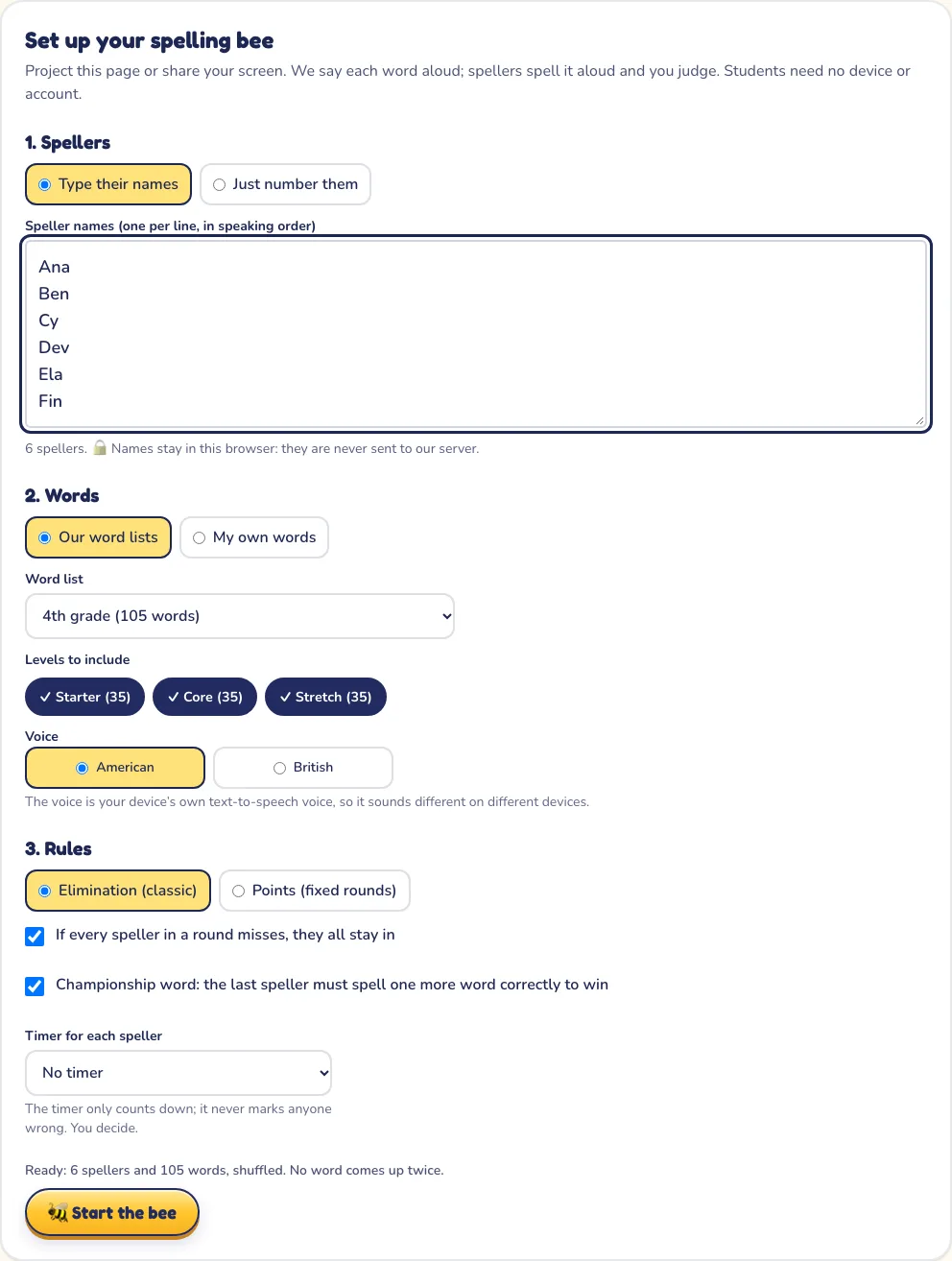
Settings you can choose: Speller names, or just a number of spellers; A word list by grade (1st–8th grade, plus harder and adult lists) or your own words; American or British device voice; Format: Elimination (classic) or Points (fixed rounds); optional answer timer.
1
Open the Spelling Bee Host
On the classroom computer, open the Spelling Bee Host page. Connect speakers or the board's sound.
What you should see: The setup form appears.
2
Add spellers and words
Type speller names (one per line) or choose Just number them. Under Words, pick a grade list or paste this week's words.
What you should see: The form says how many spellers and words are ready.
Setting up a bee: names, a word list and the format.
3
Start the bee
Press Start the bee. Explain the rules: listen, ask for the definition or a sentence if needed, then spell aloud.
What you should see: The first speller's name appears with the round number.
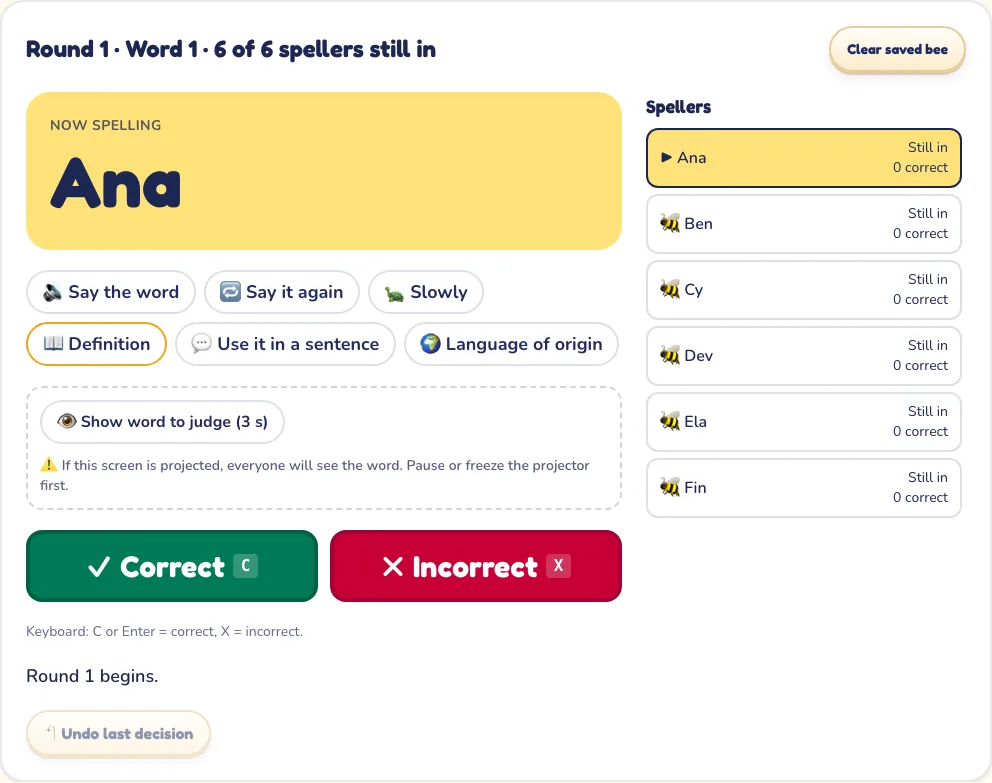
4
Run each turn
Press Say the word (and Definition, Use it in a sentence or Slowly when asked). Listen to the speller, then press Correct or Incorrect (keys C and X).
What you should see: The Host moves to the next speller and keeps track of who is still in.
A round in progress: the device says the word; you mark Correct or Incorrect.
5
Finish and review
When one speller is left (or after the points rounds), the Host shows the winner. Press Print results for the words used and missed.
What you should see: A printable results sheet to review difficult words with the class.
Good to know
Runs on one screen; students do not play on their own devices.
The voice is the device's text-to-speech: check unusual words first.
Names stay in your browser; nothing is saved by us.
If something goes wrong
No sound
Check the device volume and the board's audio; try another browser (voices differ by device).
A word sounds wrong
Use Say it again or Slowly, or read the word yourself; remove it from your list next time.
The projector shows the word
Freeze the projector before pressing Show word to judge.
Checked against Spelling Better 2.3.6 (73) and the live website on 28 November 2026. Screens marked “sample data” show example players and questions.
Free printable Grade 2 worksheets
Real worksheets made from this page's weekly lists, each with an answer key. Preview, print or save as PDF, or open one in its tool to change the words.
Consonant Blends: Look, Cover, Write and Missing Letters
Remind children to say every sound in the blend. Missing letters often falls on the blend, which is the part to practise.
Consonant Blends: Look, Cover, Write and Missing Letters
Find each word in the grid. Tick it off when you find it.
m
l
f
m
s
b
k
p
d
c
z
p
q
n
f
w
h
m
s
r
l
a
m
q
l
f
i
s
g
a
p
s
p
l
a
n
t
m
x
b
l
d
o
w
g
b
l
o
c
k
b
w
n
c
l
c
t
y
w
t
f
w
d
g
g
r
a
s
s
j
r
x
a
s
p
i
l
l
l
u
o
r
c
l
a
p
i
u
e
m
g
a
q
r
v
v
d
h
d
p
block
clap
crab
flag
frog
grass
jump
plant
pond
sled
spill
swim
Made with the free worksheet tools at spellingbetter.com
Answer key: Outdoor Play Blends Word Search
Word search
m
l
f
m
s
b
k
p
d
c
z
p
q
n
f
w
h
m
s
r
l
a
m
q
l
f
i
s
g
a
p
s
p
l
a
n
t
m
x
b
l
d
o
w
g
b
l
o
c
k
b
w
n
c
l
c
t
y
w
t
f
w
d
g
g
r
a
s
s
j
r
x
a
s
p
i
l
l
l
u
o
r
c
l
a
p
i
u
e
m
g
a
q
r
v
v
d
h
d
p
block: row 5, column 6, going right
clap: row 9, column 3, going right
crab: row 1, column 10, going down
flag: row 2, column 5, going down
frog: row 7, column 1, going down
grass: row 7, column 5, going right
jump: row 7, column 10, going down
plant: row 4, column 3, going right
pond: row 4, column 3, going down
sled: row 7, column 9, going down
spill: row 8, column 4, going right
swim: row 1, column 5, going diagonally down to the right
Answer key · spellingbetter.com
Magic e Words Vocabulary Quiz
Read the questions aloud for children who need it. Both parts use words from the start of the list; raise the counts in the tool to include cube and flute.
Two complete, printable plans built around this page's weekly lists.
Magic e: How One Letter Changes a Word
35 minutes · A 35-minute lesson that shows how a silent e makes the vowel say its name, using the Week 2 words and short words that become new words with an e.
Magic e: How One Letter Changes a Word
A 35-minute lesson that shows how a silent e makes the vowel say its name, using the Week 2 words and short words that become new words with an e.
Objectives
By the end of the lesson, students should be able to:
Explain what a silent e at the end of a word does to the vowel.
Read and spell at least eight of the twelve Week 2 words.
Materials
Week 2 word cards
A large magic e card
Short word cards: kit, cub, pin, hop
Whiteboards and markers
The Week 2 vocabulary quiz worksheet
Target words
cake
game
snake
wave
bike
kite
smile
bone
rope
home
cube
flute
Timing
Time
Stage
Minutes
0–4 min
Short vowel flash
4
4–10 min
Meet the magic e
6
10–17 min
Sort the list
7
17–25 min
Spelling Tic-Tac-Toe
8
25–32 min
Vocabulary quiz
7
32–35 min
One-letter challenge
3
Whole lesson
35
Lesson stages
1. Short vowel flash4 min (0–4 min)
Review short vowel words before changing them.
Flash kit, cub, pin and hop. Children read each one fast.
Ask: which vowel sound do you hear in each word?
2. Meet the magic e6 min (4–10 min)
Show how the silent e changes the vowel sound.
Add the magic e card to kit. Read it together: kite. Say: "The e is silent, but it makes the i say its name."
Repeat with cub to cube, pin to pine and hop to hope.
Draw a loop from the e over the consonant to the vowel on the board.
Tip: Keep the language simple: "the vowel says its name" is easier for seven-year-olds than "long vowel".
3. Sort the list7 min (10–17 min)
Read the Week 2 words and sort them by vowel.
Read the twelve Week 2 words together and talk about flute and cube, which may be new.
Children sort the word cards into four groups: a_e, i_e, o_e, u_e.
Check the groups together and loop the e back to the vowel in one word from each group.
4. Spelling Tic-Tac-Toe8 min (17–25 min)
Spell the words from memory in a partner game.
Give each pair a grid with nine Week 2 words under sticky notes.
Pairs play: read the word, spell it on a whiteboard, claim the square if correct.
Stop after two games and ask which word was the trickiest.
5. Vocabulary quiz7 min (25–32 min)
Check meanings and spellings on paper.
Children complete the multiple-choice part of the Week 2 quiz on their own.
Write tap on the board. Ask: what new word do we get with a magic e?
Children explain the rule to a partner in one sentence.
Differentiation
Support: Use the seven a_e and i_e words (cake, game, snake, wave, bike, kite, smile) plus home, and leave the word cards on the table during the game.
Stretch: Ask children to find three more silent e words in their reading book and explain what the e does in each one.
Assessment
Mark the multiple-choice part of the quiz and watch the Tic-Tac-Toe games: note who forgets the final e when spelling from memory.
Homework
Write five silent e words from the list and draw a loop from the e to the vowel in each, then use two of them in sentences.
Students who have the Spelling Better app can keep practising spelling and vocabulary with its quizzes and word games at home. This is optional extra practice: the app uses its own word lists, not the words from this lesson.
Made with the free lesson plan generator at spellingbetter.com. A template-based starting point: change anything that does not suit your class.
Compound Words and a Class Spelling Bee
40 minutes · A 40-minute lesson on the Week 4 compound words: build them, explain their meanings, then spell them in a short Points bee on the free Spelling Bee Host.
Compound Words and a Class Spelling Bee
A 40-minute lesson on the Week 4 compound words: build them, explain their meanings, then spell them in a short Points bee on the free Spelling Bee Host.
Objectives
By the end of the lesson, students should be able to:
Split a compound word into two smaller words and use them to explain its meaning.
Spell the Week 4 compound words as one word with no space.
Materials
Half-word cards for the Week 4 words
Whiteboards and markers
A projector or large screen for the Spelling Bee Host
The Week 4 crossword worksheet
Target words
sunset
rainbow
cupcake
football
bedroom
sandbox
popcorn
starfish
backpack
toothbrush
snowman
playground
Timing
Time
Stage
Minutes
0–4 min
Word math
4
4–9 min
What is a compound word?
5
9–17 min
Compound Word Partners
8
17–29 min
Class spelling bee
12
29–36 min
Compound crossword
7
36–38 min
Two-word check
2
38–40 min
Invent a word
2
Whole lesson
40
Lesson stages
1. Word math4 min (0–4 min)
Get children thinking about joining words.
Write sun + set = ? on the board. Children write the answer on whiteboards.
Repeat with cup + cake and foot + ball.
2. What is a compound word?5 min (4–9 min)
Explain compound words and how the parts give the meaning.
Explain: a compound word is two words joined together to make a new word.
Model the meaning: "A backpack is a pack you carry on your back."
Read the twelve Week 4 words together and clap once for each part.
3. Compound Word Partners8 min (9–17 min)
Build the words and explain their meanings.
Hand out the half-word cards.
Children find their partner and say what their word means.
Pairs write their word on the board as one word.
4. Class spelling bee12 min (17–29 min)
Spell the compound words aloud in a calm, team-scored game.
Open the Spelling Bee Host, paste the twelve Week 4 words, enter up to six teams as the spellers and choose Points with 2 rounds.
Each speller says the two parts first, then spells the whole word aloud.
Mark each answer and keep team scores on the board.
Tip: Pause or freeze the projector before you reveal each word, so the class cannot read it on the screen.
Ask children to invent a silly compound word and say what it would mean.
Choose two to write on the class word wall.
Differentiation
Support: Give six words with short, easy parts (sunset, cupcake, bedroom, sandbox, popcorn, snowman) and keep the half cards on the table during the bee.
Stretch: Ask children to find three compound words in a book or around the classroom (for example notebook or classroom) and add them to the word wall.
Assessment
Check the two-word slips and the bee results: note who leaves a space or drops a letter where the two parts join (for example toothbrush written as "tooth brush").
Homework
Finish the compound word crossword, then find two compound words at home and draw them.
Students who have the Spelling Better app can keep practising spelling and vocabulary with its quizzes and word games at home. This is optional extra practice: the app uses its own word lists, not the words from this lesson.
Made with the free lesson plan generator at spellingbetter.com. A template-based starting point: change anything that does not suit your class.
Send home a worksheet made from this week's list, such as look, cover, write with missing letters. Children complete it and circle the pattern in each word (the blend, the silent e or the vowel team).
Paste this week's words into the spelling test generator and share the link with families. The child listens to each word and writes it on paper, then a grown-up helps check the answers.
With a family member, look through a cereal box, a menu or a storybook for words with ai, ay, ee, ea, oa or ow. Write down five you find and underline the vowel team.
My best day out
writing · about 20 min
Write four or five sentences about a fun day out (real or made up) that use at least four words from this week's list. Underline the list words and check each one against the list.
Weekend compound word collection
weekend · about 10 min
Over the weekend, collect compound words you see or hear (for example weekend, cupboard or doorbell). Write each one as a word sum, like door + bell = doorbell, and bring your best three to class.
Students who have the Spelling Better app can do extra practice with its spelling quizzes, vocabulary quizzes, flashcards and word games. The app uses its own word lists and does not report back to teachers.
A week of English practice for 2nd grade
A five-day routine for one weekly list, with 15–20 minutes a day. The same plan works for blends, silent e, vowel teams and compound words.
Monday15 min
Pattern and pretest
Introduce the pattern with two example words, read the list together and give a quick pretest of six words. Children circle the words they want to practise most.
Tuesday15 min
Pattern game
Play the pattern game for the week: Blend Riddles, Magic E Switch, Which Vowel Team? or Compound Word Partners.
Wednesday20 min
Worksheet and meanings
Complete one printable worksheet for the list, then partners take turns explaining what three of the words mean.
☐ I checked my sentences for capitals, spaces and end marks.
☐ I fixed at least one mistake on my own.
spellingbetter.com/for-teachers/grades/
Grade 2 teacher questions
How many spelling words should 2nd graders have each week?
The weekly lists on this page have 12 words. Many second-grade classes use between 8 and 15, often with a few challenge words for confident spellers. Pick a size that lets most children spell most words by Friday. Our 2nd grade spelling words page (/2nd-grade-spelling-words/) has a longer list in Starter, Core and Stretch groups if you need more words.
Which spelling patterns fit 2nd grade?
Second graders usually move on from short vowel words to consonant blends (frog, swim), silent e words (kite, cube), vowel teams such as ai, ay, ee, ea, oa and ow, and compound words. Many classes also start simple endings such as -s, -ed and -ing. Use the weekly lists in any order that fits your phonics teaching.
How do I teach the difference between ai and ay?
Give children a rule of thumb: ay usually comes at the end of a word (play, stay) and ai usually comes in the middle (rain, sail). The same idea works for ow and oa (snow, boat). For ee and ea there is no simple rule, so children learn each word by its spelling. The Which Vowel Team? activity practises this with the whole class.
How can I run a spelling bee with 2nd graders?
Open the free Spelling Bee Host on your board, paste this week's words, enter teams as the spellers and choose the Points format so nobody is out early. Team members take turns, so every word adds to a team score. The device voice reads the words, you decide each answer, and no student needs a device or account.
Is there an app my 2nd graders can practise with?
Students who have the Spelling Better app can do extra practice with its spelling quizzes, vocabulary quizzes, flashcards and word games. The app has no grade setting and cannot load your class list, so for this week's words use the free spelling test generator or Spell It! in the browser. The app's live group rooms cost in-app coins and need each player's own device and account, so with seven- and eight-year-olds treat them as an optional extra with an adult.
What if the lists are too easy or too hard for my class?
Children in the same class can be at very different stages. Use the Week 1 blends list or the 1st grade page (/for-teachers/grades/grade-1/) as a review for children who need it, and add stretch words from the 3rd grade page (/for-teachers/grades/grade-3/) for confident spellers. Every worksheet tool lets you change the words, so you can give two groups different lists on the same sheet design.
Continue practising with Spelling Better
Students can practise spelling and vocabulary at their own level in the app, on their own phone or tablet.
Spelling Better is free to download for iPhone, iPad and Android. Group rooms use in-app coins. Premium is free for everyone until 31 December 2026.