1st Grade Spelling Games, Word Activities and English Worksheets
Four weekly lists for first graders, from short vowel words like cat and bus to tricky words like said and digraph words like ship. Each list comes with games you can run tomorrow, printable worksheets, two lesson plans and a free whole-class spelling bee.
Children in 1st grade are usually 6–7 years old. In England and Wales this is often Year 2, and in many other countries it is called Grade 1 or Class 1. Every class is different: use an easier or harder grade’s lists whenever they fit your students better.
What 1st grade students can practise
Phonics
Hear the three sounds in a short word such as pig or bus and write a letter for each sound, left to right.
Short vowels
Tell the five short vowel sounds apart in the middle of a word (nap, web, zip, dog, cup) and choose the right vowel letter.
Tricky words
Read and spell everyday words that do not follow the usual sound rules, such as said, was, they and one, by remembering the tricky part.
Digraphs
Know that two letters can make one sound (sh, ch, th, ck) and use them in words like shell, chick, bath and duck.
Word meaning
Say what each weekly word means in their own words and use it in a short spoken sentence.
Writing
Write a simple sentence that uses one or two list words, with a capital letter at the start, spaces between words and a period at the end.
Spelling patterns and word study: short a (cat, nap) · short i (pig, zip) · short e (bed, web) · short o (dog, hot) · short u (sun, bus) · tricky heart words (said, one) · sh (ship, fish) · ch (chick, lunch) · th (thin, bath) · ck after a short vowel (duck, sock).
These are suggested focus areas for this age, not an official curriculum. Adapt them to your own scheme of work.
Classroom games and activities for 1st grade
Teacher-led activities with full rules and an example round. None of them needs the app.
Sound Box Push
8–12 min · individual, whole-class · Beginning readers and spellers
Objective: Students hear each separate sound in a short word, push a counter for every sound, then write one letter in each box.
You need
A strip of paper with three boxes in a row for each child
Three counters, cubes or buttons per child
Pencils
Before you start
Draw three large boxes in a row on paper strips (one per child). Laminate them if you want to reuse them.
Pick six words from Week 1 or Week 2 and write them on a card for yourself.
How to play
Children put their three counters above the boxes.
The teacher says a word once, normally. Children repeat it.
Children say the word again very slowly and push one counter down into a box for each sound they hear.
Children touch each counter and say its sound, then say the whole word quickly.
Children move the counters away and write one letter in each box.
The teacher writes the word on the board and children check each box, fixing any letter that is wrong.
Example round: Teacher: "Pig." Children: "Pig." They say "p... i... g" and push three counters, one for each sound. They touch them: "p, i, g, pig!" Then they write p, i and g in the boxes. The teacher writes pig on the board and everyone checks. Next word: hid.
Easier: Only push the counters and say the sounds; leave out the writing. Start with words from Week 1 that begin with sounds you can stretch, such as nap and zip. Harder: Use a strip with four boxes for lunch (l-u-n-ch) and bench, and talk about why ch fits in one box. Try duck: d-u-ck is three sounds but four letters.
8–15 min · whole-class · Children who know the letter names and most letter sounds
Objective: Students listen for the short vowel in the middle of a word and walk to the corner of the room that shows that vowel.
You need
Five large signs: a, e, i, o, u
Tape
Your Week 1 and Week 2 word lists
Before you start
Tape the five vowel signs in different parts of the room, with space to stand in front of each.
Agree on a walking rule (tiptoe or "silent feet") before you start.
How to play
Everyone stands in the middle of the room.
The teacher says a word from the list twice, stretching the middle sound a little.
Children tiptoe to the vowel sign they hear in the middle of the word.
The teacher asks one child at that sign to say the middle sound and the whole word.
The whole class writes the word in the air with a finger, saying each letter.
Children who went to a different sign simply join the right sign for the next word. Nobody is out.
Example round: Teacher: "Bus... buuus." Most children tiptoe to the u sign. Leo says, "u, bus." Everyone air-writes b-u-s. Teacher: "Web." Children go to e. Teacher: "Cap." Children go to a. Teacher: "Hid." Children go to i.
Easier: Use only two signs, a and i, with the Week 1 words, then add e, o and u over the next week. Harder: At the sign, a child must spell the word out loud. Or say two words with different vowels (pot, pen) and children point to both signs in order.
Heart Word Hunt
10–15 min · pair · Children starting to read simple sentences
Objective: Partners find this week's tricky words in a short story, mark the part that has to be learned by heart, then spell the words from memory.
You need
A short story (four or five sentences) written by the teacher, one copy per pair
Two colored pencils per pair
Whiteboards or scrap paper
Before you start
Write a short story that uses six to eight words from Week 3, and print or copy one per pair.
Write the Week 3 words on the board so pairs can check them.
How to play
Partner A reads the story aloud slowly while Partner B follows with a finger.
Together they circle every word from the board that appears in the story.
For each circled word, they draw a small heart over the tricky part (the part that does not sound the way it looks).
They count how many words they found and check with another pair.
To finish, the teacher covers the board and pairs write three of the words from memory, then uncover and check.
Example round: Story: "Mia said, 'Come and see what I have!' They ran from the bus to the pond. Was it a frog? It was one big, green frog!" A pair circles said, come, what, have, they, from, was and one. They draw a heart over the ai in said and the o in come, because ai says e and o says u in those words.
Easier: Give a story with only four heart words and underline the first one together as a class. Harder: Pairs write their own two-sentence story that uses three heart words, then swap with another pair to hunt.
10–15 min · small-group · Beginning spellers, including children still learning English
Objective: Children guess a hidden object by touch, then stretch out the sounds of its name and spell it together.
You need
A pillowcase or cloth bag you cannot see through
Six real objects whose names are list words (for example a cup, a sock, a pen, a cap, a shell and a toy duck)
A whiteboard and marker for each child
Before you start
Put five or six objects in the bag. Check each one is safe to handle (no sharp edges).
Keep a card with the object names for yourself.
How to play
One child puts a hand in the bag, feels one object without looking and describes it: soft, hard, round, bumpy.
The child guesses the object. The others can add a guess.
The child pulls the object out. Everyone says its name slowly and counts the sounds on their fingers.
Everyone writes the word on their whiteboard and holds it up.
The teacher writes the word and the group checks. Point out any special letter pair, such as ck.
The bag passes to the next child.
Example round: Ava feels something soft and stretchy. "A sock!" She pulls it out. Group: "s... o... ck. Three sounds." Everyone writes sock. The teacher writes it and says, "After a short o at the end, we use ck." Next, Sam feels something hard and round with a handle: a cup.
Easier: Show picture cards of all the objects before you start, and give each child letter tiles instead of writing. Harder: After spelling the word, each child says a sentence with it, such as "I drink milk from a cup." Then they write the sentence.
Roll, Read, Write
10–15 min · pair · Children who can read simple words with support
Objective: Partners take turns rolling a die to choose a word, then read it, cover it and write it from memory while the other partner checks.
You need
One die per pair
A game sheet with six numbered rows, each with one list word and three spaces to write it
Pencils
Before you start
Make a game sheet: write the numbers 1 to 6 down the side and one word from the week's list next to each number.
Copy one sheet per pair, or let children copy the six words themselves.
How to play
Partner A rolls the die and reads the word next to that number.
Partner A looks at the word, covers it with a hand and writes it in the first empty space on that row.
Partner B uncovers the word and checks the spelling letter by letter. A correct word gets a tick.
If the word is wrong, Partner A looks again and writes it once more, then the turn ends.
Partners swap roles. The game ends when one row has three ticks, or when the timer ends.
Example round: The sheet shows 1 bed, 2 pen, 3 dog, 4 sun, 5 cup, 6 bus. Jay rolls a 4 and reads "sun". He covers it and writes s-u-n. His partner checks: tick! Mia rolls a 6, reads "bus" and writes b-u-z. Her partner shows her the s. Mia writes bus again and gets the tick next time she rolls a 6.
Easier: Use a sheet with only three words (each word appears for two numbers) so children practise the same words more often. Harder: Children write a short sentence instead of a single word, such as "The dog is in bed."
15–20 min · team · Children starting to write simple sentences
Objective: Teams draw a character card and a place card, say a silly sentence that joins them, and write it with correct spelling and a period.
You need
Character cards: cat, pig, dog, duck, chick, fish
Place cards: in a box, on the bus, in the bath, on the rug, on a ship, in a pot
Board or chart paper and markers
Before you start
Write the character and place cards and put them in two separate piles, face down.
Split the class into teams of four or five and give each team a name from the list, such as Team Sun.
How to play
A team draws one character card and one place card.
Together they make up a silly sentence that uses both cards, and say it out loud.
One team member writes the sentence on the board while the team helps spell it.
The class reads the sentence together and checks the list words, the capital letter and the period.
The team earns a point for each list word spelled correctly and a point for a capital and a period.
Every team member takes a turn as the writer before the game ends.
Example round: Team Sun draws "duck" and "in the bath". They say, "The duck sat in the bath with a fish." Ella writes it on the board. The class reads it and checks duck, bath and fish: all correct, with a capital T and a period. Team Sun gets four points.
Easier: The teacher writes the sentence frame "The ___ is ___." and teams only fill in the two cards. Harder: Teams must add one more list word to their sentence, such as a color or a verb from the list (dig, zip, chop).
Read-aloud tests by grade; the device says each word.
Grade 1 spelling and vocabulary words, week by week
Four original weekly lists with meanings and example sentences. Copy or print a list, or turn it into a worksheet, flashcards or a read-aloud spelling test in one click.
Week 1 · Short a and short i CVC words
Week 1: Short a and short i words
Objective: Students hear the short a and short i sounds in the middle of three-letter words and spell each word sound by sound.
Week 1: Short a and short i words: words, meanings and example sentences
Word
Meaning
Example
Listen
catnoun · short a
A small furry pet that purrs and says meow.
Our cat naps in a sunny spot by the door.
napverb · short a
To have a short sleep during the day.
My puppy likes to nap in a basket after lunch.
tagnoun · short a
A chasing game where the child who is 'it' tries to touch the others.
We played tag on the grass at recess.
capnoun · short a
A soft hat with a stiff part at the front that shades your eyes.
Put on your cap before we go out to play.
batnoun · short a
A strong stick for hitting the ball in some games.
Sam hit the ball with the bat and ran.
pignoun · short i
A pink farm animal with a curly tail and a flat nose.
The pig rolled in the cool mud.
zipverb · short i
To close a coat or a bag by pulling its zipper.
Zip up your coat before you go outside.
hidverb · short i
Went where nobody could see you; the past form of hide.
Lily hid behind a tree when we played.
pinnoun · short i
A small, thin, pointed piece of metal that holds paper or cloth in place.
My new badge has a pin on the back.
digverb · short i
To make a hole in the ground or in sand.
The puppy likes to dig in the sandbox.
Practice ideas
Say each word slowly and tap one finger on the table for every sound: c-a-t is three taps. Then write one letter for each tap.
Hold up an a card or an i card: the teacher says a word and children show which vowel they hear in the middle.
Make the words with magnetic letters or letter tiles, then change one letter to make another real word (pin, pig, dig).
Draw a quick picture for five of the words and label each picture with the word.
Week 2 · Short e, o and u CVC words
Week 2: Short e, o and u words
Objective: Students spell three-letter words with short e, o and u and choose the right vowel when words sound alike.
Week 2: Short e, o and u words: words, meanings and example sentences
Word
Meaning
Example
Listen
bednoun · short e
The soft place where you sleep at night.
I read a book in bed before I go to sleep.
pennoun · short e
A tool filled with ink for writing or drawing.
Can I borrow your blue pen?
webnoun · short e
The thin, sticky threads a spider spins to catch bugs.
A spider made a web on the garden gate.
netnoun · short e
Strings tied together with holes in between, used to catch or hold things.
She caught a little crab in her net.
dognoun · short o
A pet animal that barks and wags its tail.
My dog runs to the door when I get home.
potnoun · short o
A deep, round pan for cooking soup, or a holder for a plant.
Grandma made soup in a big pot.
hotadjective · short o
Very warm, like soup just off the stove.
The soup is too hot to eat yet.
sunnoun · short u
The bright star in the sky that gives us light and warmth in the day.
The sun is hot today, so wear a hat.
cupnoun · short u
A small bowl with a handle that you drink from.
I had a cup of warm milk after school.
busnoun · short u
A long vehicle that carries lots of people along the road.
We wave to the driver when we get on the bus.
rugnoun · short u
A small, soft mat that covers part of a floor.
The puppy sleeps on the rug by the fire.
Practice ideas
Play "Which vowel?": write b_d, p_t and c_p on the board and let children call out the missing vowel, then read the word.
Sort the word cards into three piles by the middle sound: e, o or u.
Read each word and act it out: pretend to sleep for bed, drink for cup, steer for bus.
Partners take turns reading a word aloud while the other writes it, then swap and check.
Week 3 · High-frequency (heart) words
Week 3: Tricky heart words
Objective: Students read and spell ten everyday words that do not sound the way they look, by learning the tricky part of each word by heart.
Week 3: Tricky heart words: words, meanings and example sentences
Word
Meaning
Example
Listen
saidverb · ai says short e
Spoke words out loud; the past form of say.
My teacher said we can play outside.
wasverb · a says short u
A past form of be, used for one person or thing.
The sky was gray this morning.
theypronoun · ey says long a
A word for two or more people or things you have already talked about.
They are my best friends.
youpronoun · ou says oo
The person someone is talking to.
Do you want to play tag with us?
haveverb · e on the end, but a stays short
To own or hold something.
I have two pet fish at home.
comeverb · o says short u
To move toward a person or a place.
Can you come to my party on Saturday?
somedeterminer · o says short u
A few, or a part of something, but not all of it.
May I have some water, please?
whatpronoun · a does not sound like cat
A question word that asks about a thing or an idea.
What is your favorite color?
frompreposition · o says short u
Shows where something started or who sent it.
This card is from my grandpa.
onedeterminer · sounds like won
The number 1; just a single thing.
I have one red ball and two blue balls.
Practice ideas
Write each word on a card and draw a small heart over the tricky part, for example over the ai in said.
Rainbow writing: write each word three times, each time in a different color, saying the letters out loud.
Hunt for the words in a picture book and make a tally mark every time you find one.
Air-spell: say the word, spell it with a finger in the air, then write it and check it against the card.
Week 4 · Consonant digraphs sh, ch, th, ck
Week 4: sh, ch, th and ck
Objective: Students learn that two letters can make one sound and spell words with sh, ch, th and ck at the start or end.
Week 4: sh, ch, th and ck: words, meanings and example sentences
Word
Meaning
Example
Listen
shipnoun · sh
A very big boat that sails on the sea.
The ship sailed across the bay.
shellnoun · sh
The hard outside cover of a snail, a crab or an egg.
I found a pink shell on the beach.
fishnoun · sh
An animal that lives and swims in water and breathes with gills.
A little fish swam under the rock.
wishverb · sh
To hope for something you would like to happen.
I wish it would snow tomorrow.
chopverb · ch
To cut something into pieces.
Dad will chop the carrots for the soup.
chicknoun · ch, ck
A baby bird, such as a baby hen.
The chick has soft yellow feathers.
lunchnoun · ch
The meal you eat in the middle of the day.
We eat lunch at twelve o'clock.
benchnoun · ch
A long seat for two or more people.
We sat on a bench in the park.
thinadjective · th
Not thick or wide.
The ice on the pond is too thin to walk on.
bathnoun · th
A wash in a tub full of water.
The baby splashed in the bath.
ducknoun · ck
A water bird with webbed feet and a wide, flat bill.
A duck swam across the pond.
socknoun · ck
A soft cover you wear on your foot inside a shoe.
I lost a sock in the washing machine.
Practice ideas
Make "sound buttons": draw a dot under single letters and a line under the two letters that make one sound (sh, ch, th, ck).
Feel the sounds: sh is a quiet "shush", th puts your tongue between your teeth, ch is a quick sneeze sound. Say each word and name its special pair.
Spot the rule: ck comes right after a short vowel at the end of a word (duck, sock, chick). Find all three on the list.
Draw a seaside picture with a ship, a shell, a fish and a duck, and label each one.
Your browser has no speech voice, so the listen buttons are hidden.
Need a longer list? See the full 1st grade spelling words, with a read-aloud test for every level.
Turn these words into a classroom game: paste a week’s list into the free Spelling Bee Host and run a spoken bee on the board, or see how to host a live game below.
How to host live word games for Grade 1 students
Suggested game session for 1st grade
The free Spelling Bee Host runs on one screen for the whole class. The device voice reads each word, children need no device or account, and the teacher decides every answer, so it suits six- and seven-year-olds who are new to spelling aloud.
Game
Spelling Bee Host (in your browser)
Settings to try
Paste this week's list (for example the ten Week 1 words) or choose the 1st grade list's Starter group, and enter teams as the spellers. Points with 2 rounds, no timer: four teams use 8 words.
Vocabulary focus
This week's short vowel, tricky or digraph words. Read the example sentence from this page if the Host has no sentence for a pasted word.
Warm-up
Practise three words together first: the Host reads the word, the whole class spells it in a chant while you point to the letters on the board.
Session length
10–15 minutes
Format
Children sit in up to five teams. Team members take turns as the speller for their team's word, or the whole team writes it on a whiteboard and the speller reads it out letter by letter.
Supervision
The teacher runs the screen, freezes or pauses the projector before showing the word, and marks each answer. Praise good tries: nobody is out in the Points format.
Afterwards
Write the two words most children found hard on the board, draw a heart or a box over the tricky letters, and add them to next week's warm-up.
Independent practice
Children practise the same words at home with the read-aloud spelling test generator: paste the list and share the link with families.
For a quieter round, open the read-aloud spelling test on the board instead: every child writes each word on paper and you check them together at the end.
Session length and grouping are teaching suggestions, not app settings. The app has no grade setting.
Step by step: Spelling Bee Host (in your browser)
Best for: A whole class on one screen, from kindergarten up. Free, no accounts, no student devices.
Players: 2–60 spellers on one screen
Devices: Any computer, laptop or interactive whiteboard with a modern browser and speakers
Cost: Free. No sign-up.
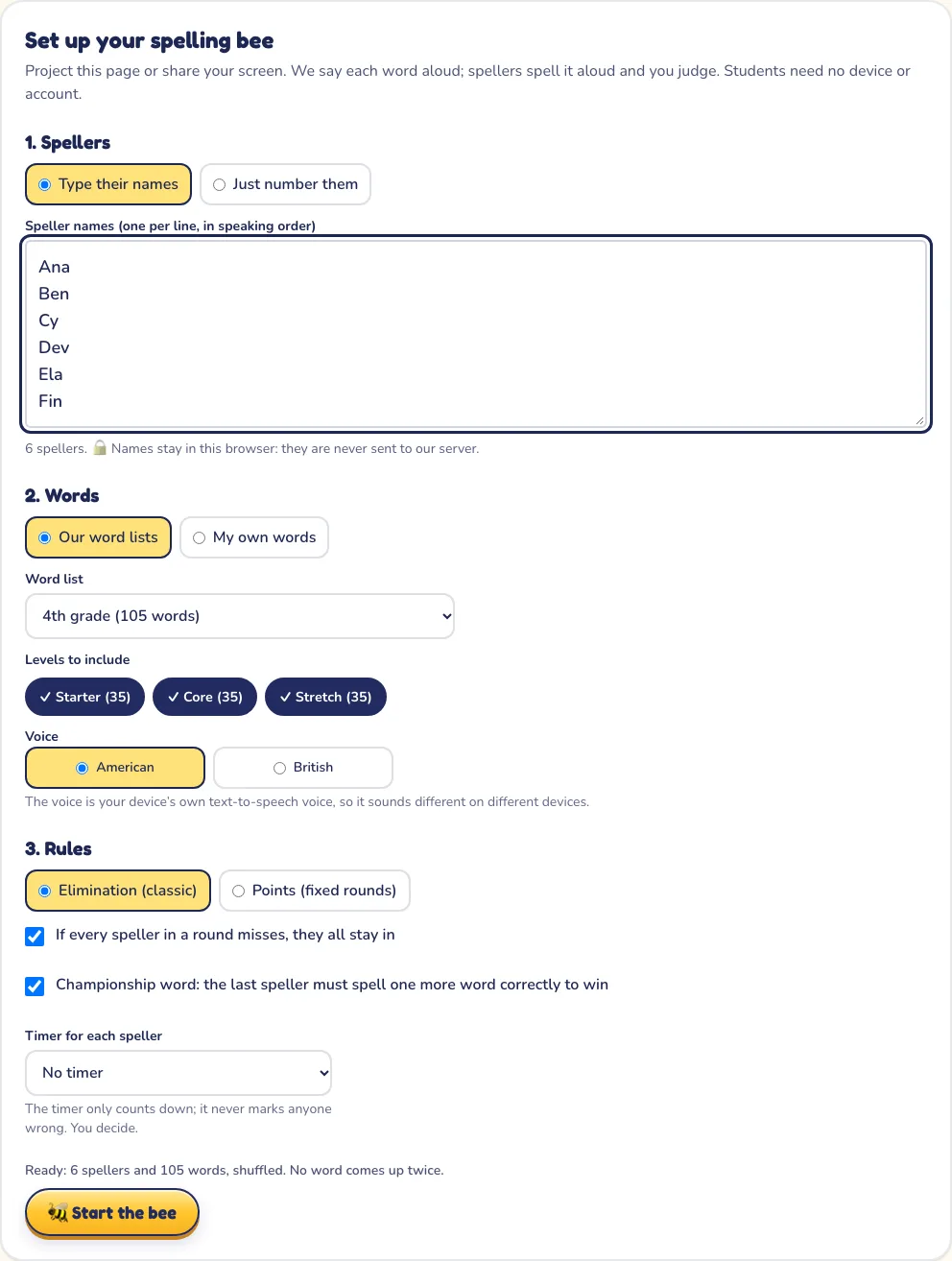
Settings you can choose: Speller names, or just a number of spellers; A word list by grade (1st–8th grade, plus harder and adult lists) or your own words; American or British device voice; Format: Elimination (classic) or Points (fixed rounds); optional answer timer.
1
Open the Spelling Bee Host
On the classroom computer, open the Spelling Bee Host page. Connect speakers or the board's sound.
What you should see: The setup form appears.
2
Add spellers and words
Type speller names (one per line) or choose Just number them. Under Words, pick a grade list or paste this week's words.
What you should see: The form says how many spellers and words are ready.
Setting up a bee: names, a word list and the format.
3
Start the bee
Press Start the bee. Explain the rules: listen, ask for the definition or a sentence if needed, then spell aloud.
What you should see: The first speller's name appears with the round number.
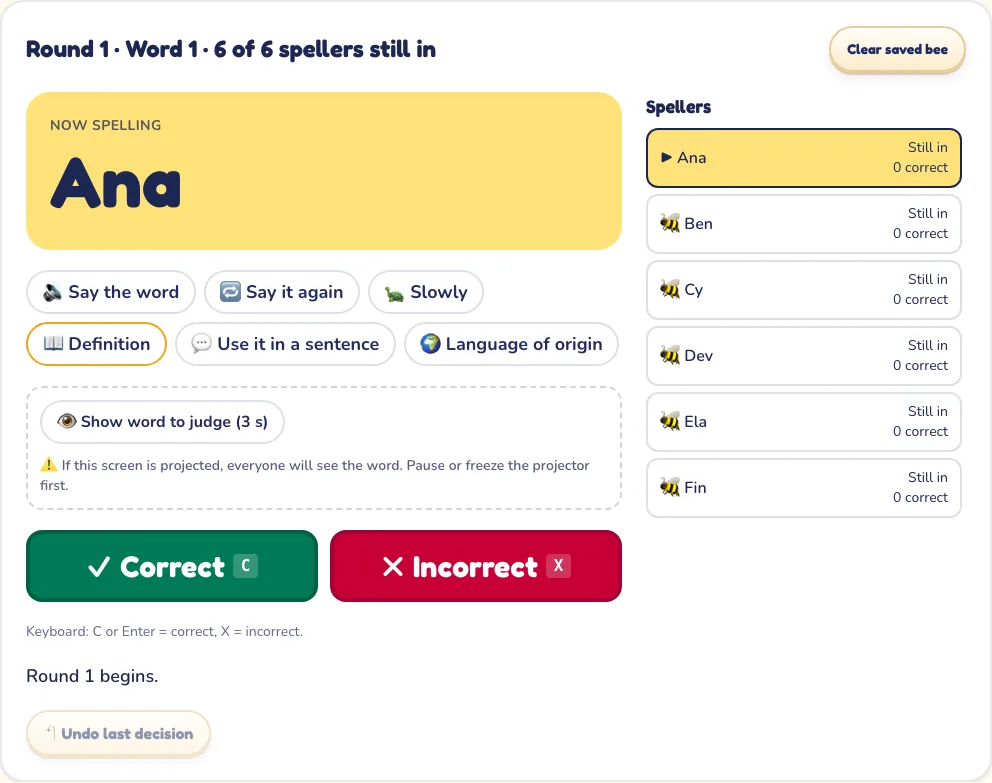
4
Run each turn
Press Say the word (and Definition, Use it in a sentence or Slowly when asked). Listen to the speller, then press Correct or Incorrect (keys C and X).
What you should see: The Host moves to the next speller and keeps track of who is still in.
A round in progress: the device says the word; you mark Correct or Incorrect.
5
Finish and review
When one speller is left (or after the points rounds), the Host shows the winner. Press Print results for the words used and missed.
What you should see: A printable results sheet to review difficult words with the class.
Good to know
Runs on one screen; students do not play on their own devices.
The voice is the device's text-to-speech: check unusual words first.
Names stay in your browser; nothing is saved by us.
If something goes wrong
No sound
Check the device volume and the board's audio; try another browser (voices differ by device).
A word sounds wrong
Use Say it again or Slowly, or read the word yourself; remove it from your list next time.
The projector shows the word
Freeze the projector before pressing Show word to judge.
Checked against Spelling Better 2.3.6 (73) and the live website on 28 November 2026. Screens marked “sample data” show example players and questions.
Free printable Grade 1 worksheets
Real worksheets made from this page's weekly lists, each with an answer key. Preview, print or save as PDF, or open one in its tool to change the words.
Short a and i: Look, Cover, Write and Scramble
Children say each sound as they write it. The first-letter hint keeps the scramble friendly for beginners.
Two complete, printable plans built around this page's weekly lists.
Short a and i: Hear It, Build It, Write It
35 minutes · A 35-minute lesson that teaches children to hear the middle vowel in a three-letter word and spell Week 1 words sound by sound.
Short a and i: Hear It, Build It, Write It
A 35-minute lesson that teaches children to hear the middle vowel in a three-letter word and spell Week 1 words sound by sound.
Objectives
By the end of the lesson, students should be able to:
Hear and name the short a and short i sounds in the middle of a word.
Spell at least six of the ten Week 1 words by writing one letter for each sound.
Materials
Week 1 word cards
Sound box strips and three counters per child
Letter tiles or magnetic letters
Whiteboards and markers
The Week 1 look, cover, write worksheet
Target words
cat
nap
tag
cap
bat
pig
zip
hid
pin
dig
Timing
Time
Stage
Minutes
0–4 min
Sound echo
4
4–11 min
Meet the short a and i words
7
11–19 min
Sound boxes together
8
19–27 min
Change one letter
8
27–33 min
Look, cover, write
6
33–35 min
Thumbs check
2
Whole lesson
35
Lesson stages
1. Sound echo4 min (0–4 min)
Wake up listening ears for single sounds.
Say a sound (a, i, p, t, g) and children echo it.
Say a short word (cat, pig) and children clap once for each sound.
2. Meet the short a and i words7 min (4–11 min)
Introduce the ten words and the two vowel sounds.
Show the a card and say "a as in cat". Show the i card and say "i as in pig".
Read each word card. Children repeat it and show a thumb up for a or a finger up for i.
Talk about the meaning of tag, bat and pin, which some children may not know (bat is also an animal).
Tip: Children who are still learning English may say "pin" and "pen" the same way. Show a picture of a pin next to a real pen.
3. Sound boxes together8 min (11–19 min)
Practise pushing a counter for each sound and writing the letters.
Say nap. Children push three counters, then write n, a, p in the boxes.
Repeat with zip, cap and dig, checking each word on the board.
Ask a child to explain how they knew which vowel to write.
4. Change one letter8 min (19–27 min)
See how one new letter makes a new word.
In pairs, children build pin with letter tiles.
Call out changes: pin to pig, pig to dig. Children swap one tile each time and read the new word.
Then build cat and change it to bat, then to bag. Ask: which of these words are on our list? (cat and bat)
5. Look, cover, write6 min (27–33 min)
Spell the words on their own.
Children complete the first five rows of the look, cover, write worksheet.
Fast finishers draw and label a picture for two of the words.
6. Thumbs check2 min (33–35 min)
Check confidence and preview tomorrow.
Say three words. Children show thumbs up for a, a finger up for i.
Tell children they will play Vowel Corners tomorrow.
Differentiation
Support: Give children who need it only five words (cat, nap, cap, pig, dig) and letter tiles with just a, i and the needed consonants.
Stretch: Ask confident spellers to write their own short a or i words that are not on the list (for example hat, fit) and use one in a sentence.
Assessment
During guided practice, note which children write the correct vowel. Collect the worksheet and count how many of the first five words are spelled correctly.
Homework
Find three things at home with a short a or short i sound in their name (a bag, a lid, a pan) and draw them with their names.
Students who have the Spelling Better app can keep practising spelling and vocabulary with its quizzes and word games at home. This is optional extra practice: the app uses its own word lists, not the words from this lesson.
Made with the free lesson plan generator at spellingbetter.com. A template-based starting point: change anything that does not suit your class.
Heart Words and a Class Spelling Bee
40 minutes · A 40-minute lesson on ten tricky words, ending with a short whole-class spelling bee on the free Spelling Bee Host where nobody is out.
Heart Words and a Class Spelling Bee
A 40-minute lesson on ten tricky words, ending with a short whole-class spelling bee on the free Spelling Bee Host where nobody is out.
Objectives
By the end of the lesson, students should be able to:
Read and spell the ten Week 3 heart words.
Name the tricky part of each word and use a memory trick for it.
Materials
Week 3 word cards with hearts drawn on the tricky parts
A short teacher-written story with the heart words
Whiteboards and markers
A projector or large screen for the Spelling Bee Host
Target words
said
was
they
you
have
come
some
what
from
one
Timing
Time
Stage
Minutes
0–4 min
Quick read
4
4–11 min
Find the tricky part
7
11–18 min
Heart word hunt
7
18–30 min
Class spelling bee
12
30–35 min
Rainbow writing
5
35–38 min
Three-word check
3
38–40 min
Share a trick
2
Whole lesson
40
Lesson stages
1. Quick read4 min (0–4 min)
Recall heart words from earlier lessons.
Flash five familiar words (the, is, to, and, my) and children read them as fast as they can.
Ask: which part of "the" do we have to remember by heart?
2. Find the tricky part7 min (4–11 min)
Introduce the Week 3 words and their tricky parts.
Show said. Children sound it out: s-ai-d. Explain that in this word ai sounds like e, so we draw a heart over ai.
Do the same with was, they, come and one.
Give a memory trick for one word, for example: "one is the little word on with an e at the end: o-n-e".
3. Heart word hunt7 min (11–18 min)
Spot the words in real sentences.
Read the short story together.
Pairs circle the heart words and count them.
Check together: how many times did they find was?
4. Class spelling bee12 min (18–30 min)
Spell the words aloud in a calm game.
Open the Spelling Bee Host, paste the ten Week 3 words, enter up to five teams as the spellers and choose Points with 2 rounds and no timer.
Teams sit together. The Host reads the word; the speller's team writes it on a whiteboard, then the speller reads the letters aloud.
Mark each answer, cheer good tries and point to the tricky part on the word card after each word.
Tip: Pause or freeze the projector before you reveal a word so the class does not see the answer early.
Students who have the Spelling Better app can keep practising spelling and vocabulary with its quizzes and word games at home. This is optional extra practice: the app uses its own word lists, not the words from this lesson.
Made with the free lesson plan generator at spellingbetter.com. A template-based starting point: change anything that does not suit your class.
Send home a look, cover, write sheet made from this week's list. Children look at each word, cover it, write it, then uncover and check, ticking each word they get right.
Paste this week's words into the spelling test generator and share the link with families. A grown-up starts the test, the device reads each word, and the child writes it on paper.
With a family member, find things at home whose names have a short vowel in the middle, like a cup, a pot, a rug or a bed. Draw three of them and write their names.
My silly sentence
writing · about 15 min
Write two silly sentences that each use two words from this week's list, for example "The pig sat on the bus." Draw a picture for one of them. Remember a capital letter and a period.
Seaside spotting
weekend · about 10 min
Over the weekend, look for things with sh, ch or th in their names, such as a shoe, a chair or a toothbrush. Say each word to a grown-up and tell them which two letters make one sound.
Students who have the Spelling Better app can do extra practice with its spelling quizzes, vocabulary quizzes, flashcards and word games. The app uses its own word lists and does not report back to teachers.
A week of English practice for 1st grade
A five-day plan for one weekly list. Each day takes 10–20 minutes, so it fits around a reading lesson. Use the same plan with any of the four lists.
Monday15 min
Meet the words
Read the list together, talk about any new meanings and do a quick try-out: children write five words, then check and circle the letters they missed. Nobody is scored.
Tuesday15 min
Sounds and letters
Play Sound Box Push with six words, then build two words with letter tiles and change one letter to make a new word.
Wednesday15 min
Worksheet practice
Complete one printable worksheet for the list, such as missing vowels or look, cover, write. Fast finishers draw and label pictures.
☐ I start my sentence with a capital and end with a period.
spellingbetter.com/for-teachers/grades/
Grade 1 teacher questions
How many spelling words should a 1st grader learn each week?
Our weekly lists have 10 to 12 words, but many first-grade teachers start with five to eight and add more once children are confident. Choose what suits your class: some six-year-olds are ready for longer lists and some need fewer words. For a longer list sorted into Starter, Core and Stretch groups, see our 1st grade spelling words page (/1st-grade-spelling-words/).
What spelling patterns do 1st graders usually practise?
Most first-grade spelling starts with three-letter words that have a short vowel in the middle (cat, bed, pig, dog, sun), then everyday tricky words such as said and was, then pairs of letters that make one sound, like sh, ch, th and ck. The four weekly lists on this page follow that order, but you can teach them in any order that fits your phonics lessons.
Can 1st graders take part in a spelling bee?
Yes, if you keep it gentle. Open the free Spelling Bee Host on one screen, paste this week's words and choose the Points format so nobody is out. Let teams write the word on a whiteboard before the speller says the letters. It works with the whole class at once and the children need no devices or accounts.
Do my students need the Spelling Better app for these activities?
No. Every activity on this page works with paper, letter cards and the free browser tools: the worksheet makers, the spelling test generator and the Spelling Bee Host. Students who have the Spelling Better app can do extra practice with its spelling quizzes, vocabulary quizzes, flashcards and word games. Its live group rooms cost in-app coins and need each player's own device and account, so for six- and seven-year-olds they are only an optional extra with an adult.
What if some children cannot read the words yet?
Start with listening. Sound Box Push, Vowel Corners and Feely Bag Spelling all begin with hearing the word, not reading it. Read the meanings and sentences aloud, give letter tiles instead of writing, and use a smaller set of words. Children learn at different speeds, so it is fine to borrow easier words from the kindergarten page (/for-teachers/grades/kindergarten/) or harder ones from the 2nd grade page (/for-teachers/grades/grade-2/).
Can I use my own word list with these worksheets?
Yes. Each worksheet on this page opens in a free tool where you can change the words, meanings and sentences, then print a new sheet with an answer key. Paste your own list into the spelling test generator to make a read-aloud test families can use at home.
Continue practising with Spelling Better
Students can practise spelling and vocabulary at their own level in the app, on their own phone or tablet.
Spelling Better is free to download for iPhone, iPad and Android. Group rooms use in-app coins. Premium is free for everyone until 31 December 2026.