Kindergarten Word Games, Phonics Activities and Simple Worksheets
Teacher-led games that help five- and six-year-olds connect letters to sounds, blend their first three-letter words and read a handful of sight words. Four weekly lists, six classroom games, a whole-class Spelling Bee Host plan, two lesson plans and printables that take a minute to make.
Kindergarten children are usually 5–6 years old. In England and Wales this is often Year 1, and in many other countries it is the last year of preschool or the first year of primary school. Every class is different: use an easier or harder grade’s lists whenever they fit your students better.
What kindergarten students can practise
Letter sounds
Children say the most common sound for each letter they have met and point to the letter when they hear its sound.
Blending
Children blend three sounds into a short word (/c/ /a/ /t/, cat), first with the teacher and then on their own with letter cards.
Segmenting
Children break a short spoken word into its sounds, tapping or robot-talking each one, as a first step toward spelling it.
Middle sounds
Children hear the vowel in the middle of a CVC word and tell short a, short i and short o words apart (pan, pin, pot).
Sight words
Children recognise ten common words that appear in almost every early reader (the, and, is, see, like) and use them in spoken sentences.
Handwriting
Children form letters from the right starting point and copy short words with a space between them.
Vocabulary and talk
Children explain what everyday words mean in their own words and use them in a sentence about themselves.
Focus areas: Letter–sound links · Blending three sounds · Short a CVC words · Short i and short o CVC words · Hearing the middle sound · First sight words · Rhyming word families.
These are suggested focus areas for this age, not an official curriculum. Adapt them to your own scheme of work.
Classroom games and activities for kindergarten
Teacher-led activities with full rules and an example round. None of them needs the app.
Sound Train Blending
10–15 min · small-group, whole-class · Early blending of CVC words
Objective: Children blend three sounds into a word by standing as 'train cars' that push together.
You need
Large letter cards on string or held in hands
Picture cards for this week's short a words
A train whistle or a bell (optional)
Before you start
Make large cards for the letters in this week's short a words: c, a, t, m, p, b, g, f, n, h, j, v.
Choose four or five words to blend today, such as cat, map, bag and fan.
How to play
Three children come to the front and each holds one letter card, standing a big step apart: these are the train cars.
The class says each car's sound slowly as the teacher, the 'engine', taps each child on the shoulder.
On the whistle, the cars shuffle together until they touch, and the class says the sounds faster and faster until they blend into a word.
A child from the class finds the matching picture card and holds it up beside the train.
Swap one car for a new child with a different letter to make the next word.
Example round: Cards m, a, p. The engine taps: "/m/... /a/... /p/." Whistle! The cars move closer: "/m/ /a/ /p/... m-a-p... map!" Kai holds up the map picture. The teacher swaps the m car for a c car: "/c/ /a/ /p/... cap! Not on our list, but a real word." Then the p car becomes a t car: "/c/ /a/ /t/... cat!"
Easier: Start with two-sound words (at, an) so there are only two cars, and say the sounds together before the cars move. Harder: Let a child be the engine and choose which car to swap, then the class reads the new word without the teacher's help.
Robot Talk Partners
8–12 min · pair, individual · Segmenting and blending three sounds
Objective: Children segment and blend short words with a partner, saying each sound like a robot and tapping it on their arm.
You need
A set of picture cards for this week's short i and short o words for each pair
Before you start
Model robot talk: stiff arms, flat voice, one sound at a time, tapping shoulder, elbow and wrist.
Put each pair's picture cards face down in a pile.
How to play
Partner A turns over a picture card without showing it and robot-talks the word: '/p/ /i/ /g/', tapping shoulder, elbow, wrist.
Partner B blends the sounds and says the word in a normal voice, then sweeps a hand down their arm.
Partner A shows the picture to check. If it matches, B keeps the card.
Swap roles for every card.
When the pile is empty, each child robot-talks one of their cards to the teacher.
Example round: Lena turns over the hop card and says in a robot voice, "/h/... /o/... /p/," tapping shoulder, elbow, wrist. Sam sweeps down his arm: "Hop!" Lena shows the picture and Sam keeps it. Sam's turn: "/l/... /i/... /d/." Lena: "Lid!" The teacher visits and asks Sam, "Robot-talk dog for me." Sam: "/d/ /o/ /g/."
Easier: Partner B chooses from two picture cards laid face up, so blending becomes 'which of these two?'. Harder: Partner B also says another word that has the same middle sound (mop, pot) or the same ending (dog, log).
Sight Word Swat
8–12 min · team · Reading first sight words
Objective: Children recognise sight words quickly by swatting the word the teacher says in a sentence.
You need
Two clean fly swatters or two soft pointers
The sight words written large on the board or on cards taped to the wall
Before you start
Write this week's sight words (the, and, is, it, see, can, we, like, my, you) large and spread out on the board.
Split the class into two teams in lines facing the board.
How to play
The first child from each team stands at the board holding a swatter.
The teacher says a short sentence, then repeats the target word: 'I can see a bird. See!'
The first child to swat the right word wins a point for their team.
Both children read the word aloud together, then pass the swatter to the next child in line.
If both swat a wrong word, the whole class helps by spelling out the right word letter by letter until someone finds it.
Example round: Teacher: "We like to play outside. Like!" Nia and Eli rush to the board; Nia swats 'like' first. Both read, "Like!" and Team Blue gets a point. Next: "This is my coat. My!" Eli swats 'my'. Next: "The dog is big. The!" Both hesitate, so the class calls "t-h-e" and Eli finds it.
Easier: Put only four words on the board and say just the word, without the sentence. Harder: Say a sentence without naming the word and children swat the sight word that was in it, or show a word for a second and hide it.
Oops, Silly Teacher!
6–10 min · whole-class · Matching sounds to letters in CVC words
Objective: Children listen for each sound in a word and spot the one wrong letter the teacher wrote.
You need
Whiteboard and marker
Magnetic letters (optional)
Before you start
Pick five or six words from this week's list and plan one 'mistake' for each: a wrong first, middle or last letter.
How to play
Draw a quick picture and write its word underneath with one wrong letter.
Children read your word by blending the sounds and shout 'Oops!' when the word does not match the picture.
Ask, 'Which sound is wrong: the first, the middle or the last?' and children show 1, 2 or 3 fingers.
A child comes up and fixes it by rubbing out the wrong letter or swapping a magnetic letter.
Everyone reads the fixed word together, and the teacher pretends to be very surprised.
Example round: The teacher draws a pig and writes 'pog'. Children blend: "/p/ /o/ /g/... pog? Oops!" Teacher: "Which sound is wrong?" Children show two fingers: the middle one. Amir swaps o for i. Everyone reads: "pig!" Next, the teacher draws a fan and writes 'fat'. "Oops! The last sound!" Lucy changes t to n.
Easier: Only make mistakes in the first sound, and show the correct first letter as one of two choices. Harder: Write the word with two letters swapped (tac for cat) and children explain what happened.
Sight Word Hide and Seek
10–15 min · pair · Reading and using sight words
Objective: Pairs find hidden sight word cards around the room, read them and say a sentence with each word.
You need
Two or three cards for each sight word
A basket for each pair
Before you start
Hide the sight word cards around the room at children's eye level: on chairs, on the bookshelf, under a cup.
Pair a confident reader with a child who is still learning the words.
How to play
Pairs walk (not run) around the room looking for word cards.
When a pair finds a card, both children read it aloud before putting it in their basket.
Each pair can collect up to five cards.
Back on the rug, each pair chooses one card and says a sentence with it to the class.
Put every card back in a pile for the next round or for the next day.
Example round: Rosa and Tom find 'you' under a cup. Tom reads, "you," and Rosa repeats it. They also find 'see' and 'and'. On the rug they choose 'see' and say together, "We see a big red bus." The teacher asks the class, "Did you hear another word from our list?" Children answer, "We!"
Easier: Hide only four different words and stick a small picture clue on each card. Harder: Pairs must make one sentence that uses two of their cards, such as 'I like you.'
Listen, Build, Show
15–20 min · team, whole-class · Spelling CVC words from hearing them
Objective: Table teams hear a word from the free Spelling Bee Host, build it with letter cards and show it for the teacher to check.
You need
The free Spelling Bee Host on a classroom screen with speakers
A set of letter cards for each table
A team name card for each table
Before you start
In the Spelling Bee Host, choose My own words and paste this week's list.
Add each table as a speller (for example Red Team, Blue Team, Green Team, Yellow Team) and choose the Points format with 2 rounds: the Host needs one word per team per round, so four teams use 8 words.
Give each table the letters it needs for this week's words.
How to play
The Host shows whose turn it is; the teacher presses Say the word for that team.
The team whispers the sounds together, robot-talk style, and builds the word with letter cards.
When ready, one child holds up the word for the teacher to see.
The teacher presses Correct or Incorrect; if incorrect, the class helps fix the word before the next turn.
Every team builds every word at the same time, but only the team whose turn it is scores.
Example round: The Host shows Red Team's turn. The teacher presses Say the word: "bag." Red Team whispers "/b/ /a/ /g/" and Jada holds up b-a-g. The teacher presses Correct. Blue Team's turn: "van." Blue Team shows v-a-n. Correct. Green Team's turn: "jam." They hold up g-a-m; the teacher presses Incorrect, and the class says the first sound slowly, "/j/", to fix it.
Easier: Give each team only the letters they need for one word at a time, so they only have to put them in order. Harder: Teams write the word on a mini whiteboard instead of using cards, and then think of a word that rhymes with it.
Four original weekly lists with meanings and example sentences. Copy or print a list, or turn it into a worksheet, flashcards in one click.
Week 1 · Letter–sound links
Letter Sounds Round-Up
Objective: Children say the sound of ten letters quickly and point to the letter when they hear its sound.
Letter Sounds Round-Up: words, meanings and example sentences
Letter or word
Meaning
Example
Listen
sletter · /s/
Name: S. Sound: /s/, as in sun, sit and sand. Say it long, like a snake.
Six silly seals sat on the sand.
aletter · short /a/
Name: A. Short sound: /a/, as in ant, apple and astronaut. Open your mouth wide.
An astronaut ate an apple on the moon.
tletter · /t/
Name: T. Sound: /t/, as in tent, top and turtle. Keep it short; do not add 'uh'.
Two turtles took a trip to town.
pletter · /p/
Name: P. Sound: /p/, as in pen, panda and pop. Feel a puff of air on your hand.
A panda packed a picnic for the park.
iletter · short /i/
Name: I. Short sound: /i/, as in insect, igloo and in. Smile a little as you say it.
An insect is inside the igloo.
nletter · /n/
Name: N. Sound: /n/, as in nest, net and nose. Hum it through your nose.
Nine noisy newts napped in a nest.
mletter · /m/
Name: M. Sound: /m/, as in map, moon and mop. Lips together, like tasting something yummy.
Mom made muffins on Monday morning.
dletter · /d/
Name: D. Sound: /d/, as in dog, dig and drum. Tap your tongue behind your top teeth.
A dinosaur danced to a drum.
gletter · hard /g/
Name: G. Hard sound: /g/, as in goat, gate and gift. Say it from the back of your throat.
A goat gave a gift to a goose.
oletter · short /o/
Name: O. Short sound: /o/, as in octopus, on and off. Make your mouth round.
An octopus hopped on and off a rock.
Practice ideas
Flash the letter cards and children say the sound only, not the name; speed up as they get confident.
Play 'Sound in my hand': hide a small letter card in one hand, say a word, and children guess if its first sound matches the hidden letter.
Give each child a letter card; call a sound and children holding that letter stand up and say a word that starts with it.
Use the letter-sound bingo sheet and call sounds, not letter names.
Week 2 · Short a CVC words
Short a Words
Objective: Children blend and build eight short a words with three sounds each, and hear /a/ in the middle.
Short a Words: words, meanings and example sentences
Letter or word
Meaning
Example
Listen
catnoun · short a
A furry pet that purrs, licks its paws and likes to nap.
The cat sat on the warm mat.
mapnoun · short a
A drawing that shows where places and roads are.
We used a map to find the park.
bagnoun · short a
Something with handles or a strap that you carry things in.
Put your lunch in your bag.
fannoun · short a
A machine with spinning blades that blows cool air on you.
The fan kept us cool on a hot day.
hatnoun · short a
Something you wear on your head to keep warm or to keep off the sun.
Grandpa wears a big straw hat in the garden.
jamnoun · short a
A sweet, sticky spread made from cooked fruit.
I like strawberry jam on my toast.
vannoun · short a
A vehicle bigger than a car, used to carry people or lots of things.
The delivery van stopped outside our house.
pannoun · short a
A flat metal dish with a handle, used for cooking on the stove.
Mom cooks eggs in a pan.
Practice ideas
Robot-talk each word (/b/ /a/ /g/) and children blend it and point to the right picture.
Build each word with magnetic letters or letter cards, saying each sound as the letter goes down.
Make rhyming pairs out loud: cat and hat, fan and van and pan. Ask which sound changes.
Play Oops, Silly Teacher with one wrong letter in a word on the board.
Week 3 · Short i and short o CVC words
Short i and Short o Words
Objective: Children blend, build and sort ten words by their middle sound, short i or short o.
Short i and Short o Words: words, meanings and example sentences
Letter or word
Meaning
Example
Listen
pignoun · short i
A pink farm animal with a curly tail and a flat snout.
The pig rolls in the mud to stay cool.
sitverb · short i
To rest your bottom on a chair or on the floor.
Please sit on the rug for story time.
lidnoun · short i
The top that covers a jar, box or pot.
Put the lid back on the paint jar.
finnoun · short i
A thin, flat part on a fish that helps it swim.
The goldfish flaps its little fin.
wignoun · short i
Pretend hair that you can put on and take off.
The clown wore a curly green wig.
dognoun · short o
A pet that barks, fetches balls and wags its tail.
My dog digs holes in the sand.
hopverb · short o
To jump on one foot, or to jump like a bunny or a frog.
Can you hop like a frog?
potnoun · short o
A deep, round dish for cooking soup or for growing a plant.
The soup is bubbling in the pot.
mopnoun · short o
A tool with a long handle and a soft, floppy end for washing floors.
Dad used a mop to clean up the spilled juice.
lognoun · short o
A thick, heavy piece cut from a tree trunk or a big branch.
A frog sat on a log by the pond.
Practice ideas
Lay two hoops on the floor labeled i and o; children say a word, listen for the middle sound and stand in the right hoop.
Change one sound out loud and say the new word: pig to dig, pot to hot, log to dog.
Build each word with letter cards, then swap only the middle card to make a new word (pit, pot).
Use the missing-middle-sound sheet: the teacher says each word and children write the vowel.
Week 4 · High-frequency sight words
First Sight Words
Objective: Children read ten common sight words on sight and use each one in a spoken sentence.
First Sight Words: words, meanings and example sentences
Letter or word
Meaning
Example
Listen
thedeterminer · sight word
A small word that comes before a naming word to point to one thing we know about.
The sun is up.
andconjunction · sight word
A joining word that adds one thing to another, as in 'cats ___ dogs'.
I have a cat and a dog.
isverb · sight word
A small linking word that tells what one thing looks or feels like now, as in 'The cat ___ happy.'
My hat is red.
itpronoun · sight word
A word we use in place of a thing we just talked about.
I found the ball and kicked it.
seeverb · sight word
To look at something with your eyes.
I see a bird in the tree.
canverb · sight word
A word that tells us someone is able to do something.
You can hop on one foot.
wepronoun · sight word
A word for me and other people together.
We sing a song after lunch.
likeverb · sight word
To enjoy something or think it is nice.
I like to paint with my fingers.
mydeterminer · sight word
A word that shows something belongs to me.
This is my red cup.
youpronoun · sight word
A word for the person someone is talking to.
Do you want to play tag?
Practice ideas
Read a big book together and children clap every time they see 'the' or 'and'.
Make sentence strips with a sight word and a picture: 'I see a [picture of a dog].' Children read them to a partner.
Play Sight Word Swat with the words on the board.
Children build each word with letter tiles, then write it once on a mini whiteboard.
Your browser has no speech voice, so the listen buttons are hidden.
Turn these words into a classroom game: paste a week’s list into the free Spelling Bee Host and run a spoken bee on the board, or see how to host a live game below.
How to host live word games for Kindergarten students
Suggested game session for kindergarten
Kindergarten children cannot run a game on their own devices, but they love hearing a word from the screen and building it together. The free Spelling Bee Host runs on one classroom screen, needs no student devices or accounts, and the teacher judges every answer.
Game
Spelling Bee Host (in your browser)
Settings to try
My own words: paste this week's list (for example cat, map, bag, fan, hat, jam, van, pan). Points format, 2 rounds for 4 table teams, no timer, American or British voice.
Vocabulary focus
Short vowel CVC words from this week's list, heard aloud and built sound by sound.
Warm-up
Robot-talk two words from the list together (/c/ /a/ /t/... cat!) so every child hears the sounds before the game starts.
Session length
15–20 minutes
Format
Table teams of 4–6. The Host says the word for the team whose turn it is; every team builds it with letter cards and the playing team holds theirs up.
Supervision
The teacher runs the screen and presses Correct or Incorrect for every turn. Children never touch the device, and a wrong build is fixed together.
Afterwards
Put the letter cards and picture cards in a word-building tub for centers, and send home the copying sheet with this week's words.
Independent practice
At centers, children pick a picture card, robot-talk the word, build it with letter tiles and check it with a partner.
No projector or speakers? Play the same team rounds without the Host: read each word yourself, keep points on the board and fix any wrong build together. The Host needs one word per team per round, so 4 teams and 2 rounds use 8 words.
Session length and grouping are teaching suggestions, not app settings. The app has no grade setting.
Step by step: Spelling Bee Host (in your browser)
Best for: A whole class on one screen, from kindergarten up. Free, no accounts, no student devices.
Players: 2–60 spellers on one screen
Devices: Any computer, laptop or interactive whiteboard with a modern browser and speakers
Cost: Free. No sign-up.
Settings you can choose: Speller names, or just a number of spellers; A word list by grade (1st–8th grade, plus harder and adult lists) or your own words; American or British device voice; Format: Elimination (classic) or Points (fixed rounds); optional answer timer.
1
Open the Spelling Bee Host
On the classroom computer, open the Spelling Bee Host page. Connect speakers or the board's sound.
What you should see: The setup form appears.
2
Add spellers and words
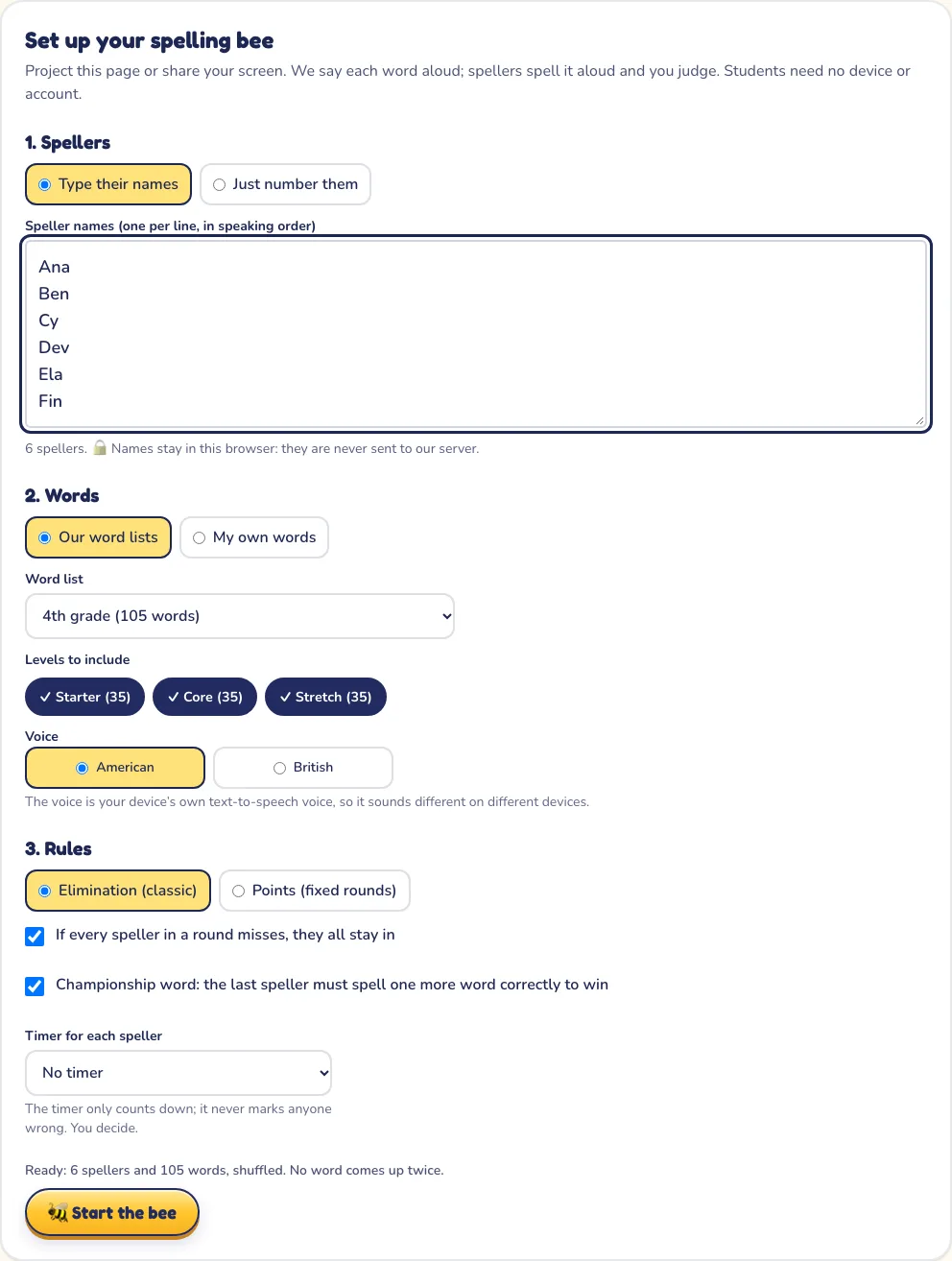
Type speller names (one per line) or choose Just number them. Under Words, pick a grade list or paste this week's words.
What you should see: The form says how many spellers and words are ready.
Setting up a bee: names, a word list and the format.
3
Start the bee
Press Start the bee. Explain the rules: listen, ask for the definition or a sentence if needed, then spell aloud.
What you should see: The first speller's name appears with the round number.
4
Run each turn
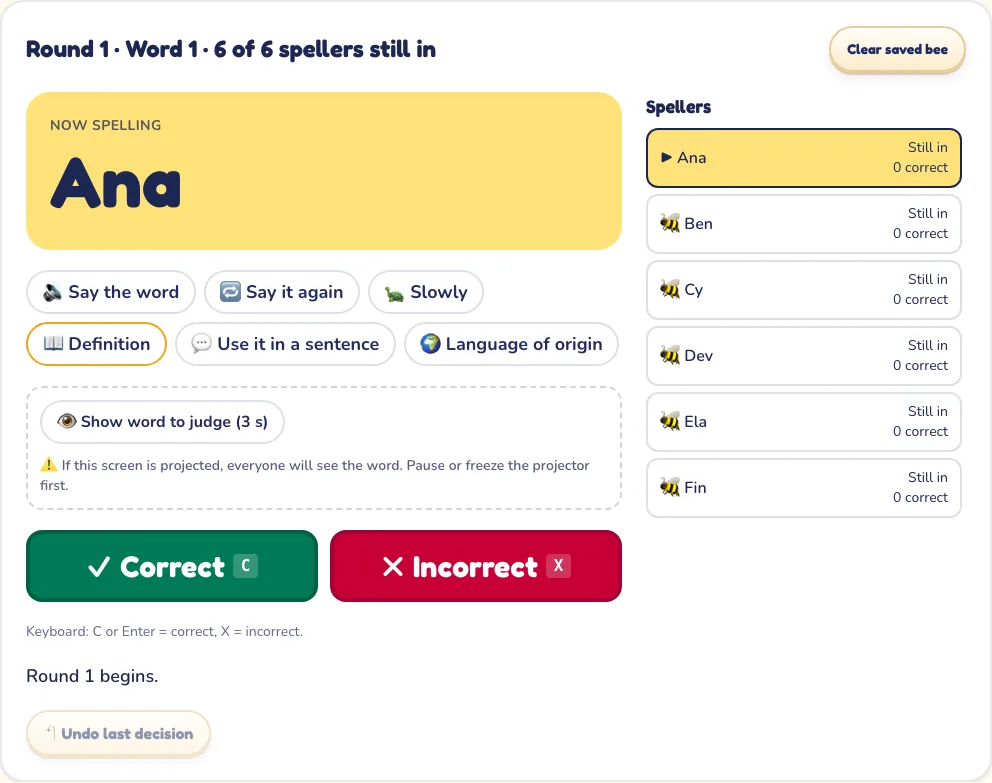
Press Say the word (and Definition, Use it in a sentence or Slowly when asked). Listen to the speller, then press Correct or Incorrect (keys C and X).
What you should see: The Host moves to the next speller and keeps track of who is still in.
A round in progress: the device says the word; you mark Correct or Incorrect.
5
Finish and review
When one speller is left (or after the points rounds), the Host shows the winner. Press Print results for the words used and missed.
What you should see: A printable results sheet to review difficult words with the class.
Good to know
Runs on one screen; students do not play on their own devices.
The voice is the device's text-to-speech: check unusual words first.
Names stay in your browser; nothing is saved by us.
If something goes wrong
No sound
Check the device volume and the board's audio; try another browser (voices differ by device).
A word sounds wrong
Use Say it again or Slowly, or read the word yourself; remove it from your list next time.
The projector shows the word
Freeze the projector before pressing Show word to judge.
Checked against Spelling Better 2.3.6 (73) and the live website on 28 November 2026. Screens marked “sample data” show example players and questions.
Free printable Kindergarten worksheets
Real worksheets made from this page's weekly lists, each with an answer key. Preview, print or save as PDF, or open one in its tool to change the words.
Letter-Sound Bingo
Ten letters on 3 × 3 boards, every board different. Call the sound (/m/), not the letter name, and children cover the letter.
Two complete, printable plans built around this page's weekly lists.
Blending Short a Words
30 minutes · A 30-minute lesson: children review letter sounds, blend short a words with the Sound Train, fix the teacher's mistakes and build words on their own.
Blending Short a Words
A 30-minute lesson: children review letter sounds, blend short a words with the Sound Train, fix the teacher's mistakes and build words on their own.
Objectives
By the end of the lesson, students should be able to:
Blend three sounds into a short a word.
Hear /a/ in the middle of a word.
Build a short a word with letter cards.
Materials
Letter cards (large for the front, small for each child)
Picture cards for cat, map, bag, fan, hat, jam, van, pan
Whiteboard and marker
Short a copying sheet
Target words
cat
map
bag
fan
hat
jam
van
pan
Timing
Time
Stage
Minutes
0–4 min
Fast sounds
4
4–10 min
Hear the middle /a/
6
10–17 min
Sound Train
7
17–24 min
Oops, Silly Teacher!
7
24–28 min
Build it
4
28–30 min
Rhyme time
2
Whole lesson
30
Lesson stages
1. Fast sounds4 min (0–4 min)
Wake up letter-sound knowledge.
Flash the letter cards from the sound round-up and children say each sound.
Speed up for the letters they know well, slow down for the tricky ones.
2. Hear the middle /a/6 min (4–10 min)
Notice /a/ in the middle of words.
Say 'cat' slowly, stretching the middle: 'c-aaa-t'. Ask, 'What sound is in the middle?'
Repeat with map, bag and fan; children open their mouths wide for /a/.
Show the picture cards and say all eight words together.
Tip: Say stop sounds like /t/ and /p/ crisply, without an 'uh' after them; it makes blending much easier.
3. Sound Train7 min (10–17 min)
Blend sounds together with support.
Three children hold c, a and t at the front, standing apart.
The class says each sound, then the 'cars' move together and the class blends: cat!
Swap one card at a time to blend hat, then fan, then van.
4. Oops, Silly Teacher!7 min (17–24 min)
Check each sound in a written word.
Draw a bag and write 'bat'. Children blend, shout 'Oops!' and show which sound is wrong (3 fingers).
A child fixes it. Repeat with 'mop' for map and 'jan' for jam.
Finish with one word written correctly; children check every sound and give a thumbs up.
5. Build it4 min (24–28 min)
Build words without help.
The teacher says pan, hat and bag; each child builds them with small letter cards.
Children who finish early copy one word onto the copying sheet.
6. Rhyme time2 min (28–30 min)
End by hearing word families.
Say 'fan, van...' and children add 'pan!'.
Say 'cat, hat...' and let children suggest another rhyme (mat, sat).
Differentiation
Support: Give children who need it only the three letters for each word, so they focus on putting them in order while you say the sounds with them.
Stretch: Ask confident children to build a rhyming word by changing the first letter (cat to bat to sat) and read it to a partner.
Assessment
During Build it, watch who builds pan, hat and bag correctly without help. Note children who reverse letters or miss the middle sound for a small-group go tomorrow.
Homework
Play 'robot talk' at home: a grown-up says a short a word in sounds (/m/ /a/ /p/) and your child says the word.
Made with the free lesson plan generator at spellingbetter.com. A template-based starting point: change anything that does not suit your class.
Short i and o Words: Team Game with the Spelling Bee Host
35 minutes · A 35-minute lesson: children sort words by middle sound, then play a whole-class team game on the free Spelling Bee Host, building each word with letter cards.
Short i and o Words: Team Game with the Spelling Bee Host
A 35-minute lesson: children sort words by middle sound, then play a whole-class team game on the free Spelling Bee Host, building each word with letter cards.
Objectives
By the end of the lesson, students should be able to:
Hear the difference between short i and short o in the middle of a word.
Spell short i and short o words with letter cards after hearing them.
Materials
The free Spelling Bee Host on a classroom screen with speakers
Two hoops or circles of tape labeled i and o
Letter cards for each table
Picture cards for pig, sit, lid, fin, wig, dog, hop, pot, mop, log
Missing middle sound sheet
Target words
pig
sit
lid
fin
wig
dog
hop
pot
mop
log
Timing
Time
Stage
Minutes
0–4 min
Robot talk
4
4–9 min
Two middle sounds
5
9–15 min
Hoop sort
6
15–25 min
Spelling Bee Host team game
10
25–31 min
Missing middle sound
6
31–35 min
Change one sound
4
Whole lesson
35
Lesson stages
1. Robot talk4 min (0–4 min)
Practise segmenting before the new words.
Robot-talk a few short a words from last week (/c/ /a/ /t/) and children blend them.
Children robot-talk 'pig' back to you, tapping their arm for each sound.
2. Two middle sounds5 min (4–9 min)
Contrast /i/ and /o/.
Say /i/ with a small smile and /o/ with a round mouth; children copy and feel the difference.
Say pig and dog slowly and ask which middle sound each has.
Show the ten picture cards and name them together.
3. Hoop sort6 min (9–15 min)
Sort words by their middle sound.
Hold up a picture card; the class says the word and listens for the middle sound.
A child places the card in the i hoop or the o hoop.
When all ten are sorted, read each hoop's words together.
4. Spelling Bee Host team game10 min (15–25 min)
Hear and build words in a whole-class game.
In the Host, choose My own words, paste the ten words, add four table teams and choose Points with 2 rounds.
Press Say the word for each team's turn; every table builds the word with letter cards.
The playing team holds up its word and you press Correct or Incorrect; fix any wrong word together.
Tip: Use the Slowly button for words where the vowel is hard to hear, such as fin and lid.
Read each word aloud twice; children write i or o in the gap.
Collect the sheets to see who needs more practice.
6. Change one sound4 min (31–35 min)
Finish with a quick listening game.
Say 'pot' and change the middle sound: 'pit'. Children shout 'i!'
Say 'dog' and change it to 'dig'; children shout 'i!' again.
End with everyone hopping once for the word hop.
Differentiation
Support: Seat children who need it with a confident partner during the game, and give them only the three letters for each word.
Stretch: Ask early finishers to write a short silly sentence with two of the words, such as 'A pig in a wig.'
Assessment
Use the missing middle sound sheet: children who write the right vowel for at least eight of the ten words are ready to mix short a, i and o; others get another hoop sort in a small group.
Homework
Find something at home with a short i or short o name (a pot, a mop, a lid) and tell your family its middle sound.
A grown-up calls letter sounds (not names) and your child covers the matching letter on a bingo board. Swap roles for the second game so your child calls the sounds.
Read a favorite picture book together. Your child chooses one sight word from this week (the, and, is, see, like) and taps it every time it appears. Count the taps together at the end.
Hear it, build it
online · about 10 min
A grown-up opens the free Spelling Bee Host, chooses My own words, pastes this week's short a words and types two speller names (the child and the grown-up). Press Say the word; your child builds each word with fridge magnets or paper letters, then you check it together.
Your child draws three things from this week's words (a pig, a mop, a log) and writes each word underneath by saying the sounds. Sound-by-sound spelling is welcome; praise each sound they hear.
Weekend I spy with sounds
weekend · about 10 min
Play 'I spy with my little eye something that starts with /p/' at home or outside. Then try a harder round: 'I spy something with /o/ in the middle' (pot, dog, sock).
A week of English practice for kindergarten
A five-day routine of about 20 minutes a day built around one weekly list. Keep the same words all week and change the game each day.
Monday15 min
Meet the words
Show the picture cards for this week's list, say each word and stretch its middle sound. Build two words together with large letter cards using the Sound Train.
Tuesday15 min
Robot Talk Partners
Pairs robot-talk and blend the week's words with picture cards. Finish with three words the teacher robot-talks to the whole class.
Wednesday15 min
Printable practice
Children work on this week's sheet (word search and copying, or the missing middle sound sheet) while you read each word aloud and help at the tables.
☐ Picture cards and letter cards ready for this week's list
☐ This week's words pasted into the Spelling Bee Host
☐ Worksheet printed with enough copies
☐ Sight words written on the board or on cards
☐ Small-group list for children who need another go
☐ Home note with this week's words sent to families
spellingbetter.com/for-teachers/grades/
Kindergarten teacher questions
Should kindergarten children take a weekly spelling test?
A formal test is rarely needed at this age. A quick 'build it' check works better: say three words from the list and watch each child build them with letter cards. It shows you who can hear every sound, and it feels like a game rather than a test.
What are CVC words, and why start with short a?
CVC words have a consonant, a vowel and a consonant, such as cat, pig and dog. Each letter makes one clear sound, so they are good first words for blending and building. Short a is a common starting point because its sound is easy to hear and stretch, but you can start with any vowel your class knows.
How many sight words should I introduce each week?
There is no fixed number. Many teachers introduce a few at a time and keep reviewing the old ones, because children need to meet a word many times before they read it on sight. The ten words in week 4 can be spread over two or three weeks if that suits your class.
Can kindergarten children play with the Spelling Bee Host?
Yes, with you in charge. The free Spelling Bee Host runs on one classroom screen, the device's voice reads each word, and you press Correct or Incorrect. Use table teams as the 'spellers' and let children build words with letter cards instead of spelling aloud alone.
Is the Spelling Better app suitable for kindergarten?
Not for whole-class use: its live rooms need a device, an account and in-app coins for every player. Students who have the Spelling Better app can do extra practice with its spelling quizzes, vocabulary quizzes, flashcards and word games, but at this age that should be with an adult beside them.
Some children are already reading. What can I give them?
Age is only a guide, so use easier or harder lists as children need. Readers can move to the 1st grade spelling words page (/1st-grade-spelling-words/), write their own sentences with the sight words, or build longer words in the free worksheet tools.
Do the kindergarten worksheets need reading skills?
Only a little. Bingo, copying and the word search work with letter and word shapes, and the missing middle sound sheet is meant to be done while you read each word aloud. Children who are not yet reading can do them with an adult saying the words.
For older students: Spelling Better
Spelling Better is made for children who are starting to read and spell. Keep it in mind for later years.
Spelling Better is free to download for iPhone, iPad and Android. Group rooms use in-app coins. Premium is free for everyone until 31 December 2026.