Preschool English Activities, Letter Games and Picture Words
Short, lively ways to help three- to five-year-olds meet letters and sounds: hopping, sorting, singing and talking about pictures, with a teacher leading every step. Four weekly letter and picture-word groups, six circle-time games, two 20-minute lesson plans and a few gentle copying sheets.
Preschool children are usually about 3–5 years old. In England this is often nursery or Reception, and in many other countries it is called pre-K, pre-primary or kindergarten. Every class is different: use an easier or harder grade’s lists whenever they fit your students better.
What preschool students can practise
Letter recognition
Children start to recognise a small group of letters by shape, pointing to the right card when the teacher names it or says its sound.
Letter sounds
Children hear and say the first sound of a familiar word (sock starts with /s/) and begin to link that sound to a letter.
Big and small letters
Children notice that each letter has a capital and a small form, and match pairs that look alike first (C and c, O and o) before trickier ones.
Listening
Children listen for a target sound in a word, a sentence or a song, and show they heard it with an action such as a hiss, a clap or a hop.
Words and pictures
Children name everyday pictures and objects (animals, body parts) clearly, and learn that the words we say can be written down.
Early mark-making
Children form letters with big arm movements, in sand or play dough and, when ready, with a crayon, starting each curly letter in the right place.
Speaking
Children take short turns in a group: naming an object, saying a sound or sharing a word that starts like their own name.
Focus areas: Letter names · First sounds · Capital and small letters · Curly letter shapes · Animal picture words · Body part words · Sounds with actions.
These are suggested focus areas for this age, not an official curriculum. Adapt them to your own scheme of work.
Classroom games and activities for preschool
Teacher-led activities with full rules and an example round. None of them needs the app.
Lily Pad Letter Hop
8–12 min · small-group, whole-class · Beginning letter knowledge
Objective: Children link a letter's shape to its sound by hopping onto the right letter when they hear the sound.
You need
Six paper plates or card circles
A thick marker
Masking tape or a clear rug space
Before you start
Write one letter from this week's group (s, a, t, m, p, i) large and in lower case on each plate.
Tape the plates in a loose circle on the floor, one small hop apart.
How to play
Children crouch around the circle like frogs waiting by the pond.
The teacher says a sound, not a letter name, for example 'sss'.
One frog (or two holding hands) hops onto the plate with that letter and says the sound and any word that starts with it.
Everyone else claps the sound three times to check: s, s, s.
Change frogs every turn. A child who is unsure can hop with a friend; nobody is out.
To finish, call 'All frogs, point to /m/!' and everyone points from where they are.
Example round: Teacher: "Froggy Ava, find /t/... t, t, t." Ava hops onto the t plate and says "t, tiger!" The class claps t, t, t. Teacher: "Froggy Leo, find /a/, like apple." Leo hops to the a plate. The teacher holds up a toy ant: "Does ant start with /a/ too?" Children give a thumbs up and Leo hops back to the edge.
Easier: Use only three plates (s, a, t) and show a matching picture with each sound you call, so children can match picture to plate. Harder: Say a whole picture word such as 'mop' or 'pig' and children hop to its first letter; later, write the capital letter on the back and flip the plates over.
Objective: Children name real objects and say their first sound, then place each object on the matching letter mat.
You need
A cloth bag or pillowcase
Six to eight small objects
Letter mats or cards for this week's letters
Before you start
Collect objects that start with this week's letters: a sock, a plastic apple, a toy tiger, a toy mouse, a pen, a toy insect.
Lay the letter mats (s, a, t, m, p, i) on the floor in the middle of the group.
How to play
Sit in a small circle with the letter mats in the middle.
Pass the sack around while chanting 'Sound sack, sound sack, what's inside?' and stop when the chant ends.
The child holding the sack feels inside, guesses, then pulls one object out and names it.
Everyone says the object's name slowly, stretching the first sound: 'ssssock'.
The child puts the object on the matching letter mat, with help from friends if needed.
Keep going until the sack is empty, then look at the mats together: 'What is on the m mat?'
Example round: The chant stops at Maya. She feels something soft, says "A sock!" and pulls it out. The group says "ssss-ock... /s/." Maya puts the sock on the s mat. Next, Omar pulls out the toy mouse: "mmmouse, /m/!" and places it on the m mat. At the end the teacher points: "The sock is on the snake letter. What sound does it make?"
Easier: Use only two letter mats and four objects, and show the letter mat while you stretch the first sound. Harder: Add one 'tricky' object that starts with none of the letters (a toy car); children decide it has no mat and say its first sound instead.
Big Letter, Little Letter Partners
6–10 min · pair, whole-class · Recognising capital and small letters
Objective: Children match capital and small forms of the same letter and say the letter's sound with their partner.
You need
Pairs of cards: one capital, one small letter (C c, O o, A a, D d, G g, Q q)
A bell or drum
Before you start
Make one card per child: half show capitals, half show the matching small letters.
Start with the pairs that look alike (C c, O o) and add the others once children are confident.
How to play
Give every child one card face down; on the signal, they turn it over and look at it.
Children walk around the room, showing their card, to find the child with the same letter in the other size.
Partners sit down together and say their letter's sound out loud.
When all pairs are sitting, each pair holds up their cards and the class says the sound with them.
Collect the cards, shuffle and play again so children meet new partners.
Example round: Zara has a big D. She walks around and spots Ben's small d: "Same letter!" They sit down and say "/d/, /d/, dog!" When the drum sounds, each pair stands up in turn. Zara and Ben hold up D and d, and the class calls "/d/!" The teacher asks, "Which pair had letters that look almost the same?" and the C and c pair waves.
Easier: Play with only the look-alike pairs (C c, O o) plus one more, and let children match cards on the carpet instead of walking. Harder: Add the letters from week 1 (S s, T t, M m, P p) so children must look carefully at pairs that change shape, such as M and m.
Animal First-Sound Parade
8–12 min · whole-class · Picture words and first sounds
Objective: Children move like animals while saying the first sound of each animal's name, then freeze and name the animal.
You need
Picture cards for this week's animals (cat, dog, pig, hen, fox, bee, goat, duck)
A drum, tambourine or shaker
Before you start
Clear a space for children to move safely around the room.
Agree on a 'freeze' signal, such as a drum tap, and practise it once.
How to play
Hold up an animal picture and say its name together, stretching the first sound.
Children parade around the room moving like that animal and repeating its first sound: waddling and saying 'd, d, d' for duck.
On the freeze signal, everyone stops still like a statue.
Ask one frozen child, 'Which animal are you, and what sound does it start with?'
Show the next picture and start a new parade; finish with a slow, quiet animal such as the fox tiptoeing.
Example round: The teacher shows the bee card: "bbbee... /b/!" Children buzz around the room with flapping arms, saying "b, b, b." Drum tap: everyone freezes. Teacher: "Sami, what are you?" Sami: "A bee! /b/!" Next card: goat. Children trot slowly on the spot saying "g, g, g" and freeze on the drum.
Easier: Use four animals that start with very different sounds (pig, hen, fox, bee) and say the first sound with the children each time. Harder: After freezing, show two letter cards (d and p) and ask which one starts the animal's name.
Busy Bee Says: Body Words
5–10 min · whole-class · Listening and naming everyday words
Objective: Children listen to instructions with body words, touch the right part and say the word's first sound.
You need
No materials needed
Optional: a bee puppet or headband for the leader
Before you start
Practise the eight body words from this week's list with a quick point-and-say round first.
How to play
The leader gives instructions such as 'Busy Bee says touch your nose.'
Children only move when the instruction starts with 'Busy Bee says'.
If someone moves without 'Busy Bee says', everyone does a silly wiggle together and carries on; nobody is out.
After every few instructions, the leader asks, 'What sound does nose start with?' and children answer together.
Let a confident child wear the bee headband and lead a few instructions.
Example round: Teacher: "Busy Bee says touch your head." Children touch their heads. "Busy Bee says wave your hand." Children wave. "Lift your leg!" A few children lift a leg and everyone giggles and does a silly wiggle. Teacher: "Head and hand. Listen: hhhead, hhhand. Which sound do they both start with?" Children: "/h/!"
Easier: Use only four body words and model every action yourself as you say it. Harder: Give two-step instructions ('Busy Bee says touch your toe, then your nose') and ask which word starts with /n/.
Sky Writing and Sand Trays
5–10 min · individual, small-group · Early letter formation
Objective: Children form curly letters with big arm movements, then with a finger in sand, saying the letter's sound as they write.
You need
Shallow trays with sand, salt or rice
Large letter cards for c, o, a, d, g, q
Before you start
Fill one tray per child or per pair with a thin layer of sand or salt.
Practise the movement words for each letter: 'curl round', 'up tall', 'down and hook'.
How to play
Show the letter card and draw the letter huge in the air with your arm straight, saying the movement words.
Children copy in the air three times, saying the sound on the last try.
Children write the letter with one finger in their tray, saying the movement words quietly.
Shake the tray gently to clear it, and try again.
Children check with a partner: 'Did you start at the top with a curl?'
Example round: Teacher holds up d: "Curl round like c, up tall, and down. /d/!" Children sky-write d three times, shouting "/d/!" on the third. In the trays, Mia starts at the bottom; her partner reminds her, "Start with the curl at the top." Mia shakes the tray and tries again, saying "curl round, up tall, down... /d/."
Easier: Stay with c and o, and guide the child's hand gently in the tray while you say the movement words together. Harder: Children write the letter in sand, then copy it with a crayon on a short copying sheet made from this week's letters.
Four original weekly lists with meanings and example sentences. Copy or print a list, or turn it into a worksheet, flashcards in one click.
Week 1 · Letter names and first sounds
First Letters: s, a, t, m, p, i
Objective: Children hear, say and point to six letters, each with a sound action and picture words that start with it.
First Letters: s, a, t, m, p, i: words, meanings and example sentences
Letter or word
Meaning
Example
Listen
sletter · first sound /s/
Say its name, S, then its sound: a long snake hiss, /s/, as at the start of sun, sock and seal.
Silly Sam the snake slides slowly through the sand.
aletter · first sound /a/
Say its name, A, then its short sound, /a/, as at the start of apple, ant and alligator.
An ant and an alligator ate apples on a rock.
tletter · first sound /t/
Say its name, T, then its sound: a quick tap of the tongue, /t/, as in tiger, ten and toes.
Tina the tiger taps ten toes on the table.
mletter · first sound /m/
Say its name, M, then its sound with lips closed, /mmm/, as if food tastes yummy: moon, mouse, milk.
Max the mouse munches muffins in the moonlight.
pletter · first sound /p/
Say its name, P, then its sound: a little puff of air on your hand, /p/, as in pig, pen and pop.
Poppy the pig pops purple bubbles in the park.
iletter · first sound /i/
Say its name, I, then its short sound, /i/, as at the start of insect, igloo and itchy.
An itchy insect hides inside an igloo.
Practice ideas
Give each letter an action: hiss and wiggle a hand for s, tap the table for t, rub your tummy for m, puff on your hand for p.
Show one letter card at a time and ask children to say its sound and do its action, then mix the cards and go faster.
Fill a basket with small objects (sock, apple, toy tiger, toy mouse, pen) and sort them onto letter cards together.
Point out the letters in children's names: 'Sara, your name starts with the snake letter!'
Week 2 · Letter shapes that start with a curl
Curly Letters: c, o, a, d, g, q
Objective: Children form six letters that all start with the same curl, like the letter c, and say each letter's sound.
Curly Letters: c, o, a, d, g, q: words, meanings and example sentences
Letter or word
Meaning
Example
Listen
cletter · curl round
Say its name, C, then its sound, /k/, as in cat, cup and cake. Start at the top and curl round, then stop.
Cara the caterpillar curls up in a cozy cup.
oletter · curl round and close
Say its name, O, then its short sound, /o/, as in octopus, on and off. Curl round like c and close the circle.
Ollie the octopus hops on and off a rock.
aletter · curl, up and down
Say its name, A, then its short sound, /a/, as in ant. Curl round like c, go up, then come straight down.
Ada the ant adds apples to her basket.
dletter · curl, up tall and down
Say its name, D, then its sound, /d/, as in dog, duck and dig. Curl round like c, go up tall, then down.
Dad and the dog dig deep in the dirt.
gletter · curl, down and hook
Say its name, G, then its sound, /g/, as in goat, gate and gum. Curl round like c, go up, then down and hook under.
A grumpy goat got stuck in the garden gate.
qletter · curl, down and flick
Say its name, Q. It nearly always has u after it, and the two together say /kw/, as in queen and quack. Curl round like c, go down and flick.
The queen heard a quick quack by the pond.
Practice ideas
Draw each letter huge in the air with a straight arm while saying the movement: 'Curl round like c, up, and down.'
Let children form the letters with a finger in a tray of sand, salt or shaving foam, saying the sound each time.
Roll play dough snakes and bend them into each curly letter; ask, 'Which ones need a tall stick?' (d) and 'Which ones hook under?' (g, q).
Play 'Is it a c-starter?': draw a letter slowly on the board and children shout 'Curly!' as soon as they see the c curl begin.
Week 3 · Picture words and first sounds
Animal Picture Words
Objective: Children name eight animals from pictures, hear the first sound of each name and match it to a letter.
Animal Picture Words: words, meanings and example sentences
Letter or word
Meaning
Example
Listen
catnoun · first sound /k/
A soft, furry pet that purrs and says meow.
The cat naps in a warm patch of sun.
dognoun · first sound /d/
A pet that barks, fetches sticks and wags its tail.
Our dog runs to the door when we come home.
pignoun · first sound /p/
A pink farm animal with a curly tail that says oink.
The pig rolls in the cool mud.
hennoun · first sound /h/
A mother chicken that lays eggs and clucks.
The hen sits on her eggs to keep them warm.
foxnoun · first sound /f/
A wild animal with red fur, pointy ears and a big bushy tail.
A fox tiptoes quietly past the farm.
beenoun · first sound /b/
A small striped insect that buzzes from flower to flower and makes honey.
A busy bee buzzes over the flowers.
goatnoun · first sound /g/
A farm animal with horns and a little beard that says maa.
The goat munches grass in the field.
ducknoun · first sound /d/
A bird with webbed feet that swims on ponds and says quack.
The duck paddles across the pond.
Practice ideas
Show each picture card, say the animal's name slowly with a stretched first sound ('ffffox'), and children copy you.
Play 'Who starts like me?': hold up the dog picture and ask which other animal starts with /d/ (duck).
Make the animal noise first and let children guess the animal, then say its first sound together.
Put picture cards next to the letter cards from weeks 1 and 2 (c, d, g, p) and talk about which animal goes with which letter.
Week 4 · Everyday words with actions
My Body Words
Objective: Children name and point to eight parts of the body, say each word's first sound and follow simple action sentences.
My Body Words: words, meanings and example sentences
Letter or word
Meaning
Example
Listen
handnoun · first sound /h/
The part at the end of your arm with four fingers and a thumb.
Wave your hand to say hello.
footnoun · first sound /f/
The part at the end of your leg that you stand and walk on.
Wiggle the toes on one foot.
nosenoun · first sound /n/
The part in the middle of your face that you smell with.
Touch your nose with one finger.
toenoun · first sound /t/
One of the five small parts at the end of your foot.
Touch your big toe with one finger.
mouthnoun · first sound /m/
The part of your face that you eat, talk and smile with.
Open your mouth wide and say ahh.
legnoun · first sound /l/
One of the two long parts of your body that you walk and kick with.
Lift one leg and stand like a flamingo.
necknoun · first sound /n/
The part of your body that joins your head to your shoulders.
Wrap a warm scarf around your neck.
headnoun · first sound /h/
The top part of your body, where your eyes, ears and mouth are.
Put both hands on your head.
Practice ideas
Sing a slow body song and stop on one word; children touch that part and say its first sound.
Trace around one child on a large sheet of paper and stick the word cards on the right parts together.
Whisper a body word to one child, who touches that part without speaking; the others guess the word.
Notice that hand and head both start with /h/: ask children to find the two /h/ parts on their own body.
Your browser has no speech voice, so the listen buttons are hidden.
Turn these words into a classroom game: paste a week’s list into the free Spelling Bee Host and run a spoken bee on the board, or see how to host a live game below.
How to host live word games for Preschool students
Suggested game session for preschool
Preschool children learn letters best by listening, moving and talking with an adult, not from a screen. A short circle-time game run by the teacher keeps everyone involved and needs no devices or accounts.
Game
A teacher-led game (no app needed)
Settings to try
No device needed: this week's letter cards (for example s, a, t, m, p, i) or animal picture cards, a bag of small objects and a space to sit in a circle.
Vocabulary focus
This week's letter sounds or picture words, heard and said many times with actions and pictures.
Warm-up
Chant this week's sounds with an action for each: hiss for s, tap the floor for t, rub your tummy for m, puff on your hand for p.
Session length
10–15 minutes
Format
Whole group in a circle. The teacher calls a sound or shows a picture, everyone answers together, then one or two children take a turn in the middle.
Supervision
The teacher leads every turn and keeps it light: nobody is out, and a wrong answer gets a friendly 'Let's listen again' and another try.
Afterwards
Leave the letter cards, picture cards and objects in a basket in the book corner so children can play the game with each other at free-choice time.
Independent practice
Children sort small toys onto letter mats or make the week's letters from play dough while an adult chats with them about the sounds.
For a screen voice, paste all eight animal words (cat, dog, pig, hen and the rest) into the free Spelling Bee Host under My own words, add two team names so it can start, and use Say the word for a listen-and-point round with picture cards.
Session length and grouping are teaching suggestions, not app settings. The app has no grade setting.
Step by step: Spelling Bee Host (in your browser)
Best for: A whole class on one screen, from kindergarten up. Free, no accounts, no student devices.
Players: 2–60 spellers on one screen
Devices: Any computer, laptop or interactive whiteboard with a modern browser and speakers
Cost: Free. No sign-up.
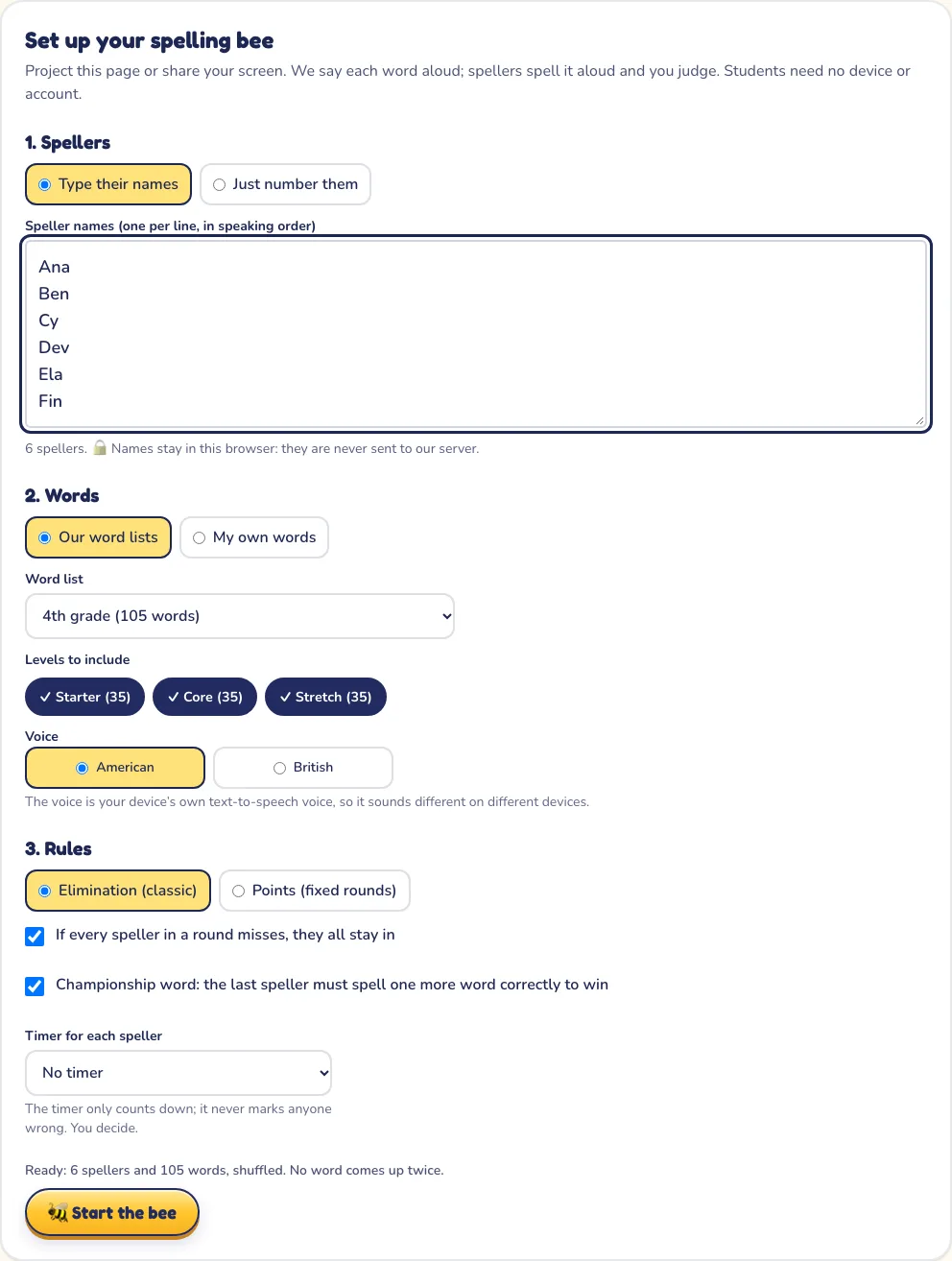
Settings you can choose: Speller names, or just a number of spellers; A word list by grade (1st–8th grade, plus harder and adult lists) or your own words; American or British device voice; Format: Elimination (classic) or Points (fixed rounds); optional answer timer.
1
Open the Spelling Bee Host
On the classroom computer, open the Spelling Bee Host page. Connect speakers or the board's sound.
What you should see: The setup form appears.
2
Add spellers and words
Type speller names (one per line) or choose Just number them. Under Words, pick a grade list or paste this week's words.
What you should see: The form says how many spellers and words are ready.
Setting up a bee: names, a word list and the format.
3
Start the bee
Press Start the bee. Explain the rules: listen, ask for the definition or a sentence if needed, then spell aloud.
What you should see: The first speller's name appears with the round number.
4
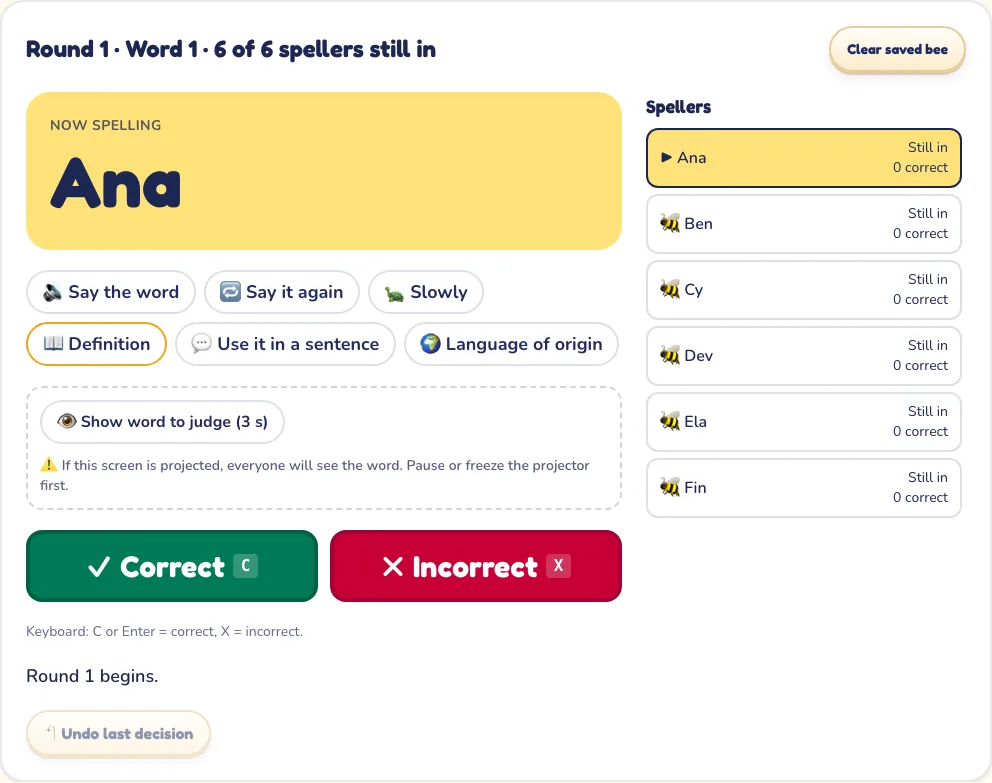
Run each turn
Press Say the word (and Definition, Use it in a sentence or Slowly when asked). Listen to the speller, then press Correct or Incorrect (keys C and X).
What you should see: The Host moves to the next speller and keeps track of who is still in.
A round in progress: the device says the word; you mark Correct or Incorrect.
5
Finish and review
When one speller is left (or after the points rounds), the Host shows the winner. Press Print results for the words used and missed.
What you should see: A printable results sheet to review difficult words with the class.
Good to know
Runs on one screen; students do not play on their own devices.
The voice is the device's text-to-speech: check unusual words first.
Names stay in your browser; nothing is saved by us.
If something goes wrong
No sound
Check the device volume and the board's audio; try another browser (voices differ by device).
A word sounds wrong
Use Say it again or Slowly, or read the word yourself; remove it from your list next time.
The projector shows the word
Freeze the projector before pressing Show word to judge.
Checked against Spelling Better 2.3.6 (73) and the live website on 28 November 2026. Screens marked “sample data” show example players and questions.
Free printable Preschool worksheets
Real worksheets made from this page's weekly lists, each with an answer key. Preview, print or save as PDF, or open one in its tool to change the words.
Trace and Copy: First Letters
Six letters, three lines each. Children trace the first one with a highlighter guide you draw, then copy. Only for children ready to hold a crayon.
Two complete, printable plans built around this page's weekly lists.
Meet the Snake Sound: the Letter s
20 minutes · A 20-minute circle-time lesson: children hear /s/, see the small and capital letter, sort objects that start with /s/ and draw s in sand.
Meet the Snake Sound: the Letter s
A 20-minute circle-time lesson: children hear /s/, see the small and capital letter, sort objects that start with /s/ and draw s in sand.
Objectives
By the end of the lesson, students should be able to:
Say the sound /s/ and point to the letter s.
Hear whether an object's name starts with /s/.
Notice that S and s are the same letter in two sizes.
Materials
Letter cards S and s
A toy snake or a snake picture
A bag with a sock, a spoon, a sun picture, a toy car and a cup
Sand or salt trays
A long rope or skipping rope
Target words
s
a
t
m
p
i
Timing
Time
Stage
Minutes
0–3 min
Sound song
3
3–7 min
Meet the snake letter
4
7–11 min
Is it a snake word?
4
11–16 min
Snake trail
5
16–18 min
Point to the snake letter
2
18–20 min
Sand snakes
2
Whole lesson
20
Lesson stages
1. Sound song3 min (0–3 min)
Wake up listening ears with sounds children already know.
Sit in a circle and sing or chant the sounds of any letters the class has met, with an action for each.
Finish quietly with a long 'sssss' and ask, 'Who makes that sound?'
2. Meet the snake letter4 min (3–7 min)
Link the sound /s/ to the shape of s.
Bring out the toy snake and hiss slowly together, wiggling one hand like a snake.
Show the small s card: 'This letter looks like a snake and says /s/.' Trace it in the air together.
Show the big S card: 'This is the same letter, just bigger. It says /s/ too.'
Tip: Keep the hiss long and quiet so children do not mix it up with /z/.
3. Is it a snake word?4 min (7–11 min)
Hear /s/ at the start of real words.
Pull objects from the bag one at a time and name them slowly: 'ssssock'.
Children hiss and wiggle a hand if the word starts with /s/ (sock, spoon, sun) and sit still if it does not (car, cup).
Put the /s/ objects next to the s card.
4. Snake trail5 min (11–16 min)
Practise the sound while moving.
Lay the rope on the floor in a wiggly line like a snake.
Children walk along it one behind the other, hissing all the way.
At the end, each child says a word that starts with /s/ or picks up one of the /s/ objects and names it.
5. Point to the snake letter2 min (16–18 min)
See who can pick out s from other letters.
Hold up three cards (s, a, t) and ask each child in turn, 'Point to the snake letter.'
Make a quick note of who points to s without help.
6. Sand snakes2 min (18–20 min)
Finish with a calm letter-forming moment.
Each child draws one s in a sand tray, hissing as they write.
Say goodbye to the snake: each child tells it one s word as they leave the circle.
Differentiation
Support: Sit beside children who are unsure, hold the s card next to each object and stretch the first sound together before asking.
Stretch: Ask confident children to find something in the room that starts with /s/ and to tell you where in the room they found it.
Assessment
During the point-to-the-letter check, note who recognises s and who hears /s/ at the start of sock and spoon. Repeat the game in a small group for anyone who is not yet sure.
Homework
Go on a snake hunt at home: find three things that start with /s/ (sock, spoon, sofa) and hiss at each one with a grown-up.
Made with the free lesson plan generator at spellingbetter.com. A template-based starting point: change anything that does not suit your class.
Animal Picture Words: First Sounds
20 minutes · A 20-minute lesson using animal pictures: children name each animal, stretch its first sound, move like it, and match animals to letter cards.
Animal Picture Words: First Sounds
A 20-minute lesson using animal pictures: children name each animal, stretch its first sound, move like it, and match animals to letter cards.
Objectives
By the end of the lesson, students should be able to:
Make an animal noise (oink, quack, buzz) and children guess the animal.
Let two or three children make a noise for the others to guess.
2. Meet the animals4 min (3–7 min)
Learn the names and hear their first sounds.
Show each picture card and say the name slowly, stretching the first sound: 'ffffox', 'hhhen'.
Children repeat the name, then say only the first sound.
Put the cards in a row where everyone can see them.
3. Who starts like me?5 min (7–12 min)
Compare first sounds and link some of them to letters.
Hold up the dog card and ask which other animal starts with /d/ (duck).
Place the c, d and p letter cards on the floor and help children put cat, dog, duck and pig on the right letter.
Ask: 'Pig starts with /p/. Which letter is that?' and let a child point.
Tip: Stretch sounds that can last (ffff, hhh) but keep /d/, /p/ and /g/ short and crisp, without an 'uh' after them.
4. Animal first-sound parade5 min (12–17 min)
Say first sounds while moving.
Show a card; children move like that animal around the room repeating its first sound.
On the drum, everyone freezes; ask one child which animal they are and its first sound.
Play four or five rounds, ending with the quiet fox tiptoeing back to the circle.
5. Goodbye animals3 min (17–20 min)
Recall the words and end calmly.
Turn the cards face down and lift one at a time; children whisper the animal and its first sound.
Each child chooses a favorite animal and says its name as they leave the circle.
Differentiation
Support: Use four animals with very different first sounds (pig, hen, fox, bee) and say the first sound together before asking anyone alone.
Stretch: Ask confident children to think of another animal that starts with the same sound as one of the cards (dog and dinosaur).
Assessment
Note which children can say the first sound of an animal name on their own during the freeze questions, and which can match cat, dog and pig to the right letter card.
Homework
Look at an animal picture book with a grown-up. Name each animal you see and say the first sound of its name together.
After class (optional)
Made with the free lesson plan generator at spellingbetter.com. A template-based starting point: change anything that does not suit your class.
With a grown-up, look for this week's letters (s, a, t, m, p, i) on food packets, signs, toys and books. Each time your child spots one, say its sound and do its action together.
Weekend sound walk
weekend · about 15 min
On a walk or a trip to the shops, play 'I spy with my little eye something that starts with /m/'. Take turns. Use the sounds of letters, not their names, and help with clues if needed.
Trace and copy the curly letters
printable · about 10 min
Your child traces the curly letters (c, o, a, d, g, q) with a crayon, saying 'curl round like c' at the start of each one. Stop after a few letters if little hands get tired; neat is less important than starting at the top.
Your child draws a favorite animal from this week (cat, dog, pig, hen, fox, bee, goat or duck). A grown-up writes the animal's name underneath, and your child points to the first letter and says its sound.
Bath-time body words
family · about 5 min
At bath time or while getting dressed, play 'Busy Bee says': 'Busy Bee says wash your foot', 'Busy Bee says touch your nose'. After a few turns, ask which body word starts with /h/ (hand, head).
A week of English practice for preschool
A gentle five-day routine of 10–15 minutes a day. Use the same letters or picture words all week, so children meet them again and again in different ways.
Monday10 min
Meet the letters
Show this week's letter cards one at a time. Say each sound, give it an action and find a child whose name starts with it. End with a quick sound song using all the actions.
Tuesday12 min
Sound Sack Surprise
Pass the sound sack around a small circle. Each child pulls out an object, names it, stretches the first sound and puts it on the matching letter mat.
Wednesday10 min
Sky writing and sand
Draw two of the week's letters huge in the air, saying the movement words, then form them with a finger in sand or salt trays. Children who are ready can try the copying sheet.
Play Lily Pad Letter Hop with the week's letters, or an animal parade with the picture cards. Keep the turns short so every child moves several times.
Friday10 min
Show and share
Children bring or find one object that starts with a sound from this week. Each one shows it, says its name and its first sound, and the class claps the sound three times.
☐ Letter or picture cards ready for this week's group
☐ A bag of small objects that match the week's sounds
☐ Sand, salt or play dough trays set up
☐ Space cleared for moving games
☐ A note of who needs another small-group go
☐ Home letter or note sent to families
spellingbetter.com/for-teachers/grades/
Preschool teacher questions
Should preschool children be learning to spell?
Not in the sense of a spelling test. At this age the useful steps come before spelling: hearing the first sound in a word, linking a sound to a letter, and forming a few letters. The weekly groups on this page are things you say and show, not lists for children to learn by heart.
Which letters should I teach first?
There is no single right order. Many teachers start with a few letters that have clear sounds and make lots of simple words, such as s, a, t, m, p and i, then add others. Letters in children's own names are also a lively place to begin, because children care about them.
Should I teach capital letters or small letters first?
Most of the print children see in books is in small letters, so many teachers start there and show the capital as 'the same letter, bigger'. Children usually notice capitals early anyway, because of their names. Matching games such as Big Letter, Little Letter Partners help them see both forms as one letter.
How long should a preschool English activity last?
Short is better: about 5 to 15 minutes, with plenty of moving and talking. Stop while children are still enjoying it, and come back to the same letters or words later in the day or the next day.
Are the worksheets suitable for three-year-olds?
Mostly not. The copying sheets and the easy word search are for older preschoolers who already hold a crayon and know some letter shapes. For younger children, use sand trays, play dough, sky writing and the circle games instead; they practise the same letters without paper.
Can preschool children use the Spelling Better app?
The app's live rooms need every player to have their own device, their own account and in-app coins, so they are not meant for preschool groups. At this age, the teacher-led circle games on this page work better. If you want a screen voice, the free Spelling Bee Host can read your picture words aloud while you lead.
What if some children are ready for more, or need more time?
Age is only a rough guide, and children in one group can be at very different points. Children who know all the letters can move on to the kindergarten lists of letter sounds and short words, while others can stay with fewer letters for longer.
For older students: Spelling Better
Spelling Better is made for children who are starting to read and spell. Keep it in mind for later years.
Spelling Better is free to download for iPhone, iPad and Android. Group rooms use in-app coins. Premium is free for everyone until 31 December 2026.