12th Grade English Vocabulary Activities, Argument Games and Worksheets
Vocabulary work for students about to leave school: professional words for emails and interviews, the language of logic and evidence, careful hedging, and advanced root-based words, with games, printable worksheets, two lesson plans and options for whole-class and small-group play.
Students in 12th grade are usually 17–18 years old; in England and Wales this is often Year 13, and in many other countries it is the final year of secondary school. Every class is different: use an easier or harder grade’s lists whenever they fit your students better.
What 12th grade students can practise
Professional writing
Use workplace and college words such as liaison, prerequisite and contingency correctly in emails, applications and formal requests.
Reasoning
Name the parts and flaws of an argument (premise, syllogism, tautology, correlation versus causation) and use the terms when evaluating sources.
Precise claims
Strengthen or soften a claim on purpose with adverbs such as arguably, unequivocally and ostensibly, matching the claim to the evidence.
Word roots
Use Latin and Greek roots (melior, tenuis, hemera, loqui) to work out and remember the meanings of advanced academic words.
Spelling
Spell commonly mistaken professional and academic words, including double letters (colleague), silent letters (rapport) and -ible endings (feasible).
Speaking
Use precise vocabulary under pressure in mock interviews, debates and presentations.
Spelling patterns and word study: double letters (colleague, corollary, syllogism) · silent letters (rapport, colleague) · -ible versus -able (feasible, incontrovertible) · -ly adverbs from -al and -ic (marginally, categorically) · French spellings (liaison, rapport) · Latin and Greek roots (hemera, tenuis, melior) · -ency and -sus endings (contingency, consensus).
These are suggested focus areas for this age, not an official curriculum. Adapt them to your own scheme of work.
Classroom games and activities for 12th grade
Teacher-led activities with full rules and an example round. None of them needs the app.
Planning Meeting Simulation
25–35 min · small-group · 12th graders preparing for college or work
Objective: Small groups run a short mock planning meeting and write professional minutes using workplace vocabulary.
You need
Role cards: chair, minute-taker, liaison and two committee members
A one-paragraph meeting brief
Week 1 word list
A timer
Before you start
Write a meeting brief with a goal, a budget and one problem to solve, such as planning a one-day senior trip.
Put students in groups of five and hand out the role cards.
How to play
The chair opens the meeting and keeps it to eight minutes.
Every member speaks at least twice and uses at least one week 1 word each time.
The liaison reports one message from an outside group, such as the bus company or the principal.
The minute-taker records decisions, who does what, and a contingency plan.
Groups swap minutes and underline any list word that sounds forced or vague.
Each group reads its main decision and its contingency aloud in one sentence each.
Example round: Brief: plan a one-day senior trip to a science museum. The liaison reports that the bus company needs numbers by Friday. The chair asks for consensus on the date, and members delegate tasks. The minutes read: 'Consensus: the second Thursday in May. Logistics: Ari confirms the itinerary with the museum. Contingency: if fewer than 30 students sign up, we book the smaller bus. Stakeholders to inform: parents and the principal.'
Easier: Give the minute-taker a template with three headings: Decisions, Actions, Contingency. Harder: Halfway through, announce a surprise change (the museum closes early) and require a second contingency in the minutes.
25–40 min · small-group · 12th graders who have met basic argument writing
Objective: Groups act as reviewers for a short invented study and write a review that judges its evidence with precise logic terms.
You need
Three short invented study summaries
Week 2 word list
Review forms with three headings: Strengths, Concerns, Decision
Before you start
Write three invented one-paragraph study summaries, each with one or two weaknesses, such as a tiny sample, anecdotal evidence or a correlation reported as a cause.
Make one review form for each group.
How to play
Each group reads one study summary and has ten minutes to complete the review form.
The review must use at least four week 2 terms, each in a way that shows its meaning.
Groups choose a decision (accept, revise or reject) and give one reason.
Every review names one caveat the authors should add and one kind of empirical evidence that would make the study stronger.
Groups present their decision in one minute; another group, acting as the authors, may answer one concern.
Example round: Study summary: 'Students who drank orange juice at breakfast scored higher on a quiz, so orange juice improves memory. We asked 12 students.' A group writes: 'Concern: this is a correlation, not causation, so the inference that juice improves memory is conjecture. With only 12 students, the evidence is close to anecdotal. Decision: revise. Add a caveat about sample size and run a controlled test with empirical measures.'
Easier: Give each group four guiding questions: How big is the sample? Is it a correlation or a cause? Is the evidence empirical? Which caveat is missing? Harder: Groups review two summaries on the same topic that reach opposite conclusions and explain which inference is better supported.
10–15 min · whole-class, individual · All 12th graders; quick enough for the start of any writing lesson
Objective: Students decide whether a claim deserves a cautious or a confident adverb, based on the evidence given.
You need
Two cards per student: HEDGE and COMMIT
A slide or board with claims and evidence
Week 3 word list
Before you start
Prepare six claims, each with a one-line description of the evidence behind it, ranging from strong to very weak.
Give every student a HEDGE card and a COMMIT card.
How to play
Show one claim with its evidence; students silently hold up HEDGE or COMMIT.
Call on one student from each side to justify the choice in a sentence.
A volunteer rewrites the claim aloud using a week 3 word that fits the evidence.
The class gives a quick thumbs up if the adverb matches the evidence; otherwise another volunteer tries.
After six claims, each student writes one hedged and one committed sentence about a topic of their choice.
Example round: Claim: 'The new bike lanes made the street safer.' Evidence: 'Two neighbors say they feel safer.' Most students hold up HEDGE. A volunteer rewrites: 'The new bike lanes have presumably made some riders feel safer, albeit on anecdotal evidence.' Next claim: 'The bridge was completed in 1932.' Evidence: 'City records and the plaque on the bridge.' Students hold up COMMIT, and the rewrite uses unequivocally.
Easier: Limit the choices to four adverbs: arguably, presumably, explicitly and unequivocally. Harder: Students must also add a caveat clause with notwithstanding or albeit to every hedged claim.
20–30 min · individual, pair, whole-class · 12th graders studying the week 4 roots
Objective: Students write a short biography of one root-based word, then meet classmates in quick rounds to find connections between their words.
You need
Week 4 word list with root notes
Biography cards
Dictionaries
A timer
Before you start
Assign each student one week 4 word (repeat words in a large class).
Make biography cards with four headings: Root and language, Original meaning, Meaning today, Relatives.
How to play
Students have six minutes to complete the biography card for their word.
The class stands in two rows facing each other; partners have ninety seconds to introduce their words.
Before time runs out, each pair agrees on one connection: a shared root, related or opposite meanings, or a sentence that uses both words correctly.
Partners write the connection on the back of their cards, then one row moves along one place.
After four rounds, students share the most surprising connection they found.
Example round: Dev has ameliorate (Latin melior, better) and meets Noor, who has exacerbate (Latin acerbus, harsh). They agree the words are near opposites and write: 'Extra buses ameliorated the crowding, but the road works exacerbated the delays.' Next, Dev meets Lucas with attenuate, and they note that both words can describe a problem getting less bad: attenuate means weakening, ameliorate means improving.
Easier: Pre-fill the root and meaning on each card so students can focus on the conversations. Harder: Each connection must be one sentence that uses both words plus a hedging word from week 3.
25–35 min · small-group · 12th graders preparing for interviews or applications
Objective: Students practise using precise vocabulary aloud in college or job interview answers while a peer notes each word used well.
You need
Interview question cards
Observer sheet listing weeks 1 and 3 words
Classroom timer
Before you start
Write eight common interview questions on cards, such as 'Tell us about a time you showed leadership.'
Form groups of three: interviewer, candidate and observer.
How to play
The interviewer asks two questions; the candidate has up to ninety seconds for each answer.
The observer ticks each list word the candidate uses and marks it 'precise' or 'forced'.
After the answers, the observer gives one strength and one suggestion, quoting the candidate's own words.
Rotate roles until everyone has been the candidate once.
Each student finishes by writing their best answer down in three sentences, improving one word choice.
Example round: Question: 'Tell us about a time you showed initiative.' Candidate: 'When our club's student liaison moved schools, I took the initiative to contact the principal myself. I delegated the event logistics to two members so we could still meet the deadline.' The observer ticks liaison, initiative, delegated and logistics as precise and suggests replacing 'stuff' later in the answer with 'responsibilities'.
Easier: Let candidates prepare notes for one question for two minutes before answering. Harder: The interviewer asks one surprise follow-up question, and the candidate must use a hedging word from week 3 in the reply.
15–25 min · individual, pair · 12th graders reading nonfiction or opinion pieces
Objective: Students compress the argument of a short text into one precise sentence that names its claim, evidence and limits.
You need
A short article or opinion piece chosen by the teacher
Weeks 2 and 3 word lists
Index cards
Before you start
Choose a one-page article or editorial suitable for your class.
Write the sentence frame on the board: 'The writer argues that ___, using ___ evidence, albeit/although ___.'
How to play
Students read the text and underline the main claim and the type of evidence.
On an index card, each student writes one sentence of no more than 35 words summarizing the argument.
The sentence must use at least one week 2 word and one week 3 word.
Pairs swap cards and check three things: is the claim right, is the evidence type named, is the limit fair?
Writers revise once; the teacher reads three strong abstracts aloud without names.
Example round: After reading an editorial about opening a new city library, a student writes: 'The writer argues that a new library would ameliorate the shortage of quiet study space, citing mostly anecdotal evidence from students, albeit with one survey that ostensibly supports the claim.' Her partner suggests that 'ameliorate' fits but 'ostensibly' sounds like she doubts the survey, so she changes it to 'arguably'.
Easier: Use the sentence frame and give students a choice of three words from each list. Harder: Students write a second abstract for an opposing article and a third sentence comparing the two.
Read-aloud tests by grade; the device says each word.
Grade 12 spelling and vocabulary words, week by week
Four original weekly lists with meanings and example sentences. Copy or print a list, or turn it into a worksheet, flashcards or a read-aloud spelling test in one click.
Week 1 · Professional words with double and silent letters
Week 1: Words for College and the Workplace
Objective: Students learn and spell the words they will meet in applications, course catalogs, work emails and team projects.
Week 1: Words for College and the Workplace: words, meanings and example sentences
Word
Meaning
Example
Listen
liaisonnoun · French: i-a-i
A person who connects two groups so they can share information and work together.
Mira acts as the student liaison between the debate club and the principal.
prerequisitenoun · pre- + requisite
Something that must be done or gained before you are allowed to do something else.
Algebra II is a prerequisite for the statistics course.
itinerarynoun · -erary
A detailed plan for a journey, listing times and places.
The team emailed the itinerary for the college visit to every family.
reimburseverb · re- + im- + -burse
To pay someone back for money they have spent.
The club will reimburse students who paid for their own bus tickets.
colleaguenoun · -league
A person you work with, especially in a job or profession.
Dr. Patel asked a colleague to review her report before sending it.
proficientadjective · -cient
Skilled and able to do something well.
Applicants should be proficient in at least one spreadsheet program.
delegateverb · Latin legare: to send
To hand part of your work or responsibility to someone else.
A good project leader delegates tasks according to each member's strengths.
consensusnoun · -sus, not -cus
General agreement reached by a whole group.
After an hour of discussion, the committee reached a consensus on the theme.
initiativenoun · -tiative
The ability to see what needs doing and start it without being told.
Sam showed initiative by organizing the volunteer schedule himself.
memorandumnoun · Latin -um
A short written note shared inside an organization, often shortened to memo.
The principal sent a memorandum explaining the new exam timetable.
contingencynoun · -ency
A possible future event that you plan for in case it happens.
Every outdoor event plan needs a contingency in case of rain.
logisticsnoun · -istics
The detailed planning of how people, equipment or supplies get where they are needed.
Ms. Okafor handled the logistics of moving the science fair to the gym.
stakeholdernoun · compound word
Anyone who has an interest in a project or decision and is affected by it.
Students, parents and teachers are all stakeholders in the new schedule.
feasibleadjective · -ible
Possible to do in practice with the time and resources available.
The council asked whether a weekend shuttle bus was feasible.
rapportnoun · double p, silent t
A friendly, understanding relationship between people.
The new coach quickly built rapport with the players.
Practice ideas
Minutes practice: write three lines of meeting minutes about a club decision using consensus, delegate and contingency.
Circle the double letters in colleague and rapport, the silent t in rapport and the i-a-i in liaison, then write each word twice from memory.
Read a real course description or job advert you supply and find any list words or close relatives in it.
Pairs quiz each other on meanings, then on spellings, with the other partner reading the example sentence.
Week 2 · Terms for reasoning and evidence
Week 2: The Language of Logic and Argument
Objective: Students use precise terms to describe how arguments are built, what evidence they rest on and where they go wrong.
Week 2: The Language of Logic and Argument: words, meanings and example sentences
Word
Meaning
Example
Listen
premisenoun · -ise
An idea or statement that an argument is built on.
The whole debate rested on the premise that homework should be optional.
inferencenoun · -ence
A conclusion reached by reasoning from evidence rather than being told directly.
Seeing the empty feeder and the scattered seeds, Ana drew the inference that squirrels had visited overnight.
syllogismnoun · double l; -ism
A form of reasoning in which a conclusion is drawn from two connected premises.
A classic syllogism runs: all birds have feathers; a robin is a bird; so a robin has feathers.
corollarynoun · double l; -ary
A result or idea that follows naturally from something already accepted.
A corollary of a longer lunch break is a later end to the school day.
tautologynoun · Greek tauto: the same
Saying the same thing twice in different words so that nothing is added, as in 'free gift'.
The phrase 'a new innovation' is a tautology, since every innovation is new.
caveatnoun · Latin: let him beware
A warning or condition that limits what has just been said.
The results are promising, with one caveat: only forty people took part.
empiricaladjective · -ical
Based on observation, experiment or measurement rather than on theory alone.
The class gathered empirical data by timing how fast ice melted in each cup.
anecdotaladjective · -al
Based on personal stories rather than careful, wide-ranging evidence.
His claim that the new pillow cures snoring is anecdotal; it comes from three friends.
causationnoun · -tion
The relationship in which one thing directly makes another thing happen.
Two trends rising at the same time do not prove causation.
correlationnoun · cor- + relation
A link between two things that tend to change together, which may or may not mean one causes the other.
The survey showed a correlation between ice cream sales and sunburns, but neither caused the other.
dichotomynoun · ch = k; Greek dicho-: in two
A sharp division between two things that are presented as opposites.
The essay questions the dichotomy between art and science.
heuristicnoun · Greek heuriskein: to find
A practical rule of thumb that helps you solve problems quickly, though not always perfectly.
A useful heuristic for editing is to cut any word that adds no meaning.
conjecturenoun · -ture
A guess or opinion formed without complete evidence.
Without the missing pages, any explanation of the ending is pure conjecture.
axiomnoun · Greek axios: worthy
A statement accepted as true without needing proof, used as a starting point for reasoning.
The team treated 'the customer comes first' as an axiom and never questioned it.
Practice ideas
Argument map: take a short opinion piece and label its premise, its evidence (empirical or anecdotal) and one caveat the writer left out.
Correlation or causation? Read six invented headlines aloud and have students decide which ones confuse the two.
Write a tautology, a premise and a conjecture about the same topic, then swap with a partner to identify which is which.
Spelling pairs: corollary and correlation both have double letters; students write both and circle where the doubles fall.
Week 3 · Adverbs and connectors that qualify claims
Week 3: Hedging and Qualifying Claims
Objective: Students choose adverbs and connectors that make a claim exactly as strong or cautious as the evidence allows.
Week 3: Hedging and Qualifying Claims: words, meanings and example sentences
Word
Meaning
Example
Listen
arguablyadverb · drop e + -ably
In a way that can reasonably be supported, though some people may disagree.
The bridge scene is arguably the most important moment in the film.
ostensiblyadverb · -ibly
Apparently, or according to what is stated, though the real reason may be different.
He came over, ostensibly to return a book, but really to see the new puppy.
inherentlyadverb · -ently
As a basic, built-in part of something's nature.
No color is inherently sad; its meaning depends on the context.
predominantlyadverb · pre- + -antly
Mainly; for the most part.
The audience at the lecture was predominantly first-year students.
marginallyadverb · -ally
Only by a small amount.
Our second test scores were marginally higher than the first.
notwithstandingpreposition · compound word
In spite of; even though something else is true.
Notwithstanding the late start, the meeting ended on time.
albeitconjunction · all + be + it
Although; used to add a limit or contrast to a point.
The plan worked, albeit more slowly than we had hoped.
inadvertentlyadverb · in- + ad- + -ently
Without meaning to; by accident.
Kai inadvertently deleted the slide he had spent an hour on.
implicitlyadverb · im- prefix
In a way that is suggested but not stated directly.
The poem implicitly criticizes the town's treatment of newcomers.
explicitlyadverb · ex- prefix
In a clear, direct way that leaves no doubt.
The assignment sheet explicitly asks for two quotations per paragraph.
tacitlyadverb · Latin tacitus: silent
In a way that is understood or agreed to without being spoken.
By staying silent, the committee tacitly accepted the proposal.
categoricallyadverb · -ically
Completely and without any exception or doubt.
The company categorically denied that the files had been lost.
presumablyadverb · drop e + -ably
Probably, judging from what you already know.
The lights are off, so the shop is presumably closed.
purportedlyadverb · -edly
According to what is claimed, though it may not be true.
The old letter was purportedly written by a famous explorer.
unequivocallyadverb · un- + -ally
In a way that is completely clear, leaving no room for doubt or a double meaning.
The judges stated unequivocally that their decision was final.
Practice ideas
Strength scale: place the adverbs on a line from 'most cautious' (presumably, purportedly) to 'most certain' (categorically, unequivocally).
Rewrite three overconfident claims from a sample essay so each matches its evidence, using one hedging word per claim.
Explicitly versus implicitly: find one thing a class text says directly and one it only suggests, and write a sentence about each.
Spelling focus: sort the -ly words by ending (-ably, -ibly, -ally, -ently, -antly, -itly, -edly) and note which ones double the l.
Week 4 · Latin and Greek roots in advanced words
Week 4: Latin and Greek Roots in Advanced Words
Objective: Students use roots to unlock and remember advanced words for change, time, judgment and character that appear in college reading.
Week 4: Latin and Greek Roots in Advanced Words: words, meanings and example sentences
Word
Meaning
Example
Listen
ubiquitousadjective · Latin ubique: everywhere
Found everywhere, or seeming to be everywhere at once.
Phones are so ubiquitous that it is hard to picture a school hallway without them.
ephemeraladjective · Greek hemera: day
Lasting for a very short time.
Chalk drawings on the sidewalk are ephemeral; the first rain washes them away.
obsolescencenoun · Latin obsolescere: to wear out
The process of becoming out of date and no longer used.
Rapid upgrades speed up the obsolescence of last year's phones.
circumlocutionnoun · Latin circum + loqui
Using many words to say something that could be said simply, often to avoid the point.
The official's circumlocution turned a simple 'no' into a five-minute speech.
exacerbateverb · Latin acerbus: harsh
To make a problem, pain or bad situation worse.
Arguing in the group chat only exacerbated the misunderstanding.
ameliorateverb · Latin melior: better
To make a bad or difficult situation better.
New benches and shade trees ameliorated the long wait at the bus stop.
assuageverb · Latin suavis: sweet
To ease or calm an unpleasant feeling such as worry, guilt or hunger.
The coach's calm words assuaged the team's nerves before the final.
proliferateverb · Latin proles: offspring
To increase quickly in number and spread widely.
Food trucks have proliferated near the stadium since it reopened.
attenuateverb · Latin tenuis: thin
To weaken or reduce the strength or effect of something.
Thick curtains attenuate the noise from the busy street.
incontrovertibleadjective · Latin contra + vertere
So clearly true that nobody can reasonably argue against it.
The video gave incontrovertible evidence that the ball crossed the line.
perspicaciousadjective · Latin perspicere: see through
Quick to notice and understand things that other people miss.
A perspicacious reader spots the clue hidden in the first chapter.
egregiousadjective · Latin e + grex: out of the flock
Shockingly bad and obvious.
Spelling the school's name wrong on the graduation banner was an egregious mistake.
inveterateadjective · Latin vetus: old
Having had a habit for so long that it is unlikely to change.
My grandfather is an inveterate tinkerer who cannot leave a broken radio alone.
pejorativeadjective · Latin peior: worse
Expressing disapproval, or making something sound worse than it is.
The review used 'cheap' in a pejorative sense, though the bikes were simply affordable.
equanimitynoun · Latin aequus + animus
Calmness and evenness of mind, especially under stress.
She answered the tough interview questions with remarkable equanimity.
Practice ideas
Root first: show only the root and its meaning (melior = better); students predict the word and its meaning before seeing it.
Opposite pairs: explain why ameliorate and exacerbate are near opposites, and why assuage is closer to ameliorate.
Find a relative: for each root, students list one more English word that shares it (circum: circumference; vetus: veteran).
Spelling hooks: write the root inside each word in a different color, such as ameLIORate and atTENUate.
Your browser has no speech voice, so the listen buttons are hidden.
Need a longer list? See the full advanced spelling words, with a read-aloud test for every level.
Turn these words into a classroom game: paste a week’s list into the free Spelling Bee Host and run a spoken bee on the board, or see how to host a live game below.
How to host live word games for Grade 12 students
Suggested game session for 12th grade
Many 12th graders have their own phones, so an Audio Quiz room can be one optional station in a rotation: a group of 2–4 listens and answers together while other groups work on paper tasks from this page.
Game
Audio Quiz room (Play with Friends, in the app)
Settings to try
Audio Quiz room with Mix it up: try C1 as a starting point, then move down to B2 if the group finds it too hard or up to C2 if it is too easy.
Vocabulary focus
Listening for precise meaning and spelling of advanced words, then linking anything new back to this week's list.
Warm-up
Before the room starts, each group writes three words from this week's list that it expects to find hard and checks their meanings.
Session length
10–15 minutes per group, as one station
Format
Groups of 2–4 including the host, each on their own phone or tablet with the app and their own account; the host creates the room and shares the 6-digit code, others type it in Join Room.
Supervision
Rooms cost in-app coins and need personal accounts, so keep the station optional and offer a paper task for anyone without the app. The host also plays; results show only on each player's screen.
Afterwards
Each group writes down two words from the game that surprised them and adds them to a class 'precision words' list on the board.
Independent practice
Students who have the Spelling Better app can do extra practice with its spelling quizzes, vocabulary quizzes, flashcards and word games.
For the whole class at once, use the free Spelling Bee Host on one projected screen: choose My own words, paste this week's list and enter teams as spellers, or pick the Adults or Hard words list under Advanced and adults. No student devices or accounts are needed.
Session length and grouping are teaching suggestions, not app settings. The app has no grade setting.
Step by step: Audio Quiz room (Play with Friends, in the app)
Best for: Small groups of older students who each have a phone or tablet: listen to a word, choose the right spelling.
Players: 2–4 players including the host
Devices: iPhone, iPad and Android phones and tablets; every player on their own device
Cost: Uses in-app coins: the host sets the entry coins and every player pays them when the game starts.
Settings you can choose: Quiz topic: a level (A1 to C2) and a skill, or Mix it up; Entry coins.
1
Install Spelling Better and sign in
Every player installs Spelling Better (iPhone, iPad and Android phones and tablets) and signs in with their own account: email, Google, phone, or Apple on iPhone and iPad.
What you should see: Each player sees the app's Home screen with the tabs at the bottom.
2
Open Play with Friends
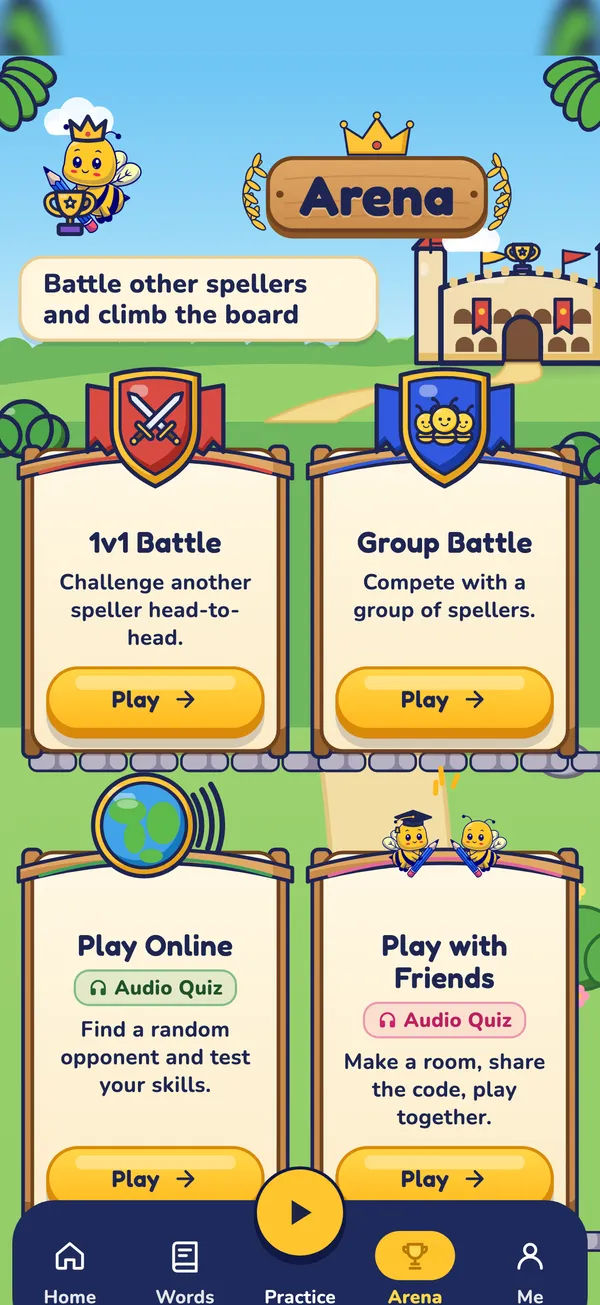
Tap Arena at the bottom, then Play with Friends.
What you should see: The room screen opens.
Arena: Group Battle and Play with Friends start group rooms. (sample data)
3
Create the room
Tap Create Room. Under Quiz topic, choose a level and a skill, or Mix it up; choose the Entry coins; tap Create Room.
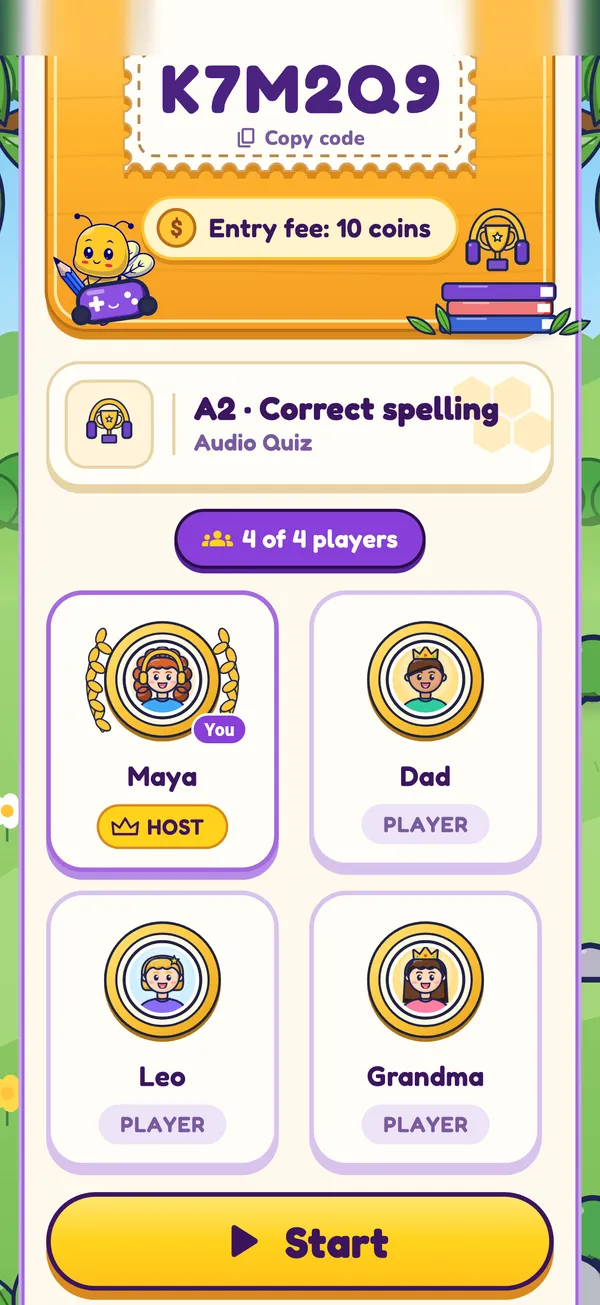
What you should see: The lobby shows a 6-digit room code.
4
Share the code
Copy the code, share it from the phone, or write it on the board.
What you should see: Players appear in the lobby as they join (up to 4).
A room lobby: share the code, wait for players, then Start. Real codes are digits. (sample data)
5
Start
When at least one other player has joined, the host taps Start.
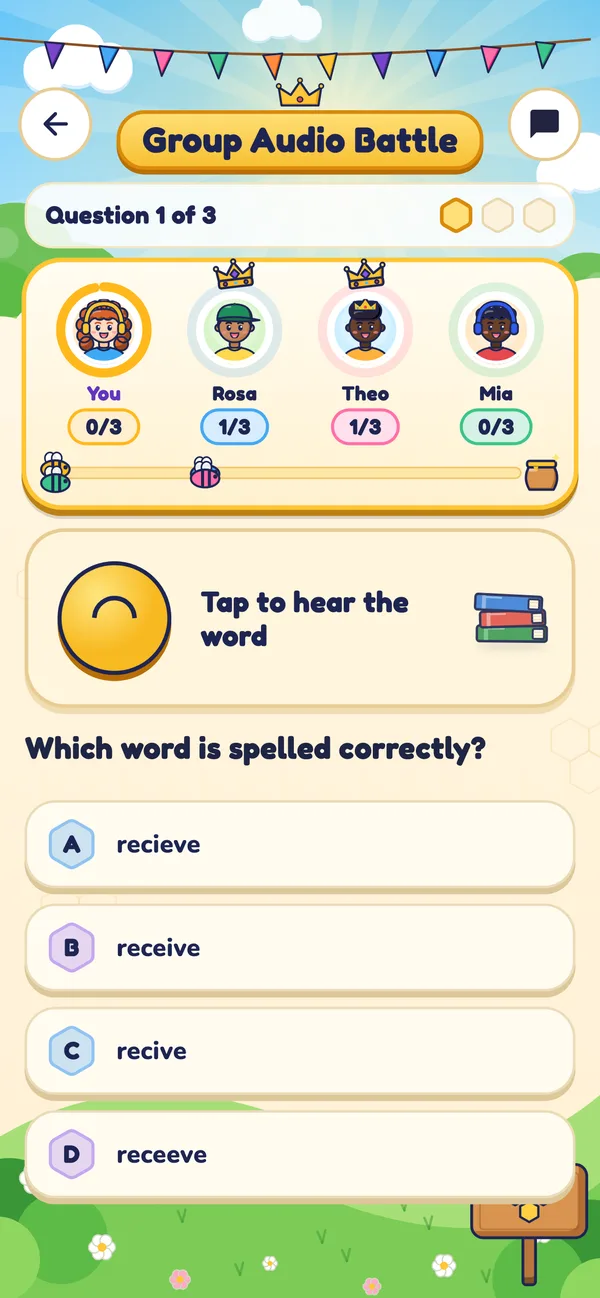
What you should see: Everyone hears the same words and chooses a spelling.
Audio rooms: players hear the word, then choose the spelling. (sample data)
6
Results and review
The result screen ranks players. Note scores yourself if you want a class record, then go over the words people missed.
What you should see: Rooms are not saved afterwards.
The result screen ranks players by correct answers. (sample data)
Student guide: how to join
1
Install Spelling Better and sign in
Every player installs Spelling Better (iPhone, iPad and Android phones and tablets) and signs in with their own account: email, Google, phone, or Apple on iPhone and iPad.
What you should see: Each player sees the app's Home screen with the tabs at the bottom.
2
Join the room
Tap Arena, then Play with Friends, then Join Room. In Join a Friend's Room, type the 6-digit code in Room code (or Paste code).
What you should see: The player appears in the host's lobby and waits for Start.
Checked against Spelling Better 2.3.6 (73) and the live website on 28 November 2026. Screens marked “sample data” show example players and questions.
Whole class on one screen instead: the free Spelling Bee Host
Best for: A whole class on one screen, from kindergarten up. Free, no accounts, no student devices.
Players: 2–60 spellers on one screen
Devices: Any computer, laptop or interactive whiteboard with a modern browser and speakers
Cost: Free. No sign-up.
Settings you can choose: Speller names, or just a number of spellers; A word list by grade (1st–8th grade, plus harder and adult lists) or your own words; American or British device voice; Format: Elimination (classic) or Points (fixed rounds); optional answer timer.
1
Open the Spelling Bee Host
On the classroom computer, open the Spelling Bee Host page. Connect speakers or the board's sound.
What you should see: The setup form appears.
2
Add spellers and words
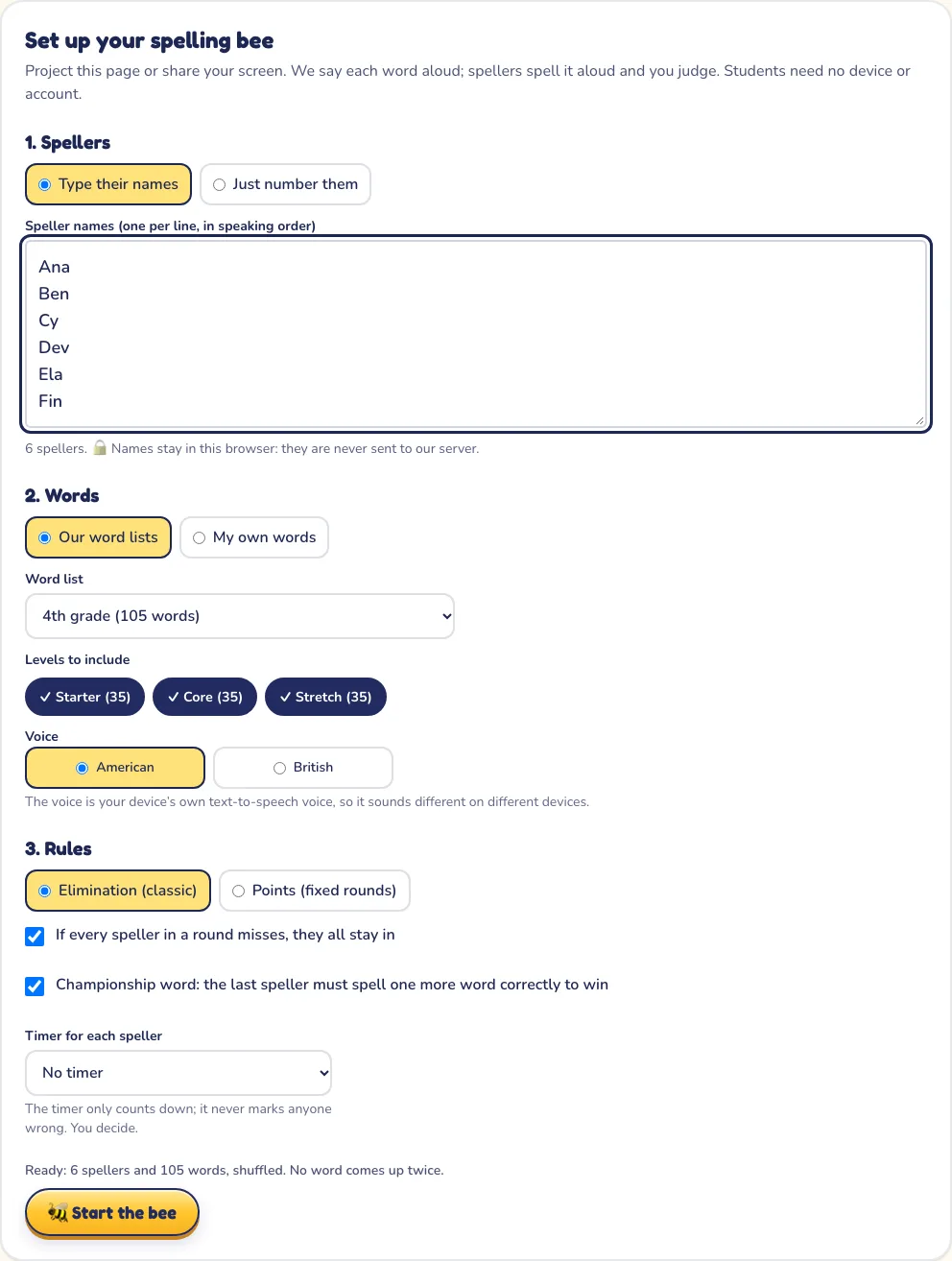
Type speller names (one per line) or choose Just number them. Under Words, pick a grade list or paste this week's words.
What you should see: The form says how many spellers and words are ready.
Setting up a bee: names, a word list and the format.
3
Start the bee
Press Start the bee. Explain the rules: listen, ask for the definition or a sentence if needed, then spell aloud.
What you should see: The first speller's name appears with the round number.
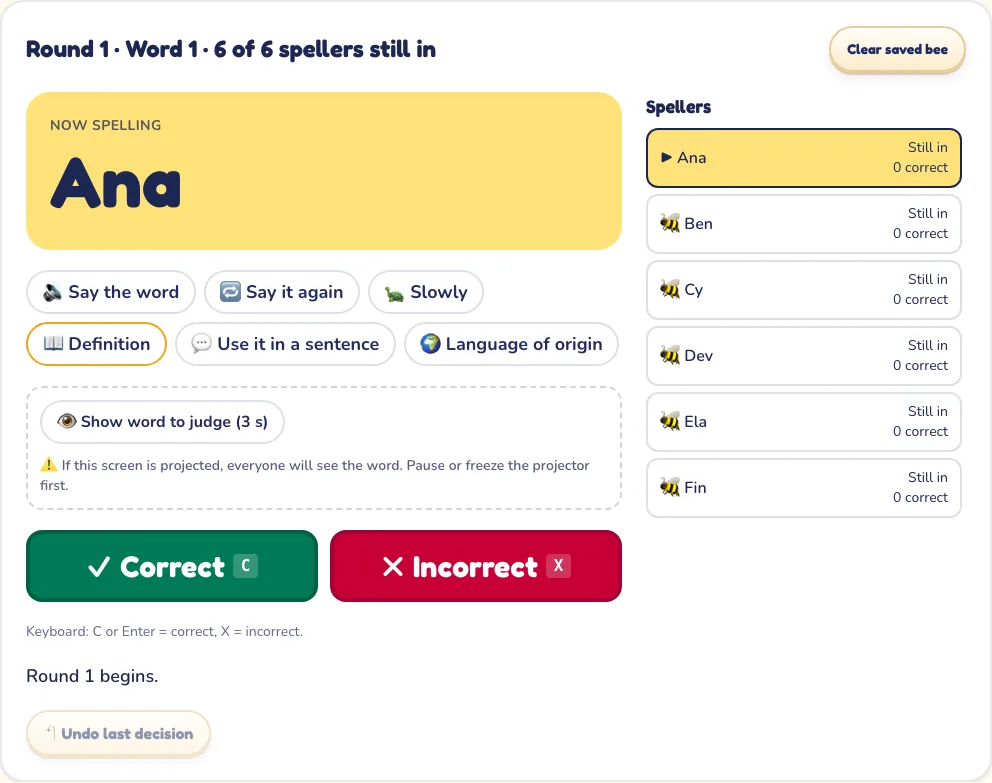
4
Run each turn
Press Say the word (and Definition, Use it in a sentence or Slowly when asked). Listen to the speller, then press Correct or Incorrect (keys C and X).
What you should see: The Host moves to the next speller and keeps track of who is still in.
A round in progress: the device says the word; you mark Correct or Incorrect.
5
Finish and review
When one speller is left (or after the points rounds), the Host shows the winner. Press Print results for the words used and missed.
What you should see: A printable results sheet to review difficult words with the class.
Good to know
Runs on one screen; students do not play on their own devices.
The voice is the device's text-to-speech: check unusual words first.
Names stay in your browser; nothing is saved by us.
If something goes wrong
No sound
Check the device volume and the board's audio; try another browser (voices differ by device).
A word sounds wrong
Use Say it again or Slowly, or read the word yourself; remove it from your list next time.
The projector shows the word
Freeze the projector before pressing Show word to judge.
Checked against Spelling Better 2.3.6 (73) and the live website on 28 November 2026. Screens marked “sample data” show example players and questions.
Free printable Grade 12 worksheets
Real worksheets made from this page's weekly lists, each with an answer key. Preview, print or save as PDF, or open one in its tool to change the words.
Workplace Words Search and Spell
A word search in all eight directions, then missing letters with the definition as a hint to focus on double and silent letters.
Two complete, printable plans built around this page's weekly lists.
Logic Words for Stronger Arguments
55 minutes · Students learn week 2 terms for reasoning and evidence, use them to review invented studies in a Mock Peer Review, and repair an argument of their own.
Logic Words for Stronger Arguments
Students learn week 2 terms for reasoning and evidence, use them to review invented studies in a Mock Peer Review, and repair an argument of their own.
Objectives
By the end of the lesson, students should be able to:
Define and spell at least ten terms for reasoning and evidence.
Tell correlation from causation and anecdotal from empirical evidence in short arguments.
Repair a weak argument by adding a caveat or better evidence.
Materials
Week 2 word list
Invented study summaries
Review forms
Logic terms exit ticket
Short opinion piece
Target words
premise
inference
syllogism
corollary
tautology
caveat
empirical
anecdotal
causation
correlation
dichotomy
heuristic
conjecture
axiom
Timing
Time
Stage
Minutes
0–5 min
Spot the problem
5
5–17 min
The vocabulary of argument
12
17–27 min
Label the argument
10
27–42 min
Mock Peer Review
15
42–50 min
Repair your own argument
8
50–55 min
Exit ticket
5
Whole lesson
55
Lesson stages
1. Spot the problem5 min (0–5 min)
Get students thinking about flawed reasoning before naming it.
Show one invented claim: 'Every student who wears a watch passes the exam, so watches help you pass.'
Students write what is wrong in one sentence, without any special vocabulary yet.
2. The vocabulary of argument12 min (5–17 min)
Teach the terms and spellings in three groups.
Group 1, building an argument: premise, axiom, syllogism, inference, corollary, heuristic.
Group 2, kinds of evidence: empirical, anecdotal, conjecture, caveat.
Group 3, common problems: tautology, correlation confused with causation, a false dichotomy.
Return to the warm-up claim and rename the problem: correlation presented as causation.
Tip: Point out the double letters in syllogism, corollary and correlation; these are the most common spelling slips.
3. Label the argument10 min (17–27 min)
Apply the terms to a real piece of writing.
Read a short opinion piece together.
Pairs label its premise, its main evidence (empirical or anecdotal) and one caveat the writer should have added.
Share answers and agree on the clearest wording.
4. Mock Peer Review15 min (27–42 min)
Use the terms to judge evidence the way reviewers do.
Groups review one invented study summary each, using at least four week 2 terms on the review form.
Each group announces its decision (accept, revise or reject) in one minute; another group may answer one concern.
Support: Give a reference card with the three groups of terms and one example for each; give groups four guiding questions for the review.
Stretch: Students find a real advertisement or headline and write a paragraph diagnosing its reasoning with four terms.
Assessment
Peer reviews show accurate use of the terms; exit tickets and the repaired arguments show meaning and spelling for each student.
Homework
Read an opinion piece the teacher provides, then write a one-sentence abstract and a short paragraph naming its premise, its evidence type and one caveat.
After class (optional)
Students who have the Spelling Better app can keep practising spelling and vocabulary with its quizzes and word games at home. This is optional extra practice: the app uses its own word lists, not the words from this lesson.
Made with the free lesson plan generator at spellingbetter.com. A template-based starting point: change anything that does not suit your class.
Root Power: Advanced Words for Change and Judgment
60 minutes · Students use Latin and Greek roots to learn week 4 words, write word biographies, and rotate through stations, one of which is an optional small-group Audio Quiz room.
Root Power: Advanced Words for Change and Judgment
Students use Latin and Greek roots to learn week 4 words, write word biographies, and rotate through stations, one of which is an optional small-group Audio Quiz room.
Objectives
By the end of the lesson, students should be able to:
Use a root to explain the meaning of at least ten week 4 words.
Distinguish near-meanings such as assuage, ameliorate and attenuate.
Spell long root-based words accurately from dictation.
Materials
Week 4 word list with root notes
Word biography cards
Roots crossword
Optional: students' own phones with the Spelling Better app
Paper alternative station tasks
Target words
ubiquitous
ephemeral
obsolescence
circumlocution
exacerbate
ameliorate
assuage
proliferate
attenuate
incontrovertible
perspicacious
egregious
inveterate
pejorative
equanimity
Timing
Time
Stage
Minutes
0–5 min
Roots you already know
5
5–15 min
Roots and words
10
15–25 min
Near-meaning debate
10
25–40 min
Stations: word biographies, crossword and optional Audio Quiz room
15
40–50 min
Root families
10
50–56 min
Dictation check
6
56–60 min
One root to remember
4
Whole lesson
60
Lesson stages
1. Roots you already know5 min (0–5 min)
Activate known roots before new words.
Write circumference, vertical, animal and veteran on the board.
Students guess the meaning of circum-, vert-, anim- and vet-, then predict where they will appear in this week's list.
2. Roots and words10 min (5–15 min)
Teach meanings by linking each word to its root.
Present the words in root families: change words (exacerbate, ameliorate, assuage, attenuate, proliferate), time words (ephemeral, obsolescence, inveterate) and judgment words (egregious, pejorative, incontrovertible, perspicacious).
For each, show the root first and ask students to predict the meaning.
Highlight spelling hooks such as the root inside the word: ameLIORate, atTENUate.
3. Near-meaning debate10 min (15–25 min)
Separate words with similar meanings.
Show the sentence 'The coach's speech helped ___ the team's worry.' Ask which of assuage, ameliorate and attenuate fits best and why.
Discuss how exacerbate is the near opposite of all three.
Pairs write one sentence where only one of the three would fit.
4. Stations: word biographies, crossword and optional Audio Quiz room15 min (25–40 min)
Practise in varied formats while the teacher circulates.
Station 1: each student completes a biography card for one week 4 word, then compares it with a partner who has a different word.
Station 2: the roots crossword, worked in pairs.
Station 3 (optional): 2–4 students with the app and their own accounts play an Audio Quiz room (Arena → Play with Friends → Create Room) at C1 with Mix it up as a starting point. Rooms cost in-app coins, so students without the app do a paper task instead.
Groups rotate every five minutes.
Tip: Keep the app station small and optional; the host is also a player, and results show only on each player's screen.
Students choose five roots from the list and write one more English word that shares each root.
They write one sentence using a week 4 word and its 'relative' together.
6. Dictation check6 min (50–56 min)
Check spelling in context.
Dictate five example sentences from the list.
Students self-check against the list and circle the part of each word they missed.
7. One root to remember4 min (56–60 min)
Close with a personal memory hook.
Each student shares one root and the word it helped them remember.
Preview the root-based homework.
Differentiation
Support: Use only the eight change and time words, and give a root reference card during the stations.
Stretch: Students research the origin of two words not on the list (for example, from the word roots page) and present them as biography cards next lesson.
Assessment
Biography cards and crossword answers show root knowledge; the dictation shows spelling accuracy for each student.
Homework
Write a 120-word paragraph about a local problem and how it could be solved, using at least four week 4 words, and underline the root in each.
Students who have the Spelling Better app can keep practising spelling and vocabulary with its quizzes and word games at home. This is optional extra practice: the app uses its own word lists, not the words from this lesson.
Made with the free lesson plan generator at spellingbetter.com. A template-based starting point: change anything that does not suit your class.
Write a short professional email to a real or imagined college office, coach or employer asking for information or a change of plan. Use at least four week 1 words and include a clear subject line, greeting, request and sign-off.
Commonly Misspelled Words Check
online · about 15 min
Open the commonly misspelled words page, choose ten words that could appear in a college or job application, and test yourself by writing them from memory. Add any you missed to your personal spelling list.
Teach someone at home two words from this week's list. Explain each meaning, give an example from everyday life, and ask them for an example of their own. Write down the best example you heard.
Club Debate Prep
club · about 30 min
In debate club, English club or with a study partner, prepare a one-minute argument on a topic you choose. Use at least two week 2 words and two hedging words from week 3, then deliver it and ask a partner to name your premise and evidence.
Students who have the Spelling Better app can do extra practice with its spelling quizzes, vocabulary quizzes, flashcards and word games. The app uses its own word lists and does not report back to teachers.
A week of English practice for 12th grade
A five-day plan for one 12th grade list that moves from meaning and spelling to real-world use in emails, arguments and interviews.
Monday20 min
Words and roots
Introduce the list with example sentences and root or spelling notes. Students mark the three words they expect to find hardest.
Tuesday15 min
Quick decisions
Play Hedge or Commit? with six claims, then write one hedged and one committed sentence using list words.
☐ I can spell every word on this week's list, including double and silent letters.
☐ I can explain each word's meaning, and its root where there is one.
☐ I used list words in a real-world task (email, argument or interview answer).
☐ I matched the strength of my claims to my evidence.
☐ I added the words I missed to my personal spelling list.
spellingbetter.com/for-teachers/grades/
Grade 12 teacher questions
What vocabulary do 12th graders most need for college and work?
Three groups are especially useful: practical words from applications, course catalogs and workplace emails (prerequisite, liaison, contingency); the language of argument and evidence (premise, empirical, caveat); and words that set the strength of a claim (arguably, unequivocally). This page has one weekly list for each, plus a list built on Latin and Greek roots.
Is there a 12th grade word list page on Spelling Better?
How can these lists help with college application essays?
Use them for precision rather than decoration. The hedging list helps students avoid overclaiming, and the workplace list helps with clear, formal requests. Encourage students to use a word only when it says exactly what they mean; a simpler word is often the better choice in a personal essay.
Can the Spelling Better app use my 12th grade word list?
No. The app cannot load a teacher's list and has no grade setting. Its Audio Quiz rooms use levels A1–C2, which are not grade equivalents; try C1 as a starting point and adjust. To run your own list with the whole class, paste it into the free Spelling Bee Host under My own words and enter teams as spellers, since the Host needs one word per speller per round.
Are app rooms a good fit for a class of seniors?
Only as a small-group option. Group Battle and Audio Quiz rooms hold 2–4 players including the host, each on their own phone or tablet with the app and their own account, and rooms cost in-app coins. Results appear on each player's screen only. Keep app stations optional and pair them with paper tasks.
How do I keep 12th graders motivated with vocabulary late in the year?
Connect each list to something they are about to do: emails to colleges or employers, interviews, debates or reading for next year. Real-world tasks like the Mock Interview Panel and the Planning Meeting Simulation give the words an immediate use. If a list feels too hard or too easy, swap in easier or harder words; age alone does not decide readiness.
Continue practising with Spelling Better
Students can practise spelling and vocabulary at their own level in the app, on their own phone or tablet.
Spelling Better is free to download for iPhone, iPad and Android. Group rooms use in-app coins. Premium is free for everyone until 31 December 2026.