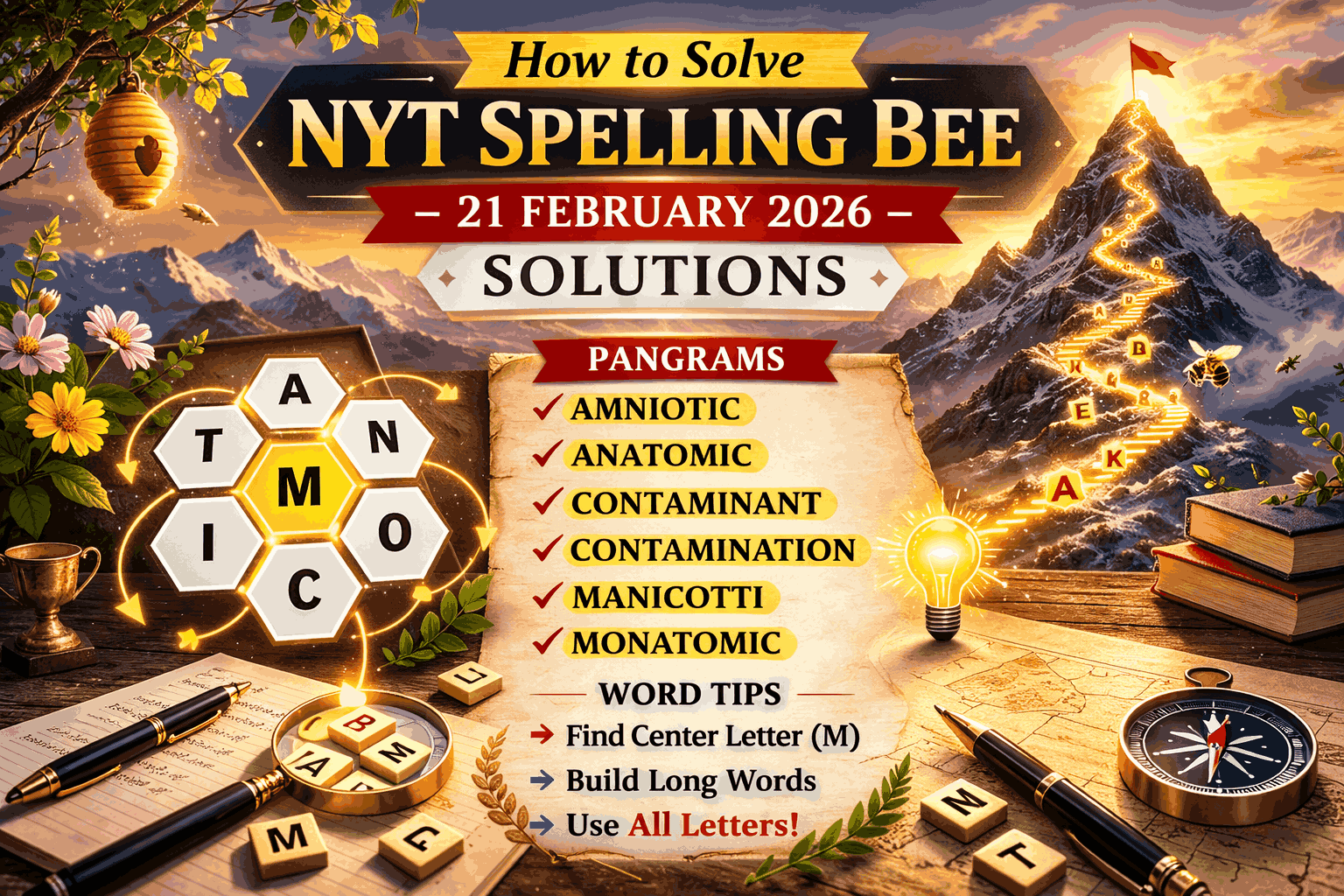
Today’s NYT Spelling Bee puzzle for February 21, 2026, featured the following letters:
Center letter: M
Surrounding letters: A, N, O, C, I, T
As always, every valid word must include the center letter M, must be at least four letters long, and may only use the letters provided. Letters can be repeated.
First Impressions
At first glance, this grid looked rich with possibility. With three vowels (A, O, I) and flexible consonants (N, T, C), the puzzle clearly favored medium-to-long word construction. The presence of M in the center strongly suggested scientific or academic vocabulary might appear.
I started with short, reliable words to warm up:
-
MINT
-
MOAT
-
MAIN
-
MANI
-
MICA
-
AMINO
-
MONA
-
ATOM
Spotting AMINO and ATOM early hinted that chemistry-related patterns could emerge.
Recognizing the Key Pattern
The real breakthrough came when I noticed the letter cluster:
CONTA + MIN
That immediately formed:
CONTAMINANT
Verifying the letters:
C
O
N
T
A
M
I
N
A
N
T
All seven letters are present. That confirmed CONTAMINANT as a pangram.
From there, adding -ION naturally formed:
CONTAMINATION
Again, it uses all seven letters, making it another pangram.
At this point, it became clear this grid allowed multiple high-scoring combinations.
Additional Pangrams
After identifying the “contamin-” structure, I began rearranging the same letters into different groupings. That revealed even more pangrams:
MANICOTTI
A well-known pasta dish that uses every letter at least once.
MONATOMIC
A scientific term meaning consisting of single atoms.
ANATOMIC
Relating to anatomy, also using all seven letters.
AMNIOTIC
Relating to the amnion (as in amniotic fluid).
That means today’s puzzle contains six pangrams:
-
AMNIOTIC
-
ANATOMIC
-
CONTAMINANT
-
CONTAMINATION
-
MANICOTTI
-
MONATOMIC
Finding six pangrams in one grid is extremely satisfying and makes this puzzle one of the richer ones in recent memory.
Building the Word List
After securing the pangrams, I worked methodically through smaller constructions.
4-Letter Words
- AMMO
- ATOM
- CAMI
- CAMO
- COMA
- IMAM
- MAIM
- MAIN
- MAMA
- MICA
- MINI
- MINT
- MITT
- MOAN
- MOAT
- MONO
- MOON
- MOOT
- OMIT
5-Letter Words
- AMINO
- AMNIO
- ANIMA
- COMIC
- COMMA
- MAMMA
- MANIA
- MANIC
- MANNA
- MANTA
- MIMIC
- MINIM
- MOMMA
- MOTTO
6-Letter Words
-
ATOMIC
- CAIMAN
- COMMIT
- COMMON
- MAMMON
- MANIAC
- MINIMA
- MINION
- MOTION
- NONCOM
- TATAMI
- TOMATO
- TOMCAT
- TOMTIT
7-Letter Words
- AMMONIA
- CATMINT
- MINICAM
- OTTOMAN
8+ Letter Words
- ANIMATION
- CINNAMON
- COMMOTION
- IMITATION
- INTIMATION
- MAINTAIN
- MONOMANIA
- MONOMANIAC
- NOMINATION
PANGRAMS
- AMNIOTIC
- ANATOMIC
-
CONTAMINANT
-
CONTAMINATION
-
MANICOTTI
-
MONATOMIC
How the Solve Came Together
The turning point was identifying the repeating cluster CONTA-MIN. Once that core was visible, the longer words unfolded naturally.
From there, the strategy shifted from linear building to creative rearranging. Grouping letters differently produced ANATOMIC and MONATOMIC. Rearranging vowel placements revealed AMNIOTIC.
The presence of balanced vowels made this puzzle especially productive. Rather than feeling constrained, the grid encouraged experimentation with longer academic and culinary vocabulary.
Difficulty Level
I would rate this puzzle as moderately challenging but highly rewarding. While some pangrams required more advanced vocabulary knowledge, the overall letter distribution was generous.
Having six pangrams makes this one of the most satisfying grids in recent weeks.
Did You Spot the Pangram?
The February 21, 2026 NYT Spelling Bee puzzle delivered an exceptional challenge with six pangrams:
-
AMNIOTIC
-
ANATOMIC
-
CONTAMINANT
-
CONTAMINATION
-
MANICOTTI
-
MONATOMIC
It was a perfect example of how recognizing strong letter clusters early can unlock multiple high-scoring words.
Check back tomorrow for another full Spelling Bee solution breakdown.