
Today’s NYT Spelling Bee was a rhythmic blend of challenge and satisfaction. With the center letter T and surrounding letters A, C, D, L, I, Y, I found myself tapping into both logic and poetic intuition. The moment I uncovered the pangram dactylic, I knew today’s puzzle was not only solvable—it was metrical.
Let me walk you through how I cracked the puzzle, the method I used, and a comprehensive list of valid words I found.
How I Solved It
The first thing I did was write down all the letters in the hive:
-
Center Letter (mandatory): T
-
Outer Letters: A, C, D, L, I, Y
From the start, I reminded myself of the Spelling Bee rules:
-
All words must be at least 4 letters long.
-
Each word must include the center letter (T).
-
Letters may be reused.
-
Only the given 7 letters can be used.
I began by brainstorming basic T-containing words like:
-
tail
-
tilt
-
tidy
-
ditty
-
tact
From there, I looked for longer forms. “Ladylit” was a fun combination, but not real. “Tactily” and “italic” were more promising.
Then I considered how the letters could form an -ic or -ly ending, and that’s when the word dactylic flashed in my mind.
I wrote it out: D-A-C-T-Y-L-I-C.
-Used all 7 letters.
-Included T.
-Dictionary check confirmed it’s a real word.
CLICK HERE to download SPELLING BETTER SPELLING BEE APP.
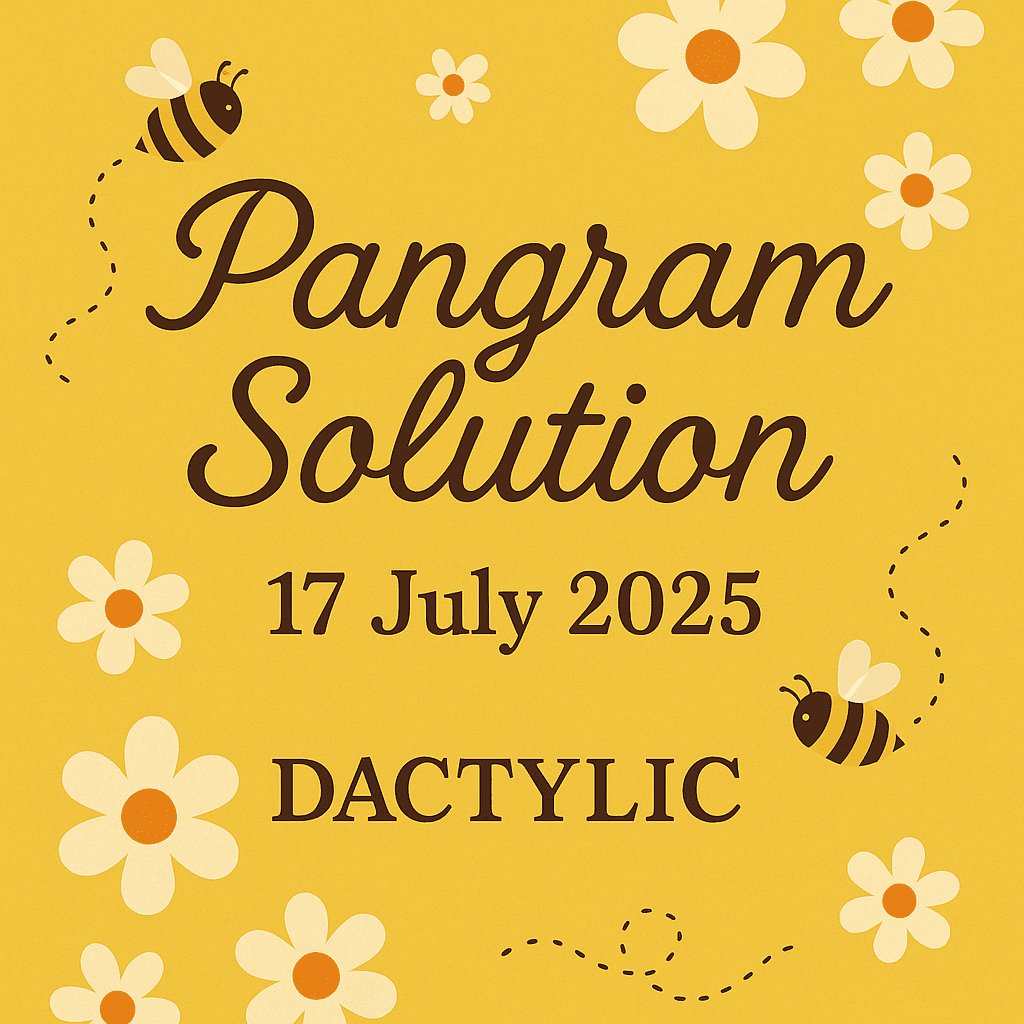
Pangram of the Day: DACTYLIC
Definition:
Dactylic (adj.) – Pertaining to a dactyl, a metrical foot in poetry with one stressed syllable followed by two unstressed syllables.
Example: The word “beautiful” is dactylic in structure: BEAU-ti-ful.
Finding such a literary term as today’s pangram made this puzzle feel like a small ode to language itself.
Full List of Valid Words Found (T as center, 4+ letters):
-
acta
-
attic
-
acid
-
alit
-
city
-
cadi
-
clad
-
clay
-
data
-
dial
-
dict
-
ditty
-
lady
-
laid
-
lactid (rare, chemical term)
-
lacy
-
tali
-
tail
-
tally
-
tact
-
tidy
-
tilt
-
trial
-
tacit
-
ital
-
italid (uncommon/rare)
-
tidal
-
dactylic (pangram)
Note: Some words or scientific terms like italid may or may not be accepted by the NYT word list. Always double-check with the app.
Tips That Helped Today
-
Break down word endings: Common suffixes like “-ic”, “-ity”, and “-ly” can unlock longer words.
-
Repetition helps: Revisiting earlier words like “tail” and testing variations like “tally,” “tali,” or “tact” leads to more discoveries.
-
Write it out: Seeing all the letters and forming patterns visually can trigger the right word faster than thinking silently.
-
Think thematically: Poetry, logic, chemistry—all appeared today, and thinking in those domains helped.
Poetic Closure
Today’s puzzle was clever—not because it was overwhelming but because it disguised brilliance in plain sight. Dactylic is a sophisticated word, but it rewards players who think creatively and break the mold.
From “tidy” to “tally,” every word felt like a step toward metrical mastery. I’m walking away from today’s Spelling Bee not just with points, but with poetic appreciation.
Until tomorrow—keep spelling, keep stretching your mind, and keep buzzing!