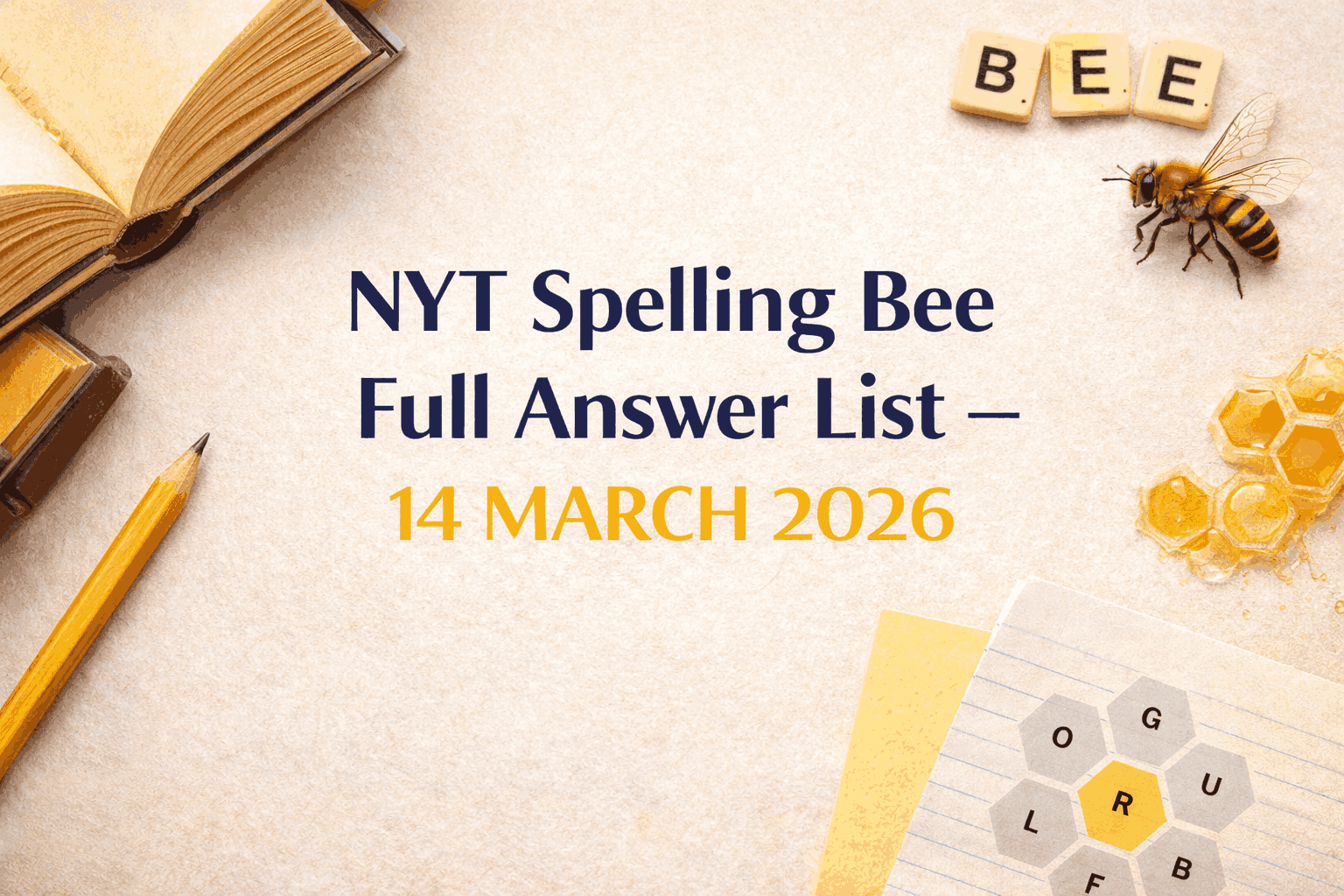
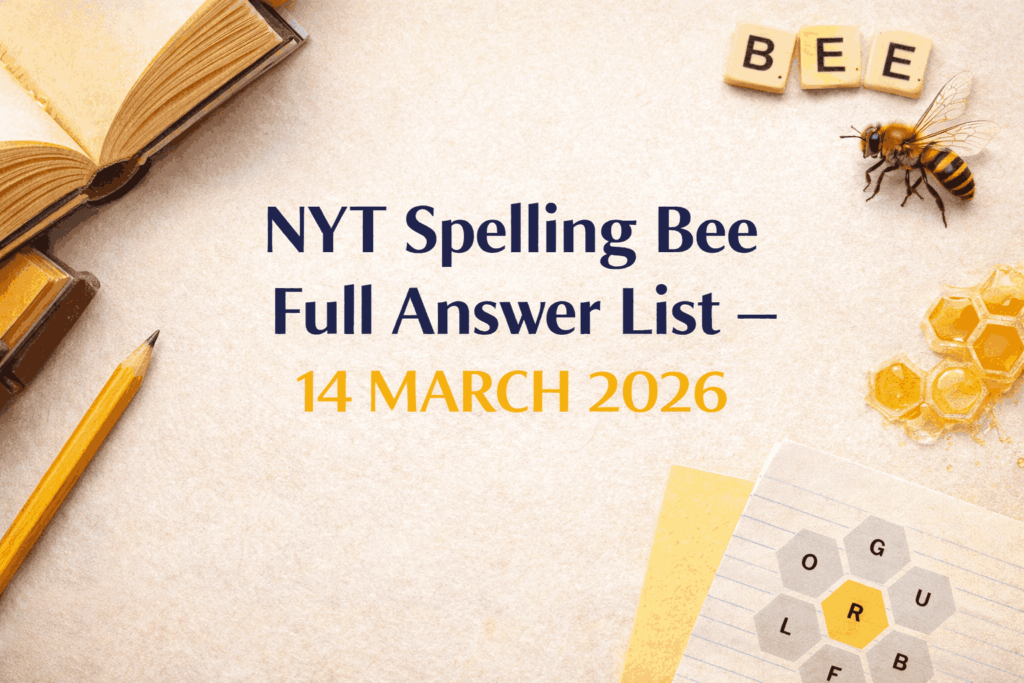
The NYT Spelling Bee puzzle for 14 March 2026 presents a fresh set of letters that challenge players to uncover as many valid words as possible. In today’s puzzle, the center letter is R, and the surrounding letters are G, U, B, F, L, and O. As with every New York Times Spelling Bee puzzle, there are a few important rules: each word must include the center letter, must be at least four letters long, and can only use the letters provided in the hive. Letters may also be reused multiple times.
At first glance, this puzzle looked interesting because the letter set contains only one vowel (O and U) but several strong consonants such as B, F, G, and L. This type of puzzle often produces fewer words, but it also encourages creative thinking and experimentation with letter combinations.
Let’s walk through the approach used to solve today’s puzzle.
Starting with Simple Words
When solving a Spelling Bee puzzle, the best strategy is usually to begin with short four-letter words that contain the center letter. These words help identify the basic letter patterns available in the puzzle.
Some of the first words that appear from today’s letters include:
- FROG
- FURL
- FURR
- ROOF
- BOOR
- BURL
These short words confirm that combinations such as FR, BR, and OR work well with the available letters. Once a few of these basic patterns are identified, it becomes easier to build longer words.
Looking for Word Families
After discovering a few simple words, the next step is identifying word families. Many Spelling Bee puzzles contain groups of words that share similar roots.
For example:
FROG family
- FROG
- FROGGER
BURL family
- BURL
- BURRO
ROOF family
- ROOF
- ROOFING
These repeating patterns help expand the total word count and reveal additional possibilities within the letter set.
Searching for Longer Words
Once several smaller words are discovered, I begin testing longer combinations using more of the available letters. The goal at this stage is to try using as many different letters as possible to uncover the pangram.
Because the puzzle letters include B, U, L, L, F, R, O, G, a few longer combinations quickly appear. Rearranging these letters eventually leads to a very recognizable word.
Discovering the Pangram
The highlight of any Spelling Bee puzzle is finding the pangram, which is a word that uses all seven letters from the hive.
For today’s puzzle, the pangram is:
BULLFROG
This word uses every letter in the puzzle:
B – U – L – L – F – R – O – G
Although the letter L appears twice, that is allowed in Spelling Bee puzzles because letters can be reused. Once this word appears, it confirms that all letters in the puzzle have been successfully used.
Finding the pangram usually provides a large score boost and is one of the most satisfying parts of solving the puzzle.
Word List for Today’s Puzzle
Below are some of the valid words that can be formed using today’s letters.
Four-Letter Words
- BLUR
- BOOR
- BURB
- BURG
- BURL
- BURR
- FOUR
- FROG
- FRUG
- FURL
- GROG
- GRUB
- GURU
- ROLL
- ROOF
- RUFF
Five-Letter Words
- BLURB
- BURRO
- FLOOR
- FLOUR
- FORGO
- FUROR
- GRUFF
Six+ Letter Words
- BULGUR
- BURGOO
- FROUFROU
- LOGROLL
- BULLFROG (PANGRAM)

Tips for Solving Spelling Bee Puzzles
If you want to improve your Spelling Bee solving skills, a few strategies can help.
Start with the center letter
Every word must include it, so build combinations around that letter first.
Look for common prefixes and suffixes
Endings like -OR, -ER, and -ING can help generate new words.
Identify repeating letters
Words like BOOR or BURRO show that letters can be reused.
Try longer combinations early
Testing longer words often reveals the pangram more quickly.
Brain Teasers That Paid Off
The NYT Spelling Bee puzzle for 14 March 2026 offers an interesting challenge with a consonant-heavy letter set. Even though the puzzle contains fewer vowels, it still allows for several creative combinations.
The discovery of the pangram BULLFROG is the highlight of today’s puzzle, using all the available letters and providing a satisfying conclusion to the challenge.
Daily Spelling Bee puzzles are a fun way to improve vocabulary and pattern recognition. With regular practice, spotting word families and pangrams becomes easier and more enjoyable each day.